
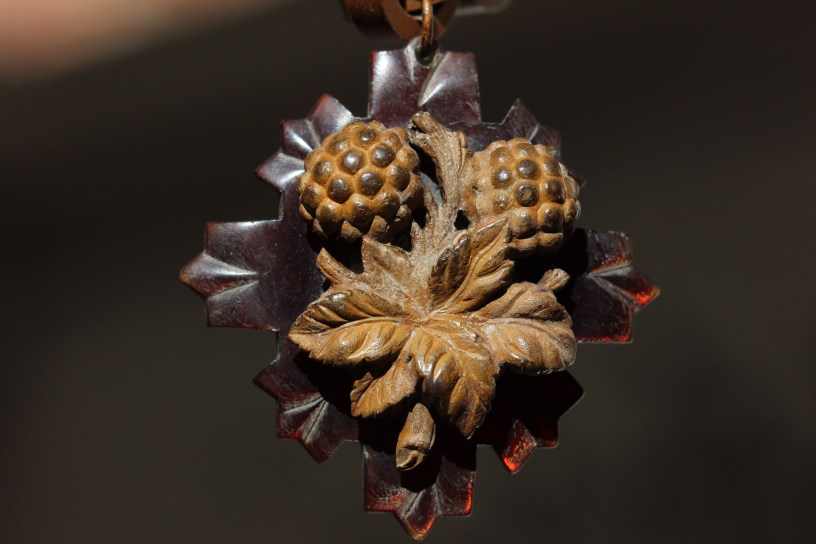
The 19th century saw a growth in technology in a number of fields, including that of jewellery production. New mechanical processes for making jewellery were developed, making it easier for manufacturers but demand for jewellery also increased. At the same time, supplies of gemstones, as well as ornamental and organic materials used in jewellery, became harder to access. Substitutes were needed.
One substitute that was invented involved india-rubber, a sap from trees from India and South America. In the 1840s, Thomas Handcock in England and Charles Goodyear in the US developed processes separately for heating india-rubber to make it more flexible. The Hancock patents (at least 16 between 1820 and 1847) involved improvements to an india-rubber material, some of which was used for waterproofing macintoshes. Charles Goodyear’s patent in 1844 was for a process for making ‘certain new and useful Improvements in the Manner of Preparing Fabrics of Caoutchouc or India-Rubber’. Charles Goodyear and his brother Nelson were particularly interested in producing better waterproof shoes.
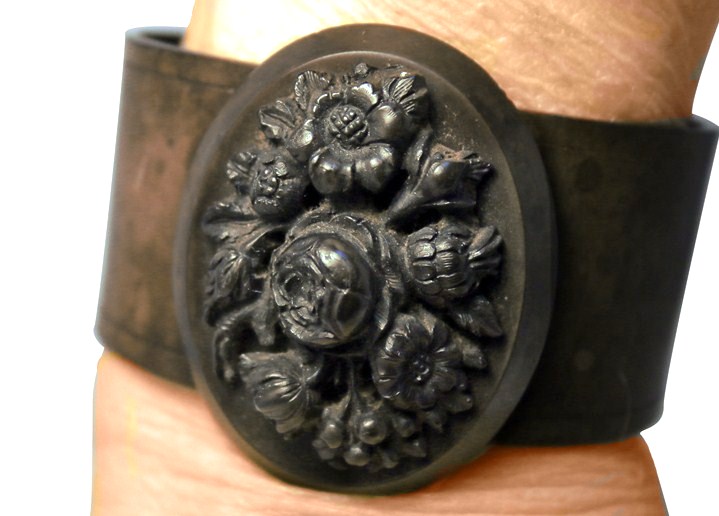
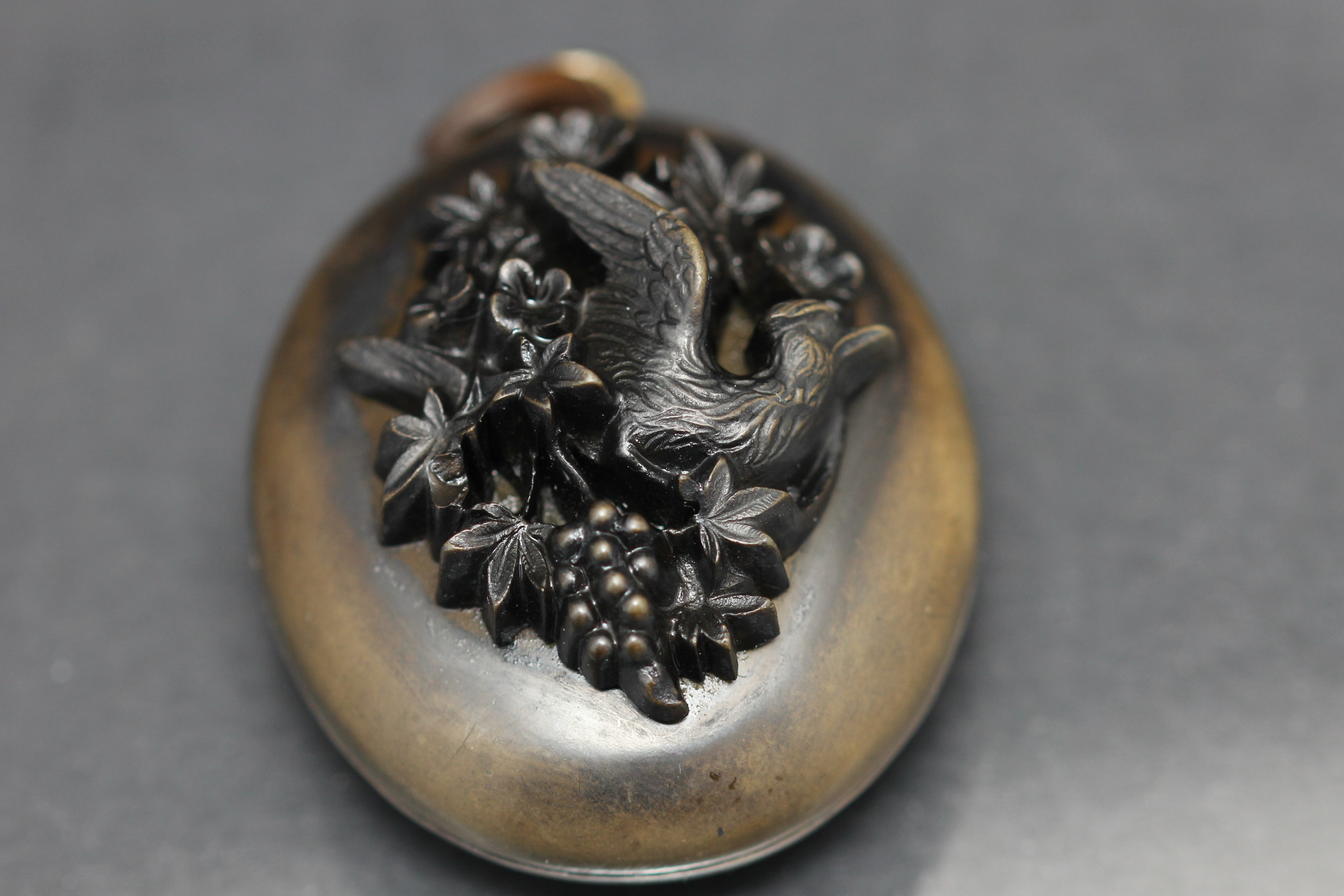
One offshoot of these patents was the production of a hard rubber, which is india-rubber with sulphur added to it and which is heated to very high temperatures (vulcanizing). It forms a hard opaque rubber substance that could be dyed and moulded. The term ‘vulcanizing’ had no real meaning other than describing a process whereby rubber and sulphur were combined in a chemical change brought about by heat. It is based on the Roman god of fire, Vulcan, and Hancock claimed that a friend of his, William Brockedon, invented the word to describe the process. Hancock used the term ‘vulcanizing’ first in a 1846 patent. This hard rubber became known as vulcanite or ebonite. It had not initially been considered for use in jewellery but the shortage of Whitby jet, a key organic substance for mourning jewellery, after the 1860s, resulted in an opening for its use later in the century.
Gutta-Percha is another thermoplastic like India-rubber, and is the latex extruded from trees in Malaysia. Processes for using gutta-percha to make corks were also patented by Charles Hancock in 1844 and a number of other patents by him and others for gutta-percha, sometimes with India-rubber, followed over the next decade. It was used a lot for telegraph wire insulation. It does not appear to have been used as a substitute for Whitby jet.
Whitby jet jewellery was displayed at the Great Exhibition in 1851 and attracted international attention. And then, in 1861, Prince Albert died and Queen Victoria went into mourning for the rest of her life. Her court also mourned the dead consort for a considerable time. Whitby jet jewellery was in great demand and between 1862 and 1874, prices for it soared. Vulcanite was able to be used to satisfy the demand to some extent as did French glass and bog oak.
References:
It you are interested in patents for India-rubber (Vulcanite) and Gutta-Percha, have a look at this publication in 1875, subsequently revised, by the UK Office of the Commissioners of Patents for Inventions. In a mere 492 pages, it contains the patents and abridgements and associated documents for these two products between 1791 and 1876 (https://ia804609.us.archive.org/25/items/patentsinventions00grearich/patentsinventions00grearich.pdf). Be aware that these represent only the UK patents.
Shirley Bury, ‘Jewellery 1789-1910’, Vol I, 1991
 navette jewellery