
In the search for materials which could imitate organic gems like coral, ivory, and tortoiseshell, a number of semi-synthetic substances were experimented with. Semi-synthetic means a material made of a chemically altered natural material. Two natural substances were to lead to very good imitations. They were cellulose, which is the main constituent of green plant cell walls and of vegetable fibres, and casein, which is the main protein in milk.
Let’s start with cellulose. There were a number of attempts to use cellulose commercially in the first half of the 19th century, involving a process of exposing cellulose to a mixture of nitric acid and sulphuric acid, resulting in a material called cellulose nitrate. One inventor, German Frederick Schonbein, in 1846, accidently invented a highly flammable version of it which was used as a gun cotton in armaments.
Englishman Alexander Parkes is credited with producing the first mouldable thermoplastic material which he patented in 1865. He called his product Parkesine but was unsuccessful in producing a stable product. In 1869, Daniel Spill, who had worked with Parkes, established the Xylonite Factory, which folded, and finally, the British Xylonite company.
In the US, John Wesley Hyatt started to work with cellulose nitrate in response to a competition to develop a replacement for ivory billiard balls. He and his brother Isaac patented a number of developments and in 1872, changed the name of their company to the Celluloid Manufacturing Company. Daniel Spill was to sue Hyatt for breach of patents and although he won in the first instance, his case was eventually dismissed in 1884.

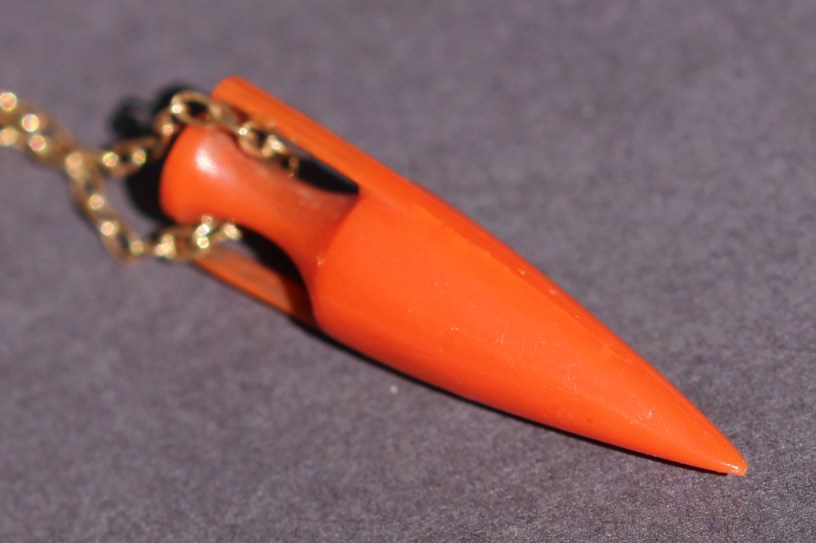
Patents for the use of cellulose (or xylonite) as an substitute for ivory, coral and tortoiseshell were granted in the 1860s onwards. The little celluloid amphora at the top of the post illustrates how good a substitute it was.
In 1876, Julius Frauenberger of New York was granted a patent for ‘a new and Improved Composition for Artificial Corals, Ivory, Amber, Horn, Etc’. The composition required one to mix fresh caseine or milk curds with water and washing soda, heat it, allow it to cool and then add acetic acid and colourings. The mixture could then be placed in molds to set. I am unable to trace any jewellery from this patent. The patent can be found at https://www.buttoncountry.com/Z%20old%20site/PatentsImages/1876-Frauenberger-CaseinFormula.pdf
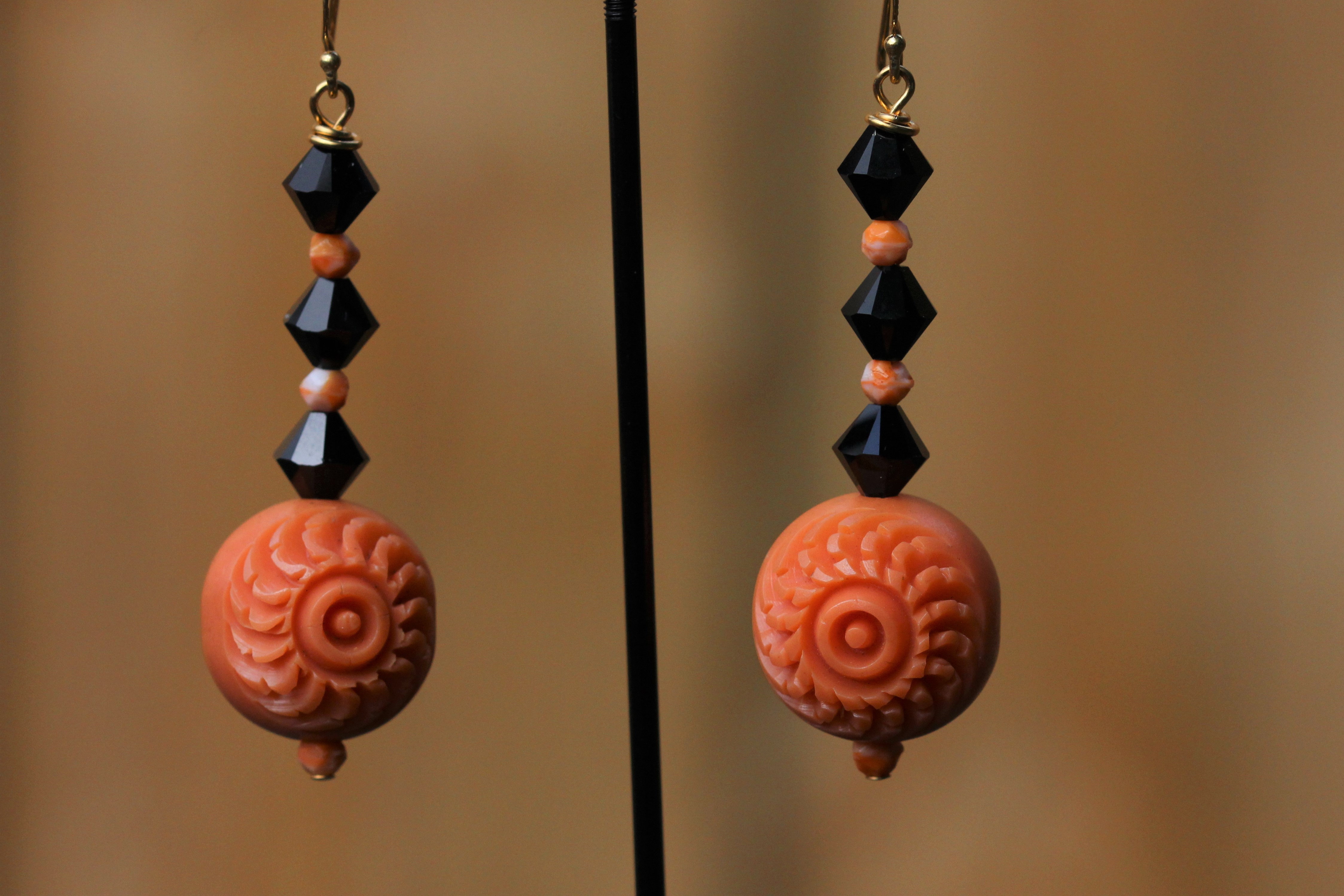
The next development in a casein product came from Germany where there was a need to produce a white film to coat blackboards. A printer from Hanover named W Krische and a chemist from Batavia, A Spitteler, created a material made from casein and formaldehyde. It was patented in Germany in 1899 and in the USA in 1900. The material was first produced in Germany and France under the name Galalith (milkstone). Galalith was a rigid and hornlike material and took dye easily. It was not flammable like celluloid but was affected by excess humidity. It was popular with button makers and with a number of European jewellery designers like Coco Chanel and Jakob Bengel. It was manufactured at various times in the US under different names but never achieved the popularity of celluloid.
Reference:
Thesis on Identification of Plastics https://discovery.ucl.ac.uk/id/eprint/1348913/2/327732_vol2.pdf
 navette jewellery