
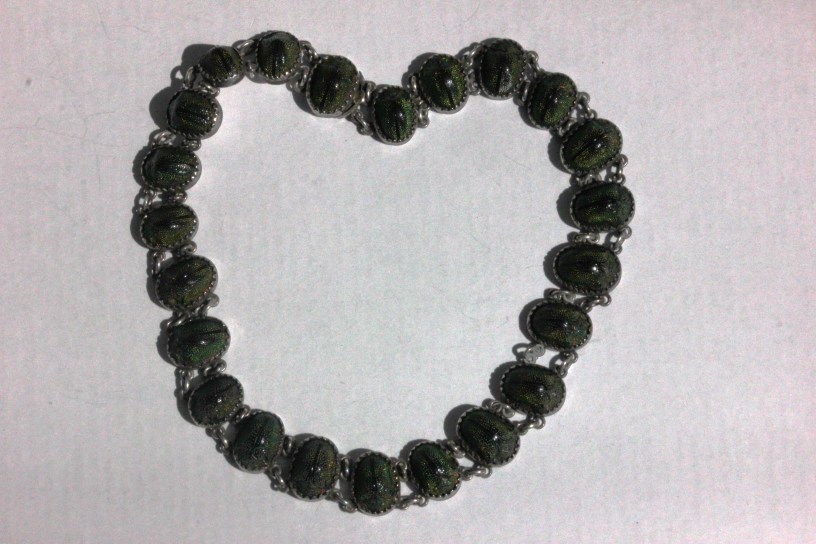
There is a very long history associated with the use of beetles as decorative items, unlikely as it may seem. Eygptologists began to find little stone amulets buried with women and children in cemeteries dating from round 2500BC. These amulets were pyramid shaped and had geometric and animal designs engraved on the bottom. A beetle was one of these animals. Over time, the shape of these amulets changed and flattened, and as well, the beetle, particularly the dung beetle, emerged as the only animal used. The dung beetle, Scarabacus Sacer L, was viewed by the Egyptians as symbolic of the cycle of rebirth and regeneration as represented by the god, Khepri, who was believed to roll the sun across the sky each day, leading to a new day.

The little stone amulets were used to help the dead to an eternal life in paradise but also began to be used as seals on clay stoppers and on documents. The scarabs were made of different stones and were often glazed. Commonly, a soft talc was used as it was easily carved. It was then placed into a hot liquid glaze which gave a shiny exterior as well as drying the stone so it became hardened. Scarabs were also used as pieces of jewellery and these could be made of gold or silver, or carved out of gemstones.

Scarabs appeared again the 19th and 20th centuries, following Napoleon’s campaign in Egypt in 1798 and the excavation of graves in Egypt. There was a jewellery revival, reproducing Egyptian jewellery, including scarab jewellery. It was the Victorians, though, who used real (but dead) beetles in their jewellery. Dried iridescent green beetles were imported from South America around the time of the opening of the Suez canal in 1869 and were incorporated into imitations of ancient Egyptian amulets and pendants containing scarabs. Using real beetles also satisfied the Victorians’ interest in natural history.

Reference:
William A Ward, ‘Beetles in Stone: The Egyptian Scarab’, The Biblical Archeologist, Dec 1994, Vol 57, No 4, pp 186-202.
 navette jewellery