
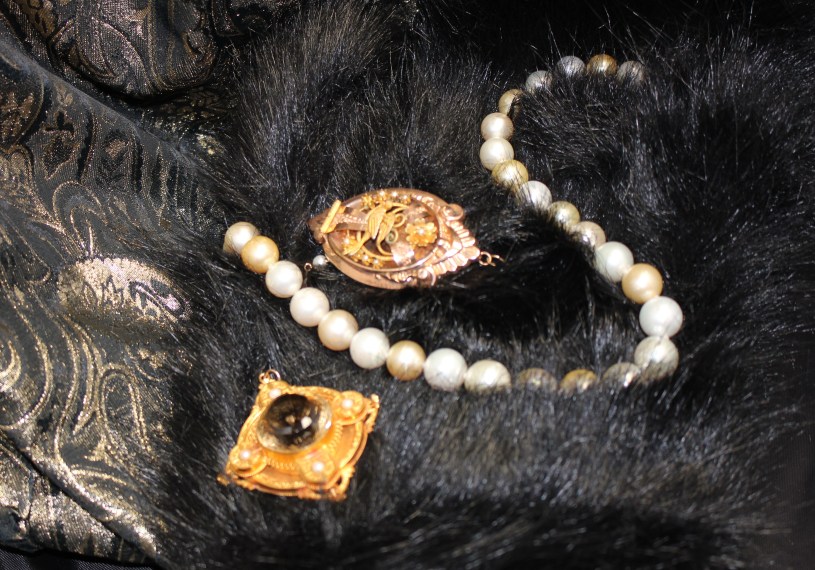
Jewellery has always been an expensive item, purchased by those with money. It has often been a status symbol, a sign of one’s place in society. Today, it is expensive brand names that are associated with wealth, names like Bulgari, Tiffany & Co, Cartier and Van Cleef & Arpels, but for centuries it was just simply having enough money to afford jewellery. Of course, the jewellery was worn with fashionable clothes, clothes which indicated one’s position in society and, as so often happens, people eager to move up in society aspired to wear certain clothing and jewellery.
Sumptuary laws were one way to ensure class structures were maintained, regulating who could wear and buy what. Sumptuary laws could also attempt to control what items were imported and exported, so that markets could be protected. They were introduced by the ancient Greeks and the Romans, and between 1300 and 1600, a number of European countries did so too. The sumptuary laws might dictate what a member of a social class could wear or not wear, what cloths and fabrics could be imported, and the amount that could be spent on banquets and weddings. The laws were often a mixture of economic imperatives, for instance, protecting a certain product, and moral imperatives, such as limiting who could wear gold embroidered cloth, velvet or furs. Jewellery was not always captured by sumptuary laws but there are some examples. For instance, Rome at some stage restricted the wearing of gold rings, the Tudors restricted the wearing of gold necklaces by certain classes, and Florence allowed some women to wear only one pearl necklace.

Sumptuary laws were generally not well regulated. They often lacked penalties and enforcement mechanisms and were easily avoided. They were also not very successful in achieving their aims. As French philosopher Montaigne wrote in his essay on 16th century Sumptuary Laws: “The way by which our laws attempt to regulate idle and vain expenses in meat and clothes, seems to be quite contrary to the end designed…For to enact that none but princes shall eat turbot, shall wear velvet or gold lace, and interdict these things to the people, what is it but to bring them into a greater esteem, and to set every one more agog to eat and wear them?”
Sumptuary laws in Europe were generally dispensed during the 17th century but that did not necessarily mean that Governments stopped trying to regulate certain consumption of valuable goods.
Reference:
Michel de Montaigne, Book 1, Chapter 43, On Sumptuary Laws, https://hyperessays.net/essays/on-sumptuary-laws/ Greece = gold jewellery
 navette jewellery