
In the 19th century, Irish jewellery became quite popular in the rest of Britain due to a couple of factors. The first was that there were a lot of archeological finds in Ireland, such as iron age forts, Viking burials, preserved bog bodies, leading to an increase in Irish nationalism and so on. Second, there was a growing Victorian Middle class looking to acquire jewellery and other objects, and with an interest in tourism. Reproductions of the early Christian brooches, ring brooches, like the Cavan, Ballysperran and Tara brooches, were produced and even Queen Victoria owned one. The jewellery often incorporated Irish symbols such as harps and traditional Claddagh rings.
Bog oak jewellery was characteristic of Irish Victorian jewellery. Bog oak is partially fossilized oak that had been preserved in peat bogs. Bog oak had been used for furniture but from the 1820s, it was also used to make jewellery (Scott, p 168), particularly mourning and souvenir jewellery. A number of jewellers began to specialize in bog oak jewellery and some exhibited in the 1851 Great Exhibition.

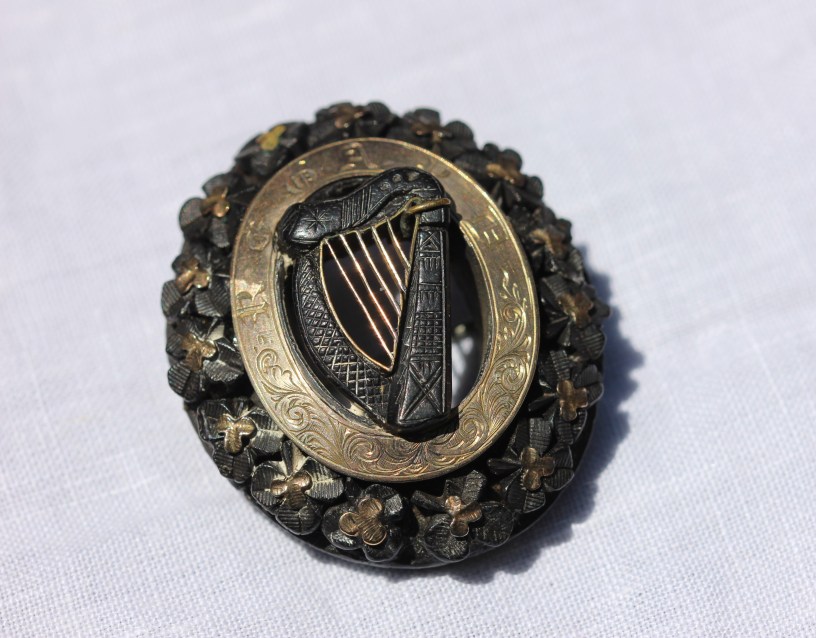
The brooch at the top of the post is a good example of Irish bog oak jewellery. It is an oval shape with an Irish harp inset in the centre. The strings are gold. There is a gold border around the harp and then another border of shamrocks, each decorated with a gold centre. It has a c-clasp. It is a mourning brooch, as the word ‘Regard’ is written around the gold border. A similar brooch but with a different engraving was apparently exhibited in the Dublin Exhibition of 1861 (McCrum, p19). Another one is pictured at Figure 2.7 of the Scott thesis and as the front of a bangle at Figure 4.24 (see references).
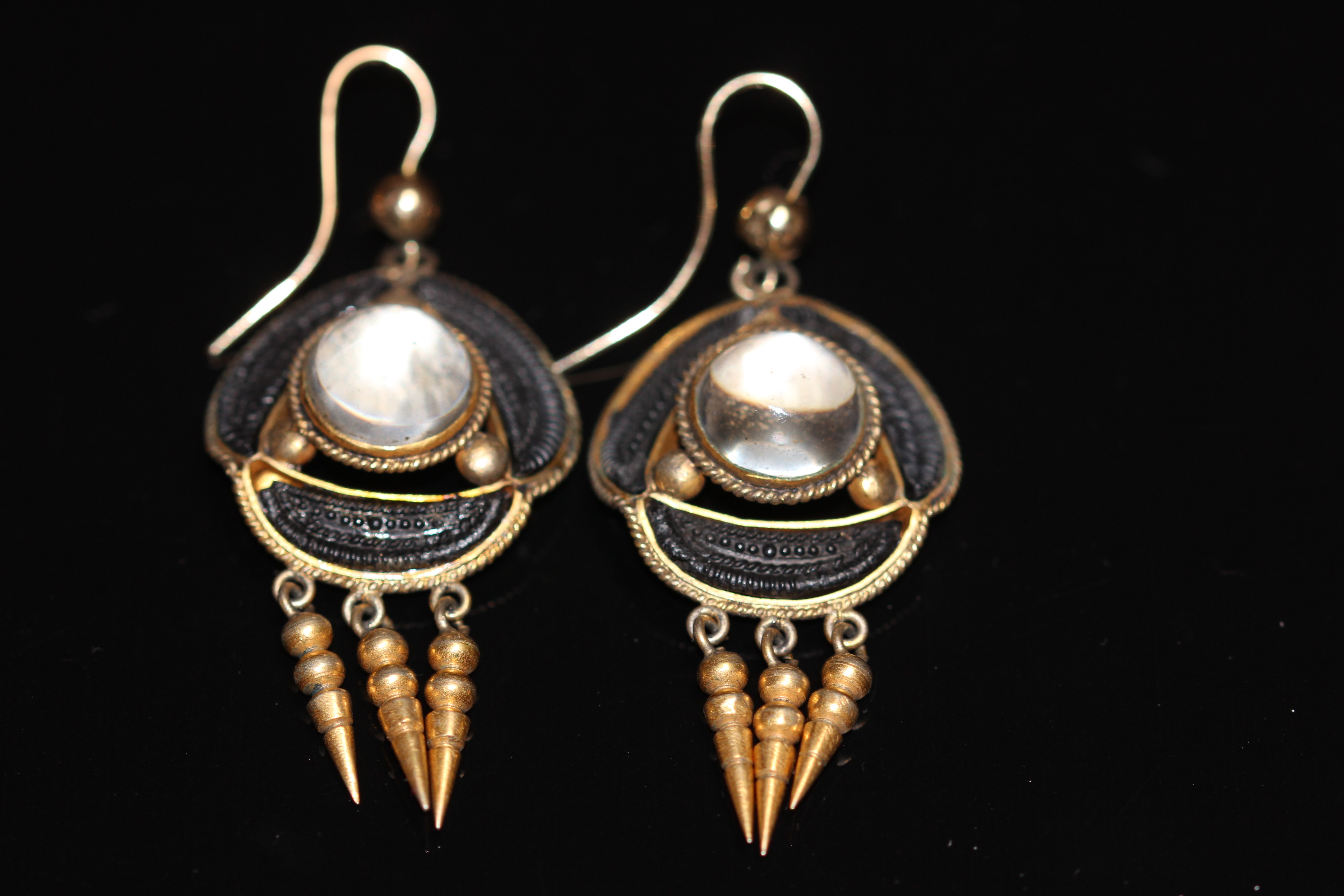
The earrings above are Victorian, set in pinchbeck and made of bog oak with central rock crystal cabochons. You can see the carving marks in the oak. Irish rock crystals in the 19th century were often described as ‘Irish’ diamonds.
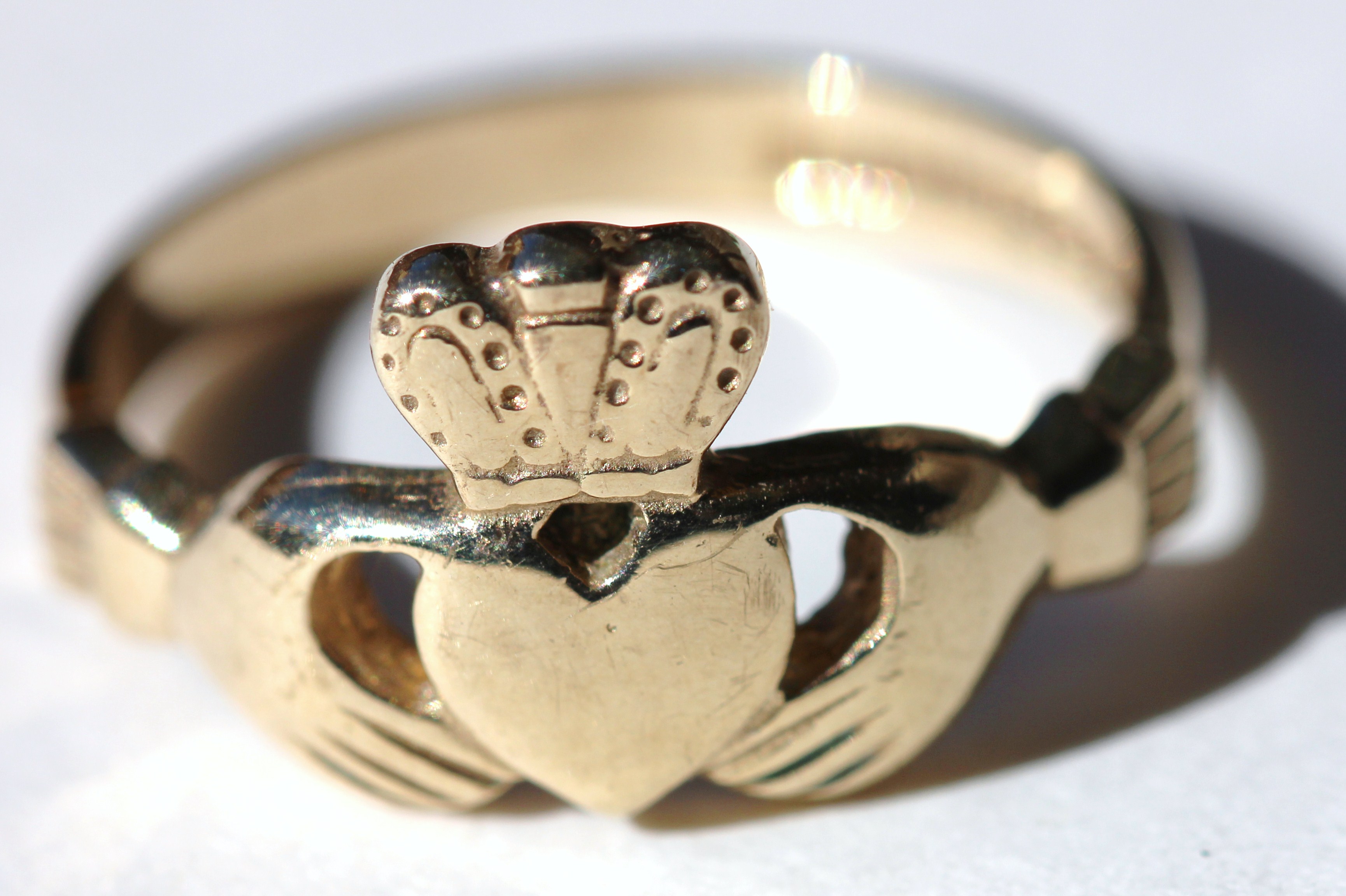
The Claddagh ring is a traditional Irish ring with origins back to the early 17th century. The hands represent friendship, the heart represents love, and the crown represents loyalty. According to McCrum at p21, the rings were wedding rings ‘passed from mother to daughter in the Claddagh district of Galway city’. The area was mainly inhabited by fishing families. The original rings were gold, without gemstones as we see now in later versions of the ring.
Some jewellery incorporated local Irish materials. Iron pyrites was used as was green Connemarra marble, often used to duplicate Scottish pebble jewellery. Wicklow gold, so called due to a gold rush in County Wicklow in 1795, was also used.
References:
Elizabeth McCrum, ‘Irish Victorian Jewellery’, (1984-1987) 1 Irish Arts Review 18-21, Spring 1985.
Breda Scott, ‘Small Treasures: the production, retail and consumption of jewellery in Dublin’, c.1770 to c.1870’, Vol 1, PhD thesis, 2016, National University of Ireland, Maynooth, https://mural.maynoothuniversity.ie/15526/1/Scott.pdf
The Bog-Oak Industry forum, https://www.925-1000.com/forum/viewtopic.php?t=39084
 navette jewellery