
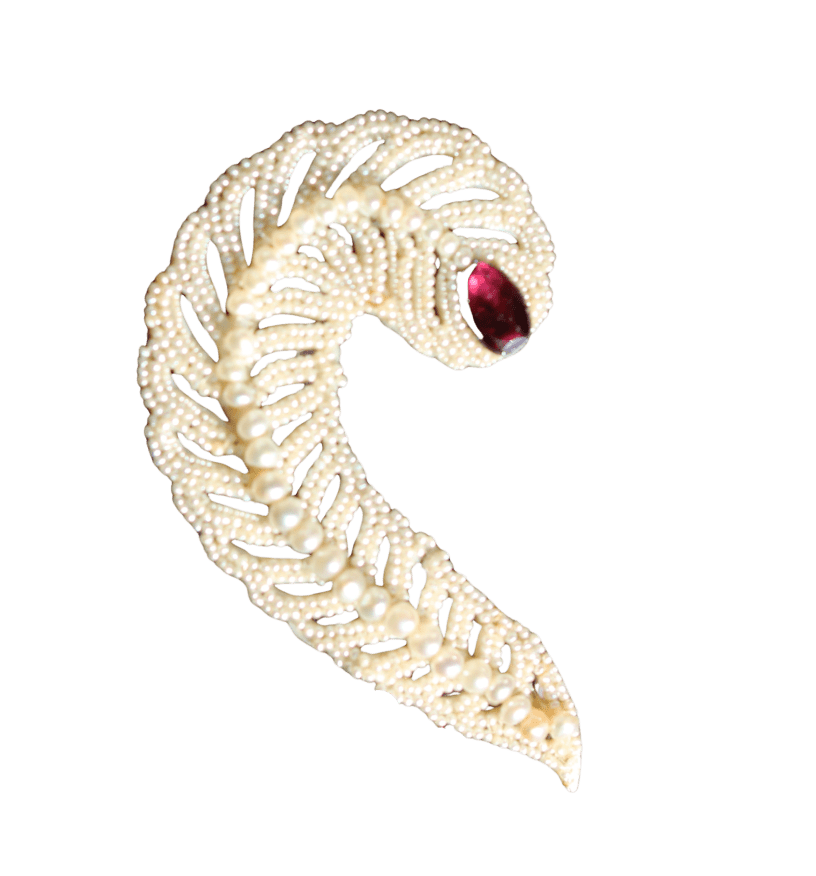
Recently I acquired the beautiful antique seed pearl feather brooch shown in the photo at the top of the post and can’t stop admiring it. Apart from the incredible amount of work that went into its construction, it is such a lovely shape, a long sweeping curve, highlighted at one end by the foiled garnet.
Seed pearl jewellery like this, comprised completely of seed pearls and pearls, was popular from the late Georgian period to around the 1860s. Suites were created with a necklace, two bracelets, two earrings, a brooch and a corsage. The work was extremely time intensive and needed good eyesight and good light. The way the pieces of jewellery were constructed was to cut out a pattern on a thin plate of mother-of-pearl. The mother-of-pearl plate was then pieced to show where the seed pearls were to be attached. Then the pearls were attached using white horsehair. Horsehair from a living horse was used as it was finer than normal silk thread. When the threading was completed, the fittings were attached. The smallest seed pearls came drilled in bunches from China, slightly larger ones from India. The pearls were both sea and river pearls.
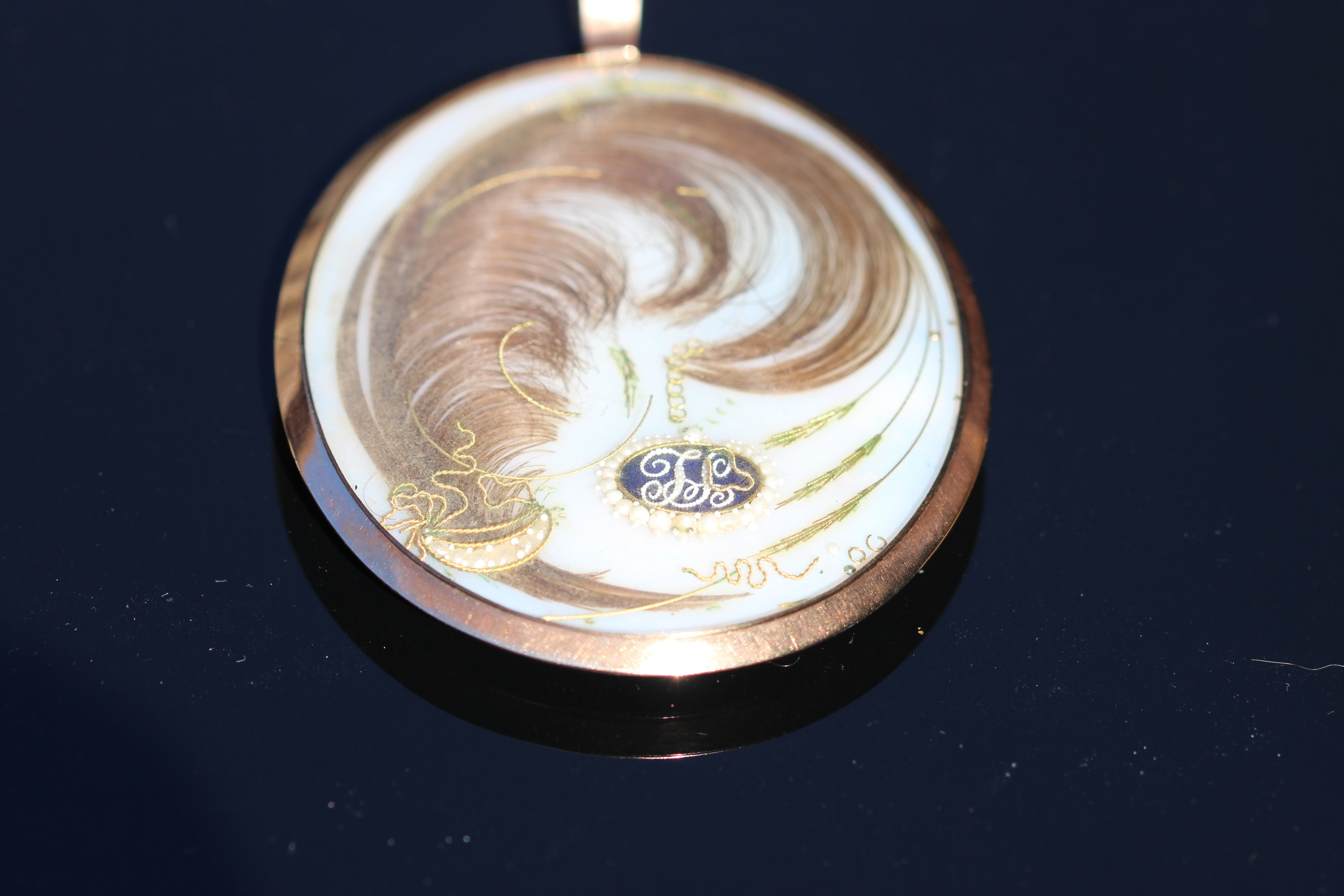
You can also find feathers in hair work mourning jewellery. In the Georgian and Victorian eras, hair was used to create patterns and pictures, using glue to hold it together as well as thin ribbons and gold wire thread. Seed pearls, representing tears, were often included in the pictures. The technique was called ‘palette work’ because it was often worked on an artist’s palette at home.
Simple examples of palette-worked hair were curls of hair, tied with a thin cord of some sort, placed inside a brooch, pendant or ring. To create the curls, the hair was washed, dried and then covered with a glue wash. Then it was cut and curled into the desired shape and affixed into the frame with cornstarch. Often these frames were sold as kits, in gold, gold-filled or gilt. The hair used might be from one person or, as in the pendant below, from two or more people.
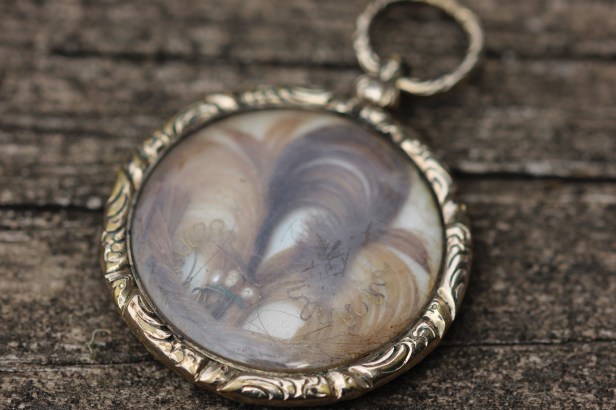
There is no doubt that the most common form of palette work is the curl, and three curls grouped together were called the Prince of Wales feathers. Some were shaped like a fleur de lis. More ambitious designs involved ears of barley, feathers, flowers, bouquets and wreaths.
 navette jewellery