

It is not always easy to identify a gemstone, particularly if it has been mounted in jewellery. Take the blue stones in the photo at the top of the post – are they sapphires or are they something else? They could be glass, a blue tourmaline, a blue spinel or maybe a tanzanite. How can you tell?
As a gemmologist, someone who has studied how to identify gems, I can usually identify unmounted stones without a problem but mounted gems, those set in jewellery, can be much harder. This is because many of the tests used by gemmologists rely on being able to look through the gem with a loupe or microscope searching for inclusions and possible treatments, to use a dichroscope and a refractometer to determine refraction, to check fluorescence with a UV light, to check optical properties with a polariscope, a spectroscope to check light absorption, various filters to differentiate between similar coloured stones, and a balance beam scale to check the specific gravity of a loose stone. Not all of these tests are possible if the gem is set in a ring. In particular, gems set in antique jewellery can be difficult to identify depending on the setting, for instance, if the gem has a closed back and is foiled.
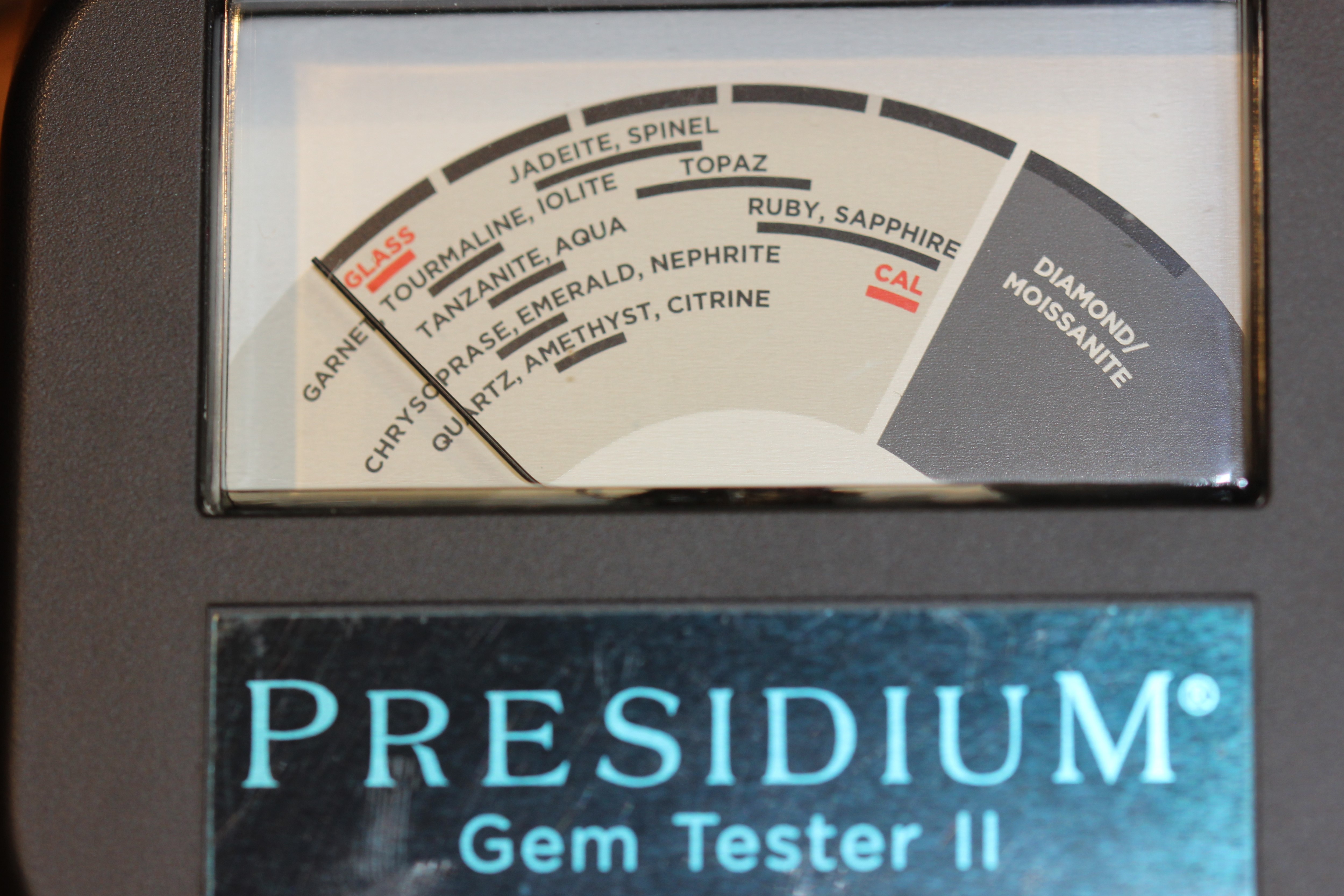
Some gemmology laboratories use expensive equipment like advanced spectroscopes, spectrometers, X-rays and XRF and so on, but there are some less expensive pieces of equipment now available that can help gemmologists and others working with jewellery to identify stones. For instance, there are a number of hand held instruments that can identify diamonds and others that can differentiate between diamonds and moissanite, the lab grown diamond imitation that came onto the market in 1998. Another instrument is called a gemstone tester, a thermal conductivity tester, which can help identify certain classes of gemstones. I have attached the photo above of a gemstone tester by Presidium and you can see the gemstone classes it can identify. By itself, the tester is not an adequate test of identity but it is very useful for indicating what a gemstone isn’t so that other testing can be conducted.

For your information, two of the four rings above are set with sapphires while the other two have blue glass. The ring on the right above has three sapphires of different blues but they are all sapphires. The ring with the pearls has sapphires.
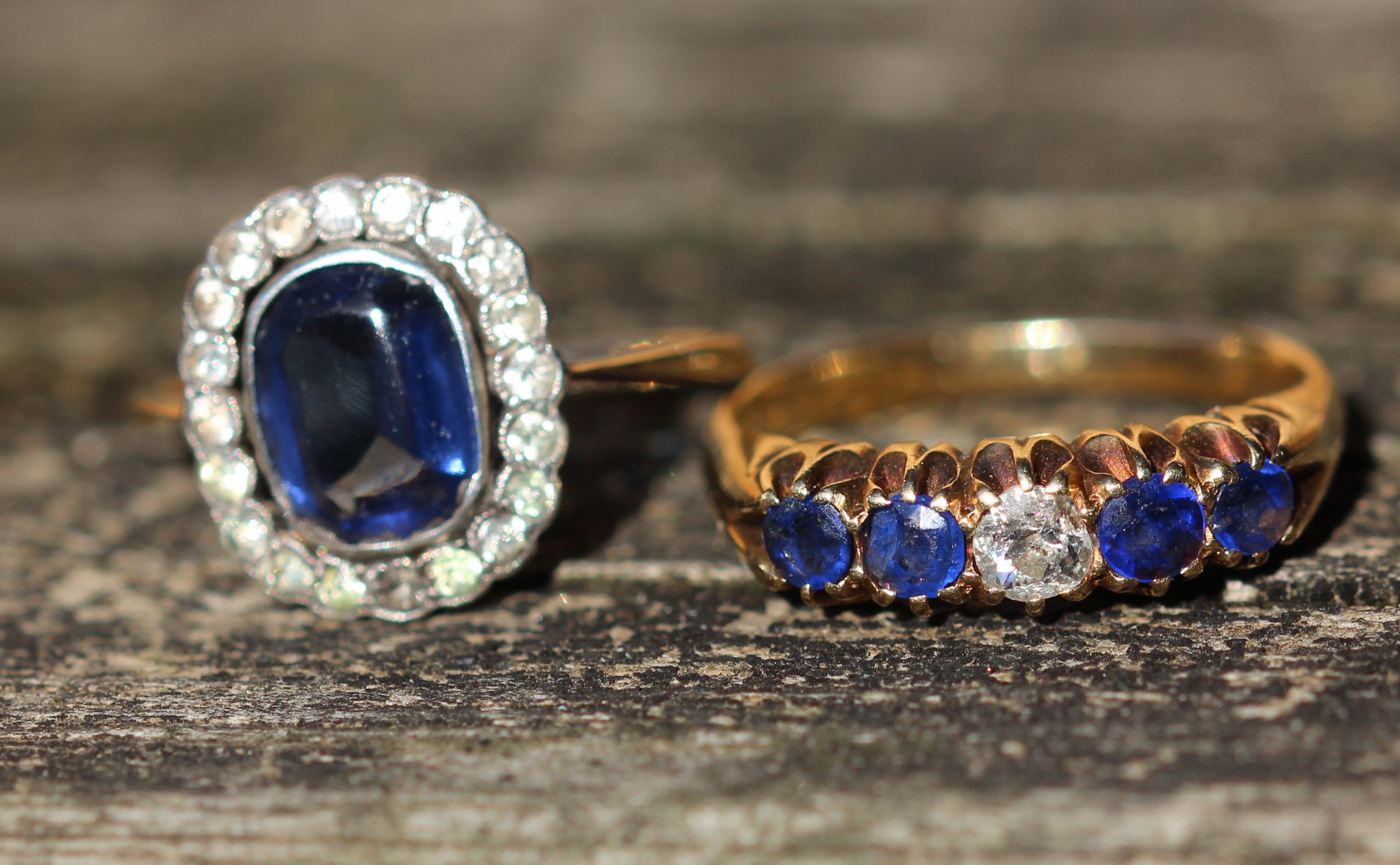
The blue stones in the rings above are glass, unfortunately, although the central stone of the five stone ring is a diamond.
 navette jewellery
Really useful. Thank you.
LikeLike
Thanks for the good feedback.
LikeLiked by 1 person