
There are quite a lot of green ornamental gemstones, many from the quartz family which I am going to briefly discuss here. In my next post, I will talk about jade.
Quartz has two main categories and one, the category of microcrystalline (also called cryptocrystalline) quartz, contains varieties of chalcedony gemstones, such as agates, carnelian, sard, chrysoprase, jasper and bloodstone. Microcrystalline quartz are translucent to opaque, unlike macrocrystalline quartzes which are transparent gemstones, like citrines and rock crystal.
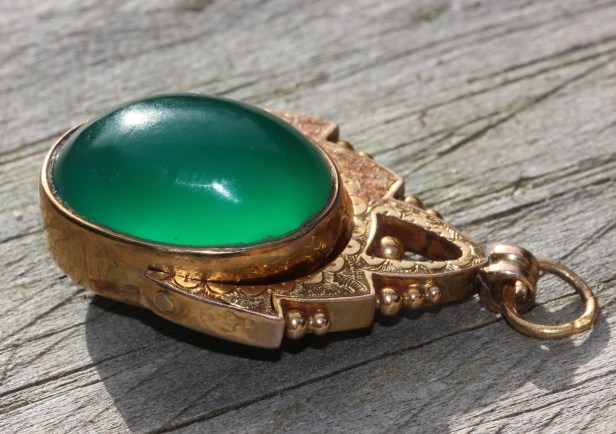
The green stone below is a chrysoprase (part of the chalcedony quartz group) and gets its colour as a result of nickel. It can often be found in a softer, more milky green.
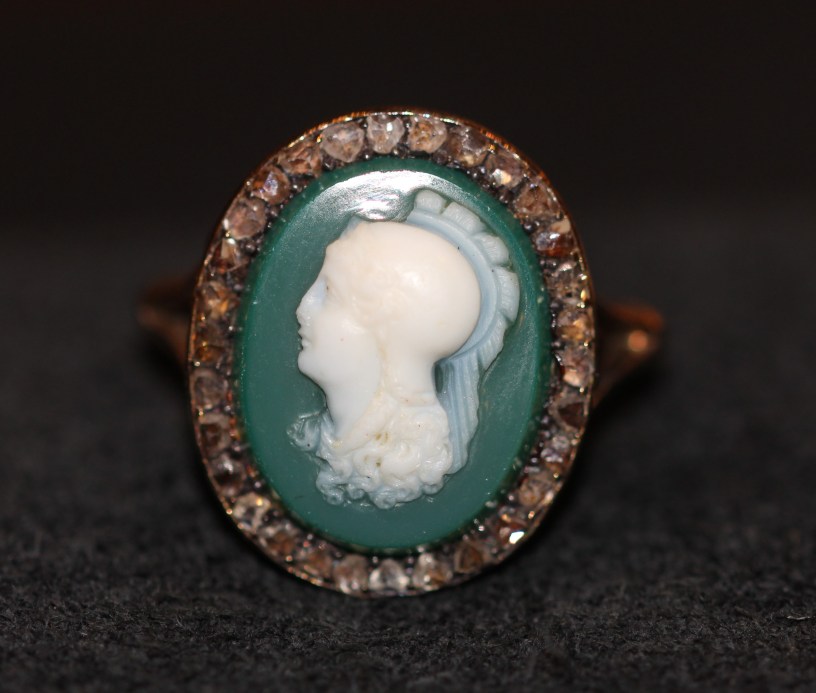
Then we have agate, also from the chalcedony quartz family. The gemstone in the ring at the top of the post shows its two bands of colour, green and white, revealed through the carving of the cameo. The brooch below has moss agate, which has green moss-like inclusions.

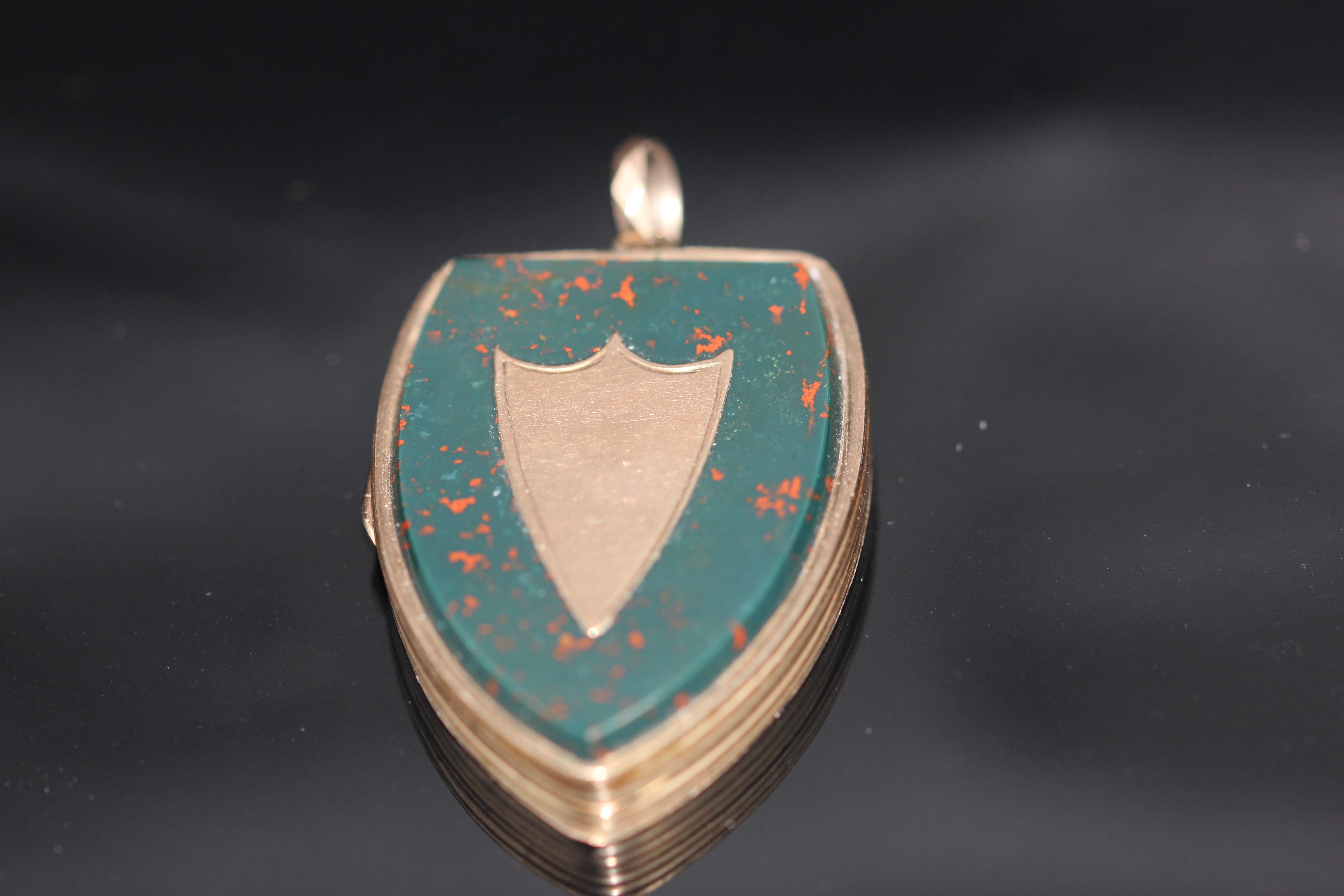
The final quartz stone, set into the front of a gold locket, is bloodstone and it falls into the plasma family comprising opaque green to dark green stones. Bloodstone (also known as heliotrope) is green with red spots or streaks. It was used in antiquity for intaglios and this use continued for centuries.
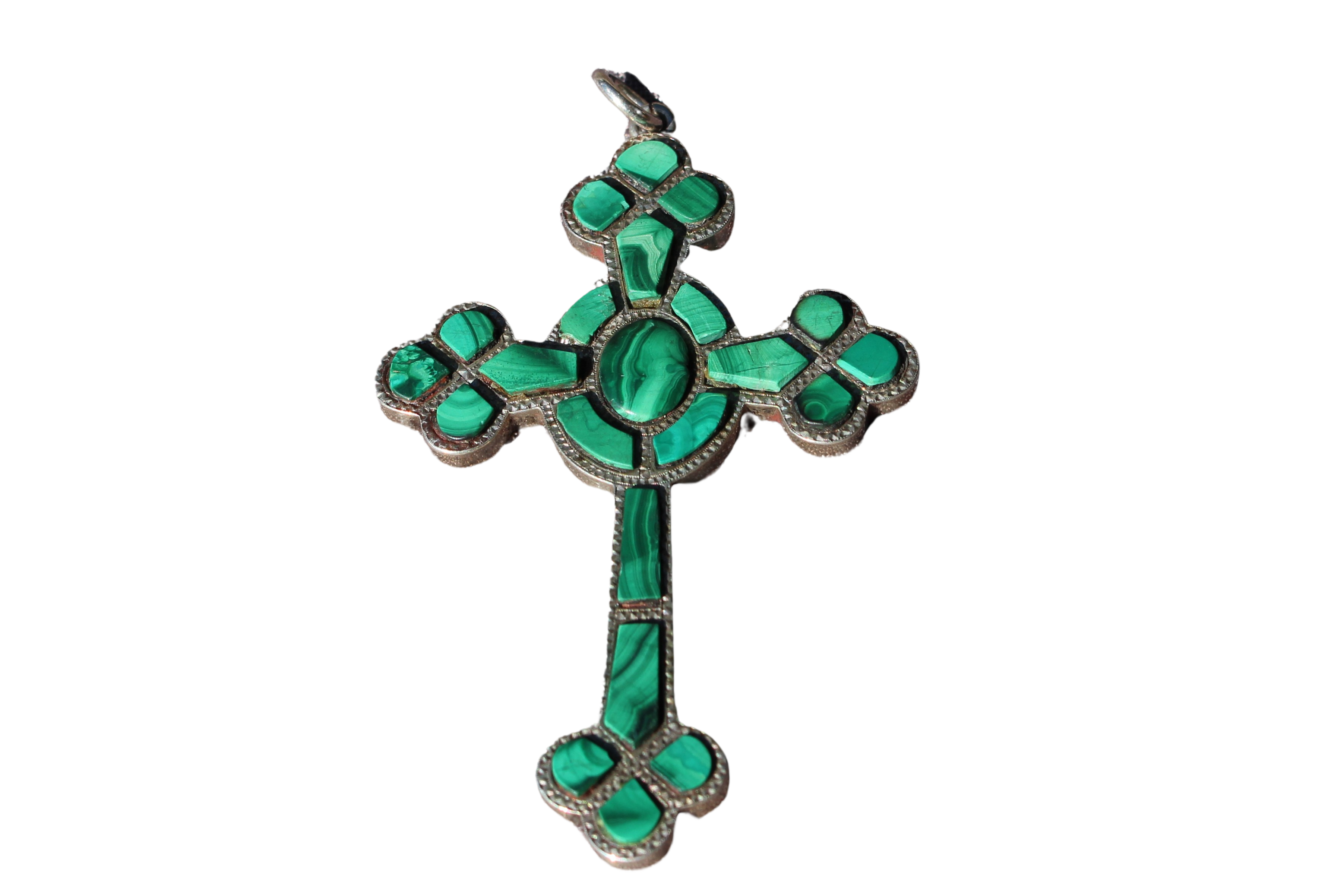
Malachite is the last green ornamental gemstone that I wanted to show you in this post. It is not a member of the quartz family but instead is made of copper carbonate and usually forms in globular groups, looking like a bunch of grapes or bubbles. It can be cut across the ‘bubbles’, resulting in a beautiful pattern of bull’s eyes and curves, or as a cross section, which results in bands of different greens. It can sometimes form as thin stalactites.
 navette jewellery
Beautiful examples. Thank you
LikeLike
Thanks for reading. I think the chrysoprase is my favourite.
LikeLiked by 1 person