
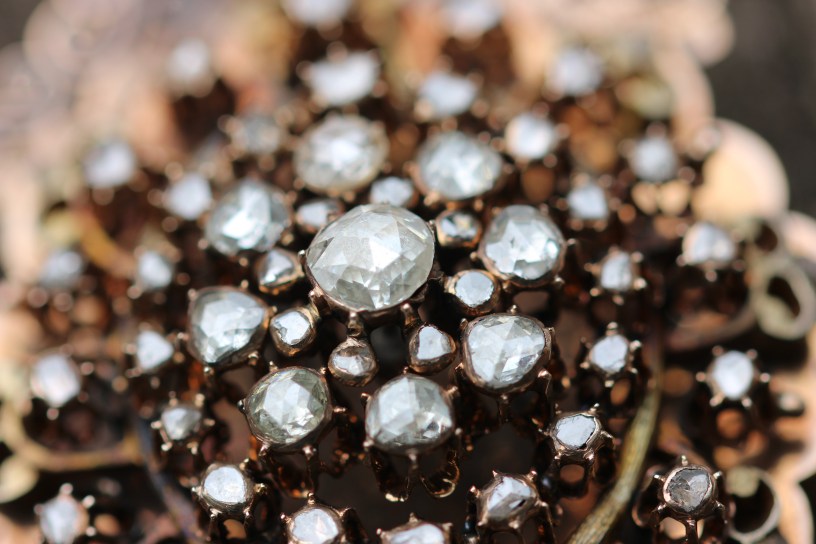
The technology to cut diamonds evolved in Europe in the 14th century (although evidence suggests that Asian lapidaries were far more advanced). The move away from just being able to polish and smooth gemstones was driven by the use of diamond dust as a grinding agent and then the invention of a crank-operated belt drive and iron wheels in the 15th century which allowed for cutting gems. Description of 16th century lapidary workshops show drawings of these drives and wheels, and vices, dop sticks and cups to hold the gemstone steady. Originally hand-turned, wheels were later driven by water power. In later centuries, horse and then steam power would be used.

The point cut was one of the first cuts made to diamonds and can be seen in jewellery from the 15th and 16th centuries. In some instances point cuts were created by just grinding and polishing the stone rather than cutting it, using the natural octahedral shape of the diamond. The diamond looks like a square pyramid with a wide girdle. The new technology allowed cutters to duplicate the natural diamond pyramid shape which was prized.
The greater availability of diamonds in the late 1500s as a result of the discovery of Brazil lead to new gem cut, notably the table cut. The table cut, which is usually square, comprises ten facets, with a flat top (the table) in the centre with four facets surrounding it, then below the girdle, four large facets on the bottom plus a tiny culet. The cut was usually used for small stones (Carvalho, p119).
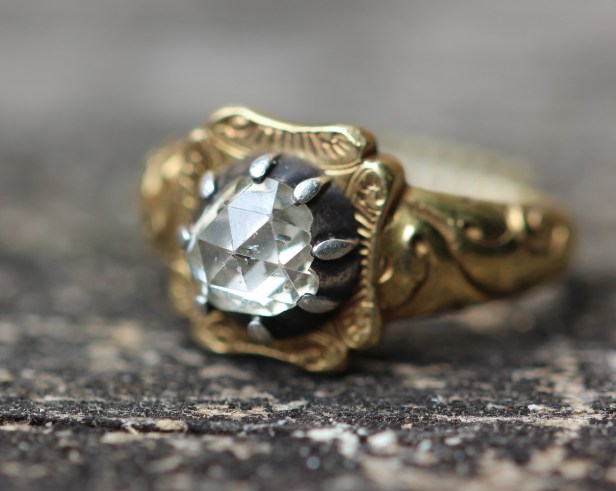
The rose cut, which had dominated diamond jewellery since the 1500s, took over as the main diamond cut in the 17th century, much of the 18th and into the 19th. Rose cut diamonds have flat bottoms, between 3 to 24 facets, and either a peaked or dome top. The rose cut is named after a rose bud as the facets on the top of the diamond are supposed to resemble a rose bud just beginning to open. I have to admit, I find the rose cut a beautiful cut.
References:
Jack Ogden, ‘Diamonds: An Early History of the King of Gems’, 2018, Yale University Press.
Rui Galopim de Carvalho, ‘Evolution of Diamond Cuts in Portuguese Jewellery and Sacred Objects During the 16th-18th Centuries: A Brief Review’, The Journal of Gemmology, 2014, Vol 34, No 2, pp114-128.
 navette jewellery
I love a rose cut too
LikeLike
I think the rose cut enhances the stone without its shape being lost in too much brilliance.
LikeLiked by 1 person
Exactly!
LikeLike