
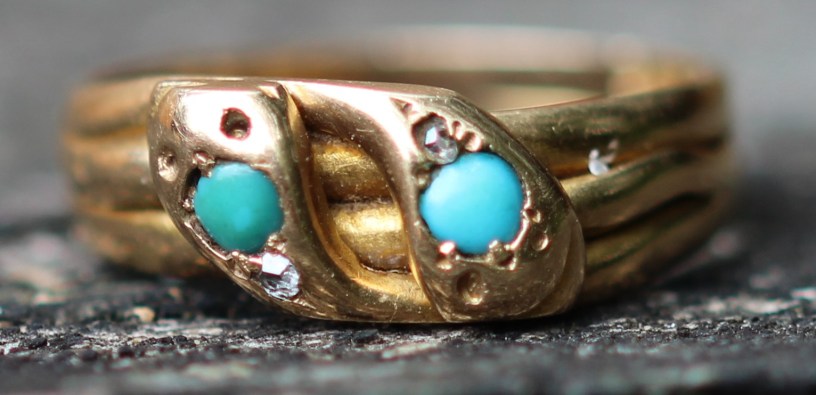
Turquoise is such a lovely coloured gemstone. It is opaque and while we normally call it a blue stone, the hue of each stone can vary a lot, from a pure sky blue to a blue green. Where the stone was mined affects the colour as Persian turquoise is a uniform sky blue while American turquoise can be a more greenish colour as it contains iron. American turquoise also can contain spider webbing or veining.
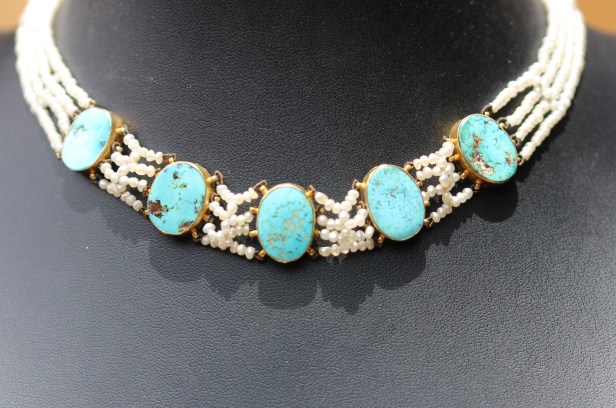
Victorian turquoise and seed pearl collar
How often as well as the manner in which turquoise jewellery has been worn can affect its colour. It is very porous and so can darken and turn greener due to perspiration and access to water.
The Egyptians used it a lot, with discoveries of jewellery set with turquoise from as early as 3000BC. King Tutankhamen’s funeral mask from about 1323 BC was inlaid with turquoise. The name ‘turquoise’ arose in the 17th century, derived from the French expression ‘pierre tourques’ (‘Turkish stone) as it arrived in Europe via Turkey, mainly from mines in what was then Persia where it was mined for over 2000 years. Iran and Eygpt still operate mines today.
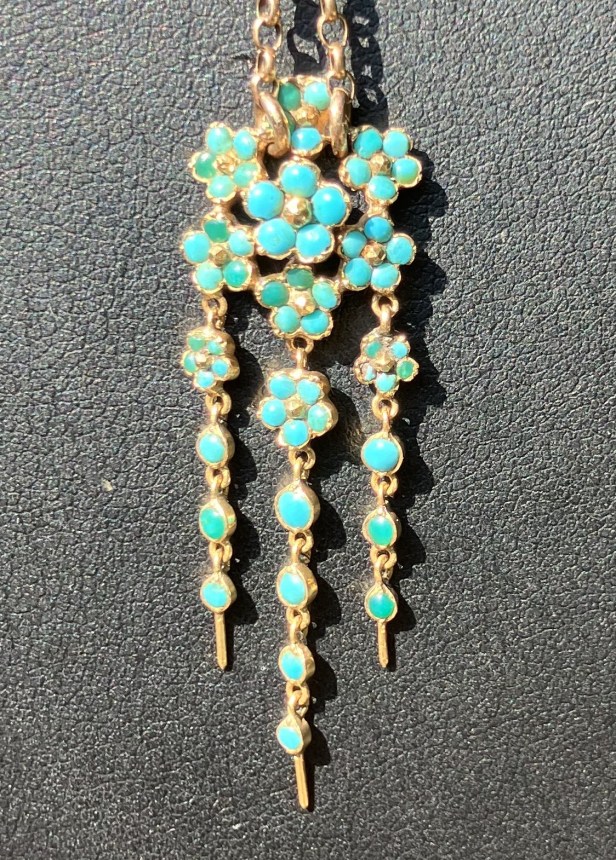
Delicate Victorian turquoise pendant
Turquoise was also found in early jewellery in Mexico, the US and China. Jewellery dating from around 300AD has been found in Arizona. In 1576, the conquistador Bernal Diaz del Casillo noted that the Aztecs of Mexico valued a blue stone called chalchihuitl.
In Georgian and Victorian times, turquoise was used a lot in sentimental jewellery containing flowers as the colour was similar to the blue forget-me-not flower. Also, a lot of brooches in the shape of a bow or knot contain turquoise beads. Generally, antique European turquoise jewellery will be set in gold and is often pavé set, that is, small beads or stones set closely together.
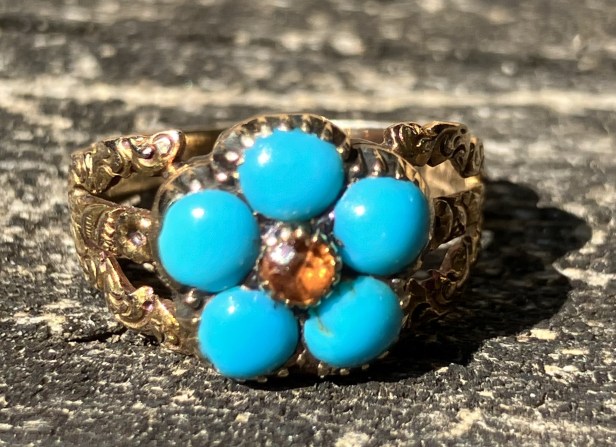
Victorian turquoise forget-me-not ring
Turquoise is a much imitated stone, as far back as the Ancient Egyptians who produced an artificial imitation of turquoise, faience, which was made of glazed earthenware. In the Middle Ages, ‘bone turquoise’ or ‘odontolite’, which is fossilized tusks of mammoths or mastodons, was used. Over a long period, the ivory is replaced by minerals. The material is a greeny blue or a gray blue , but it is believed that Cistercian monks developed a process to heat it to a sky blue. In the early 1800s, odontolite was mined commercially in the southern French Department of Gers for use in turquoise jewellery. Turquoise imitants in later 19th century jewellery, particularly non-French jewellery, were more likely to be glass than odonolite.
Substitutes for modern turquoise are common and are likely to be dyed howlite or magnesite, both naturally a white stone. Howlite also has natural veining similar to the turquoise from Nevada. Pierre Gibson produced a synthetic turquoise in 1972, both as a uniform coloured stone and one with matrix. Natural turquoise today is also likely to have undergone treatments which include waxing, oiling, dyeing and stabilising.
References:
Krzemnicki, Herzog and Zhou, ‘A Historic Turquoise Jewelry Set containing Fossilized Dentine and Glass’, Gems & Gemology, Winter 2011
Joe D Lowy & Joe P Lowry, ‘Turquoise: The World Story of a Fascinating Gemstone’, 2010, Gibbs Smith.
 navette jewellery