
The first settlement, at Sydney in 1788, consisted of about 850 convicts and around 550 crew, soldiers and family members. The convicts had no belongings but the families of the soldiers did bring their own belongings, including clothing and jewellery. This jewellery could be repaired if necessary as a few convicts had previously worked as jewellers in England but there was very little new jewellery in the colonies unless it was imported from England. This began to change a little with the arrival of free settlers. The first free settlers, five single men and two families, arrived in 1793 but by1850, approx. 200,000 free settlers and assisted immigrants had arrived.
The discovery of gold in 1851 in New South Wales and then Victoria led to an influx of jewellers and by 1853, there were 30 goldsmiths and jewellers in Victoria alone. The abundance of gold meant that significant jewellery could be made and that people were eager to buy it. The jewellery made during the two to three decades after this time became known as goldfield jewellery, although there were different categories of jewellery made. One category of goldfield jewellery symbolized work on the goldfield, containing gold nuggets, shovels, buckets, picks, etc. Similar brooches also spread to other goldfields in Australia, to South Africa in the 1890s and to the American Klondike gold rush in the late 1890s.

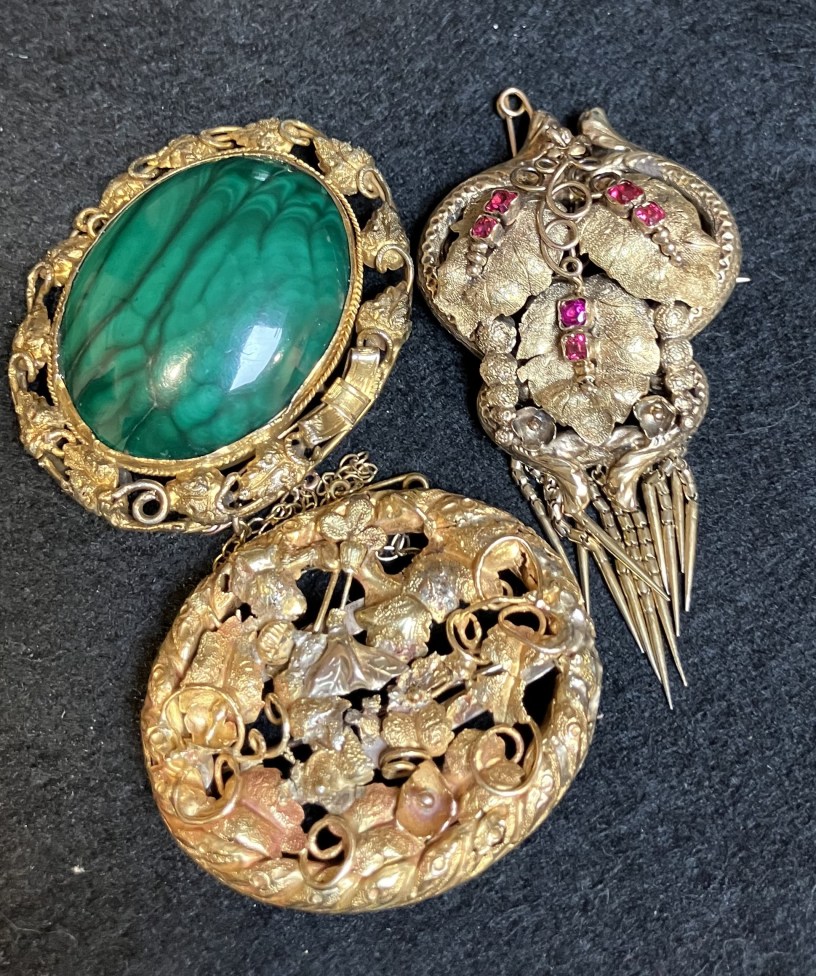
For those not wanting a practical souvenir, ornate gold jewellery was produced, with decorative borders featuring grape leaves (the symbol of prosperity), flowers and birds. Many of these were round and oval brooches, usually with miniatures or photos in the centre. The oval brooch in the photo above, with is grape leaf border, is missing its glazed centre pieces.
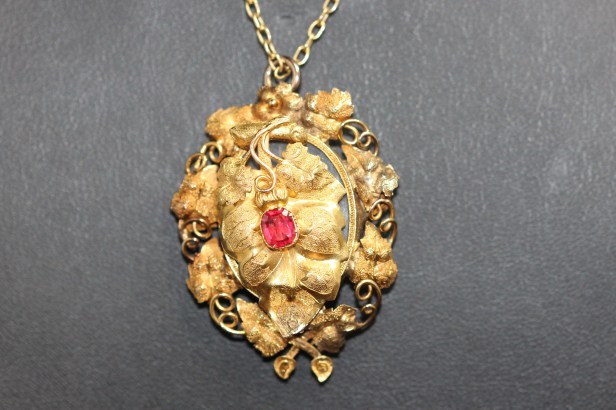
Above is another pendant/brooch, very typical of antique jewellery from the Australian goldfields era, with ornate grape and vine decoration around an oval glazed locket. The central part of the locket is hinged and lifts up to reveal the concealed locket. There is a red paste stone in the centre.
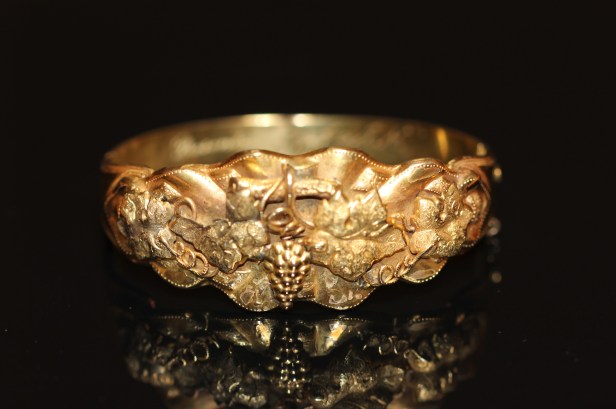
The bangle below also features grape leaves as well as a bunch of grapes and some flowers.
During the19th century, in addition to the goldfields jewellery mentioned above, many Australian jewellers copied UK and European styles so that it is often difficult to identify if pieces have been made in Australia, particularly as hallmarking in Australia was only for a limited period towards the latter part of the century. However, some jewellers did incorporate native gemstones, shells and nuts into their pieces as well as Australian flora and fauna and I will talk about these in my next post.
References:
Kenneth Cavill, Graham Cocks and Jack Grace, ‘Australian Jewellers: Gold & Silversmiths, Makers & Marks’, 1992, C.G.C. Gold.
Hayden Peters, ‘Colonial Australian Sentimental Jewels’, https://artofmourning.com/colonial-australian-sentimental-jewels/
‘Bling: 19th Century Goldfields Jewellery’, Museum of Australian Democracy at Eureka, 2016
Anne Scholfield and Kevin Fahey, ‘Australian Jewellery: 19th and Early 20th Century’, 1990, David Eli Press Pty Ltd.
 navette jewellery