

Anita Mason in ‘An Illustrated Dictionary of Jewellery’ claims that there are really only three types of chains – trace, curb and fancy – although there are lots of versions of each. Oppi Untracht, in her book ‘Jewellery Concepts and Technology’, offers a broader description of chain types, listing 11 different chain groupings. She includes simple link chains, twisted chains (called curb chains) and fancy chains but adds more varieties. It is difficult, though, to find a clear definition of a fancy chain. Oppi Untracht defines them as ‘[c]hains in which the wire links are not just simple rings or ovals, but [are] of some special form’ (p188), which is fine as far as it goes but I am not sure if it really helps me to identify them.
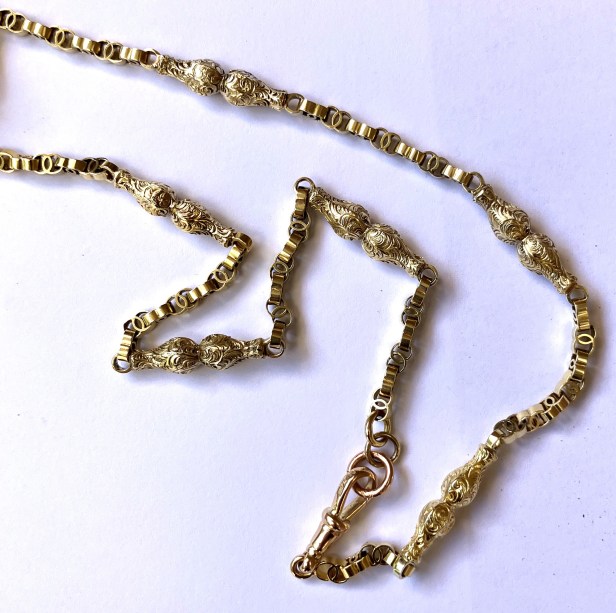
I thought the most useful approach to understanding fancy chains was to look at chains that I have bought which are described as a fancy chain. The first chain, above, certainly falls into the category of not being simple rings or ovals. It has a mixture of rings and links but then also has an ornate engraved feature every five centimetres.

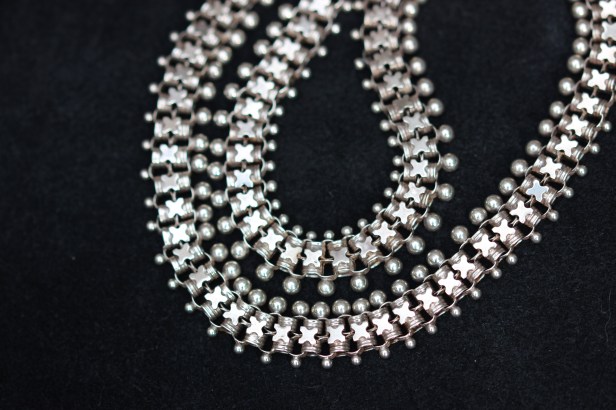
The French chain above is a mixture of links, knots and filigree stations while the Victorian silver collar below has cyclinders, bobbles and crosses. Very fancy indeed.
The final piece to look at is a vintage gold chain with textured links which I think fall into the category of a ‘special form’, as mentioned by Oppi Untracht above.
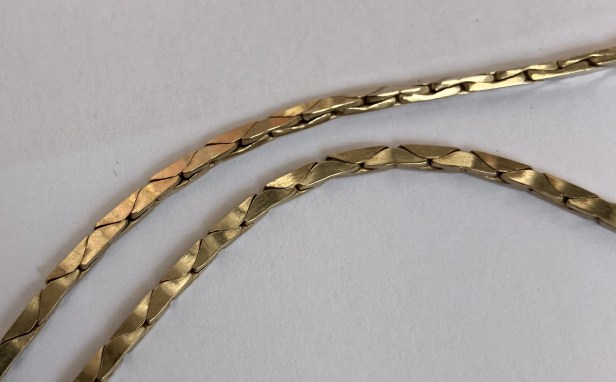
Certainly, none of the chains pictured above could be described as ‘simple rings or ovals’ so I think a fancy chain is a good term to use.
 navette jewellery
Chain making is one of my favourite tasks
LikeLike
I can understand that. I made a silver link chain once and it was very soothing.
LikeLiked by 1 person
Lovely, I wonder why they do not make chains like this anymore.
LikeLike
It’s a shame, isn’t it
LikeLike