
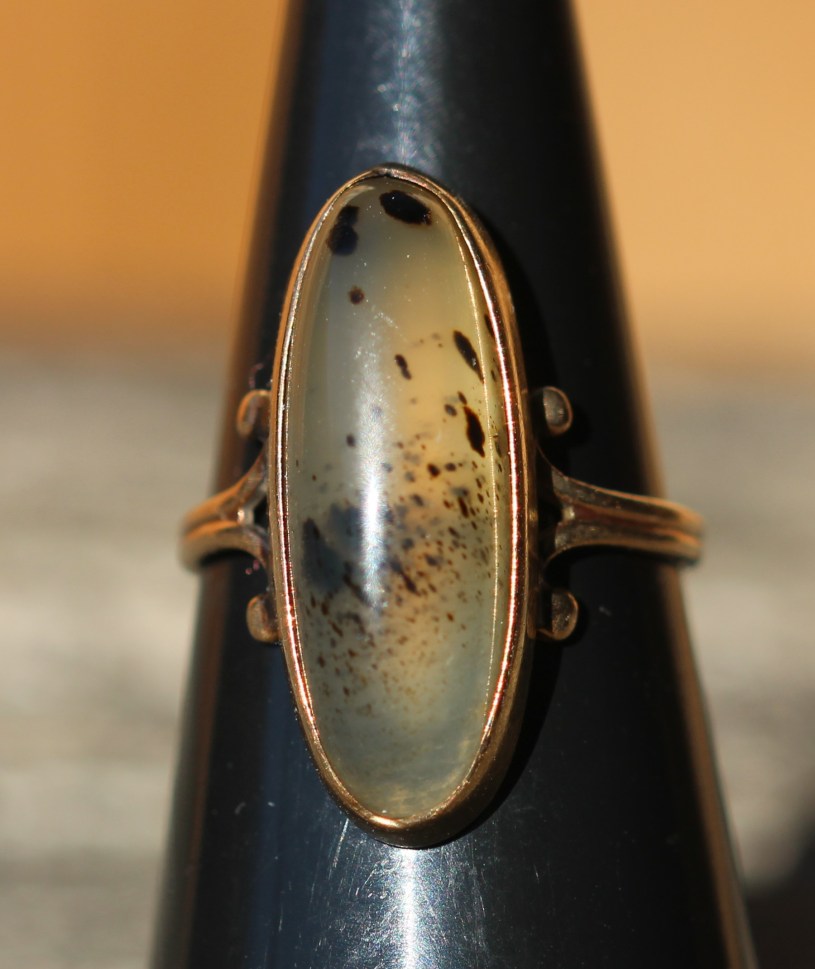
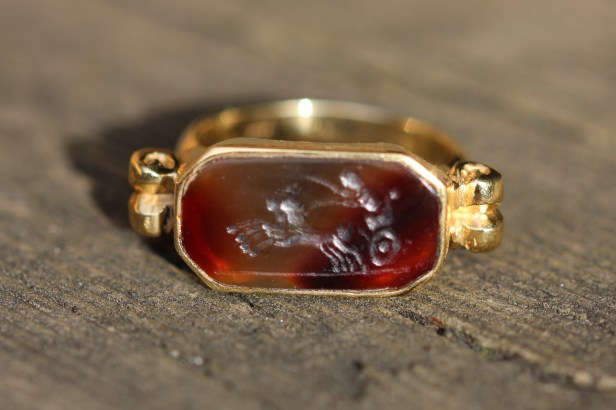
Hardstones, such as agates, were used from the ancient Roman time in cameos and intaglios. Pliny the Elder wrote about agates in his Natural Histories series:
‘The agate was … first discovered in Sicily near the river of the same name, but was later found in many countries. Its size can be exceptional, and its varieties are very numerous. The descriptive terms applied to it vary accordingly. For example, it is given names like ‘jasper-agate,’ ‘wax-agate,’ ’emerald-agate,’ ‘blood-agate,’ ‘white agate,’ ‘tree-agate’ (which is distinguished by marks resembling small trees), ‘anti-agate’ (which, when burnt, smells like myrrh) and ‘coral-agate,’ which is sprinkled with golden particles like those of lapis lazuli and is a variety that is very plentiful in Crete…’ (from Chapter 54, Book XXXVII).
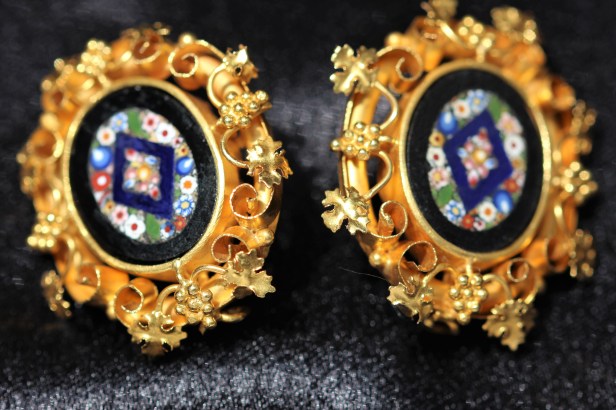
Agates were used in the production of pietra dura jewellery. Pietra Dura (or pietra dure), an Italian term for a method of inlaying coloured stones or gems into a stone base, first appeared in Rome in the 16th century. The craft became centred in Florence when in 1588, Grand Duke Ferdinando I de’ Medici established a court laboratory which specialised in semi-precious mosaics and inlays. It was also in Naples to a lesser extent. In the 17th century, the craft spread to India where it became known as Parchin Kari.
A common theme of the pieta dura pictures was flowers, sometimes with birds and fruit. In Italy the technique is also called commesso, meaning ‘fitted together’ and ‘pietre dure’ refers to the hard stones used in the technique. The stones used in pietra dure work include coloured marble, as well as gemstones like quartz, chalcedony, agate, jasper and porphyry. On rare occasions, gemstones such as emerald, ruby and sapphire were used.
During the Georgian era, dendritic and moss agates are decorative stones were used in rings and lockets. While they are not a true form of agate because they lack agate’s concentric banding, they are still described as agate. Dendritic agates are colourless or whitish with dark black or brown inclusions of manganese or iron oxides that form in tree-like patterns. Moss agate is similarly translucent but has moss-like usually green inclusions. Pliny described moss agate as ‘iris agate’ and linked it to rock crystal. I don’t have any Georgian examples, unfortunately, but the ring at the top of the post, from the Art Deco period, is a good example of such stones.
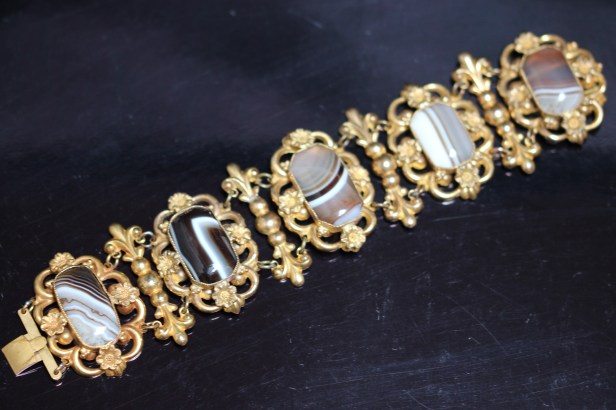
Also during this period, agate was used to very good effect in bracelets and necklace set with gold or pinchbeck, focusing on the gorgeous banding as in the example above.
It was the 18th and 19th centuries that agate really became popular and I will talk about this popularity in the next post.
Reference:
Pliny, ‘The Natural History of Precious Stones’, https://www.attalus.org/translate/pliny_hn37b.html)
 navette jewellery