
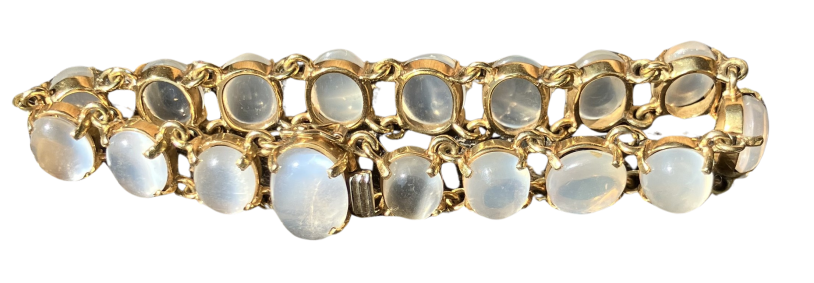
June has three birthstones – the rare alexandrite, the moonstone and the pearl. I am going to focus on the lovely moonstone in this post. It is such an intriguing gemstone, usually almost colourless, translucent to transparent, but with an opalescent or adularescent sheen which adds a mysterious look to it. Moonstones belong to the Feldspar family, along with amazonites, labradorites and sunstones.
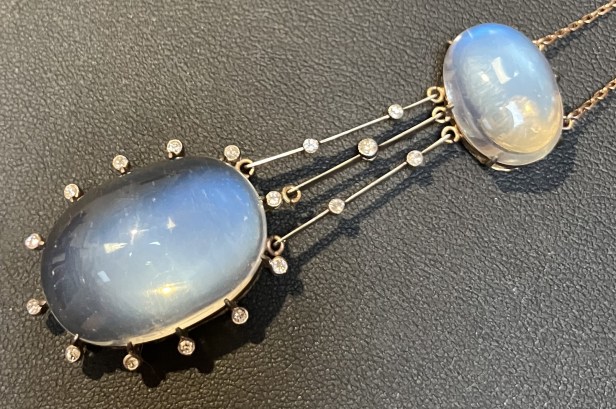
They have been used in jewellery for a long time. It is thought that Pliny wrote about moonstones in his Natural History book, calling them ‘selenitis’ which he described as being:
‘…white and transparent, with a reflected colour like that of honey. It has a figure within it like that of the moon, and reflects the face of that luminary, if what we are told is true, according to its phases, day by day, whether on the wane or whether on the increase…’ (Book XXXVII, Chap 67).
The word ‘selenite’ is derived from the Greek for the moon and while there is a gypsum mineral that is called ‘selenite’ which is transparent to opaque, it is quite soft so the Pliny quote is taken to be referring to moonstone, the gem.
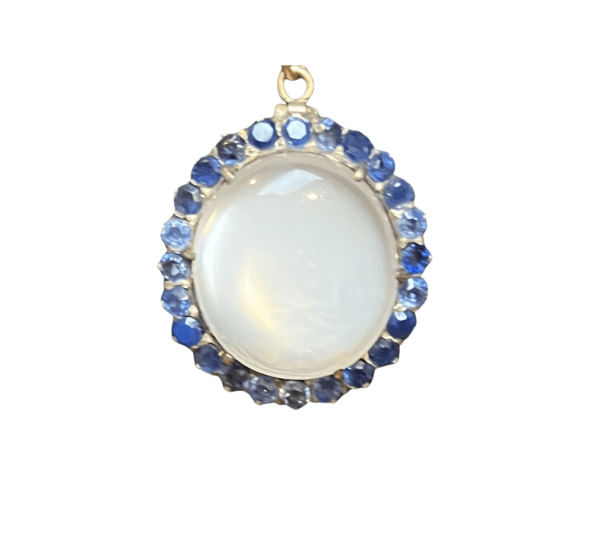
Historically, moonstones are linked to worship of the moon and some Victorian jewellery contains moonstones carved with the face of the man in the moon. They were particularly popular gemstones in the Art Nouveau and Arts and Craft periods. The stones are usually cut as cabochons, with a domed top.
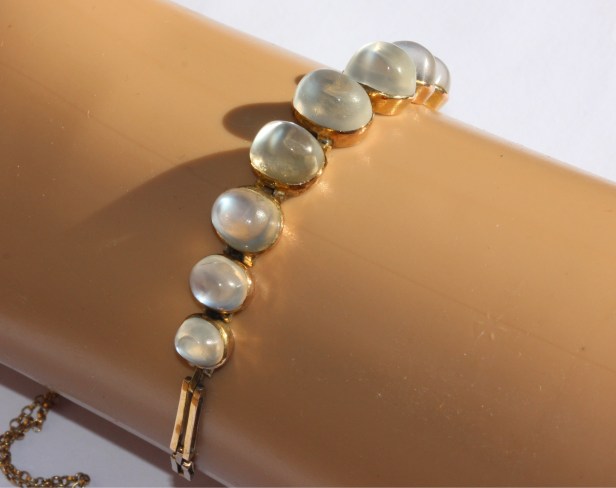
 navette jewellery
I love moonstone, and alexandrite even more!
LikeLike
Both lovely gemstones!
LikeLiked by 1 person
I hated moonstone most of my life and was disheartened when I found out that it was my birthstone. But reading more about it fro ma gemmological point of view, made me appreciate it for it for adularescence.
LikeLike
It’s quite a mysterious looking gemstone, lots of mystique.
LikeLike