

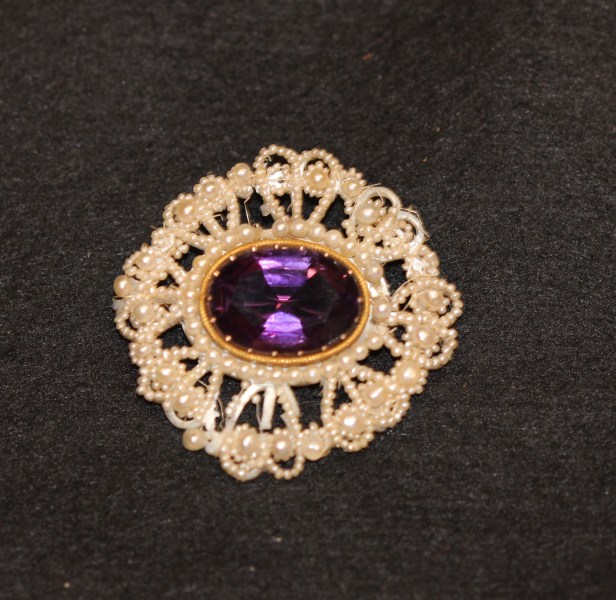
Another June birthstone is the pearl, another gorgeous gem, organic rather than mineral though. It, too, is a quietly mysterious gem. While not as durable as many other gems, pearl jewellery dating around 500 BC has been found in Iran as well as pieces from Ancient Egypt around 323-330 BC. Because of their scarcity, pearls were generally associated with wealth and power, particularly during the Elizabethan period and the Renaissance. Seed pearls, from freshwater mussels or seawater oysters, were more obtainable than large pearls and became very popular in the 18th and 19th centuries, particularly for bridal and mourning jewellery. The little delicate brooch below is made of seed pearls and larger pearls sewn by hand onto a backing of mother of pearl and is typical of the jewellery.
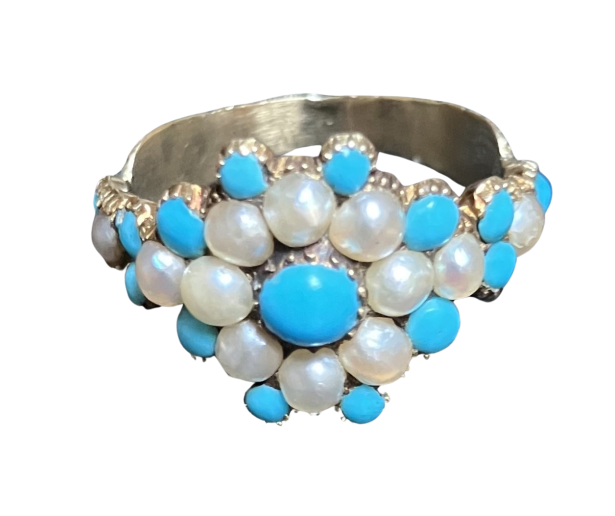
An interesting thing about pearls is the variation in size that is used in jewellery, from tiny seed pearls through to half pearls, large South sea pearls and baroque pearls. Half pearls, which range in size from .5 mm to .75mm, up to 4mm in some cases, were used a lot in the19th century in lockets, watches, rings and as borders for brooches. They are small pearls that either had been cut away from the shell of the mussel and so had a flat side or were the better halves of defective pearls. The centre of the half pearl industry was Idar and in Oberstein in the Duchy of Oldenburg, Germany. Pearls were purchased from India.
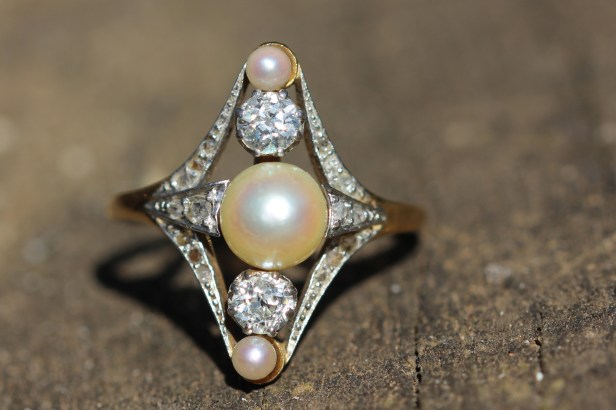
The introduction of cultured pearls in the 1920s led to a greater availability of good sized round pearls and to the popularity of the ubiquitous single row pearl necklace in the 20th century. It is difficult to tell if a pearl is cultured or natural without testing.
One type of pearl that is particularly striking is the baroque pearl. This is an irregularly shaped pearl which can occur with natural and cultured pearls. They can be quite large, as is the case with the modern pendant below. The pearl measures 45mm by 30mm.

 navette jewellery