
The hardest question to answer when I acquire some new pieces of jewellery described as being antique is whether they really are antique. Having hallmarks on a piece of jewellery is useful as it generally helps you identify what it is made of and in some cases its age. For instance, English hallmarks can also give you the maker’s mark, the assay office, the fineness of the metal and the date of assay. However, it was not until the enactment of the 1973 Hallmarking Act that it became compulsory to hallmark jewellery in the UK. In 1738, the Plate Offences Act exempted from hallmarking ‘all jeweller’s works’ unless it was a mourning ring (compulsory from 1784) or a wedding ring (from 1855). It applied to gold and silver. Rings with gems, signet rings and other types of dress rings were exempted from hallmarking as were chains like watch chains, Albert chains, necklace chains, key and fob chains and seals. Lockets, brooches, necklace beads, items set with gems and paste and small works set with amber, and filigree work were also exempted. Of course, voluntary hallmarking was possible which is why we see some hallmarked pieces.

France is another country with a long history of hallmarking but even then the hallmarking is not always as useful as you might think. The right facing eagle head mark for a minimum of 18ct gold was introduced in 1838 and remains in use today with some changes over time to the frame within which it is set. The horse head stamp, also for 18ct gold, applies between 1838 and 1919. So there is quite a span of years during which these stamps have been used.

Many countries, like Australia and the USA, have no compulsory hallmarking schemes at all, despite attempts to introduce them. In 1906, the USA did introduce a voluntary scheme which permits a jeweler to put a purity mark and from 1961, this must be accompanied by a maker’s mark.
So if hallmarks aren’t helpful, how else can you identify the age of a piece of jewellery? For very old pieces of jewellery, museums are particularly useful. Their ancient jewellery collections are made up of discoveries from excavated tombs and hoards, and they frequently publish catalogues of their collections (see, for instance, https://gemology.se/gill-library/gemjewelry/Catalogue_of_the_Jewellery_Greek_Etruscan_and_Roman_in_the_British_Museum_F_H_Marshall_1911.pdf).
Jewellery from the 14th, 15th and 16th centuries can also be found in paintings from those eras which show individuals wearing jewellery. As well as identifying jewellery styles, they can also show how the jewellery was worn, for instance, how many rings were worn on a hand or how long chains were. Particularly useful for understanding jewellery in these periods is the London Cheapside Hoard, discovered in 1911 when a row of shops built in 1667 were demolished. What was excavated was the stock-in-trade of a 17th century jeweller, and it provides great insight into styles and sources of the gemstones in the collection.

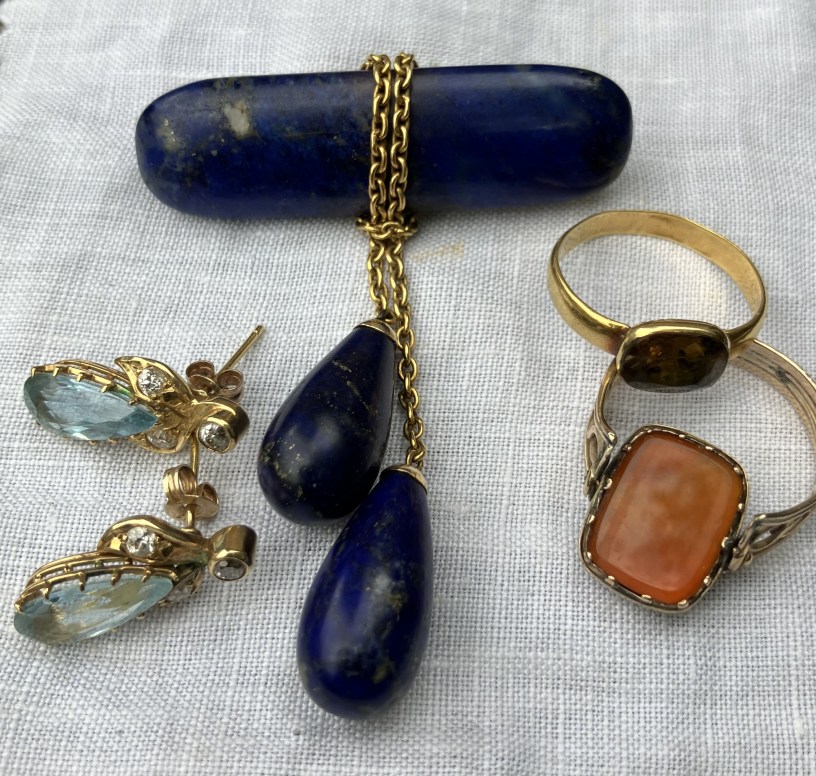
Catalogues from auctions, Exhibitions and from 19th and early 20th century jewellers are all useful and I will give some examples of this in my next post, using the jewellery pictured at the top of the post.
 navette jewellery