

The peridot is one of three birthstones for August. It was added as an alternate stone to sardonyx on the US National Association of Jewelers list of birthstones in 1912. It is an unusual gemstone as it really only comes in one colour –green. While the green colour can vary a bit, sometimes being a greeny brown or a golden green, it is commonly a green which is similar in colour to new leaves in springtime. Very distinctive and very pretty. Because it is a doubly refractive stone, it has a great depth of colour.
Prior to the early 18th century, peridot gemstones were called topaz as it had been mined for over 3500 years on the island of Zabargad (now St John) in the Red Sea. That island was known by the Greeks and Romans as ‘Topazios’. When the topaz family was actually identified gemmologically, a new name for the green gemstone was required. In 1790, the name ‘olivine’ was selected. The word ‘peridot’ is French for olivine and, eventually, it was the French name that became commonly used, rather than olivine.

It was popular during the late Georgian and Edwardian periods. In the latter period, it became associated with the suffragette movement. Women suffragettes wore colours of green, white and violet, standing for ‘give women votes’. Jewellery contained peridot (green for give), pearls (white for women) and amethyst (violet for votes).
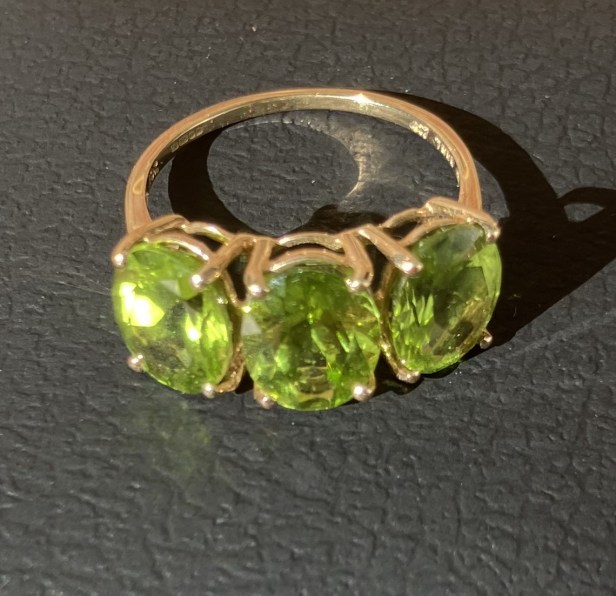
Today, peridot is mined in Myanmar and Pakistan as well as a number of other sites, including China, Vietnam and the US. Peridot is formed in magma and is pushed to the surface through volcanic activity.
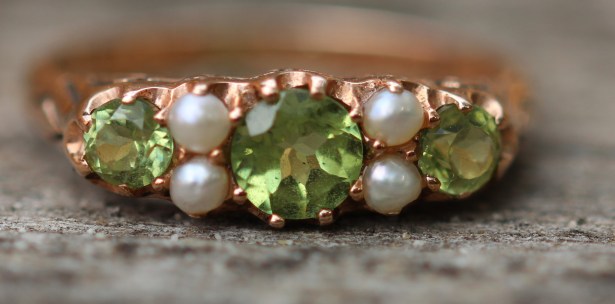
Peridots mix well with other coloured gemstones but I think that its perfect match is the pearl as you can see in the half hoop ring in the photo at the top of the post, the lovely earrings and ring above.
 navette jewellery