
In the 17th and 18th centuries, the Grand Tour was a crucial rite of passage undertaken by wealth young men from Europe, the UK, and Russia. Initially, they visited historical Renaissance sites in Europe but by the 18th century, that focus had moved to Roman and Greek antiquities. The Grand Tour offered a way to access private collections of sculptures, paintings and other art works as well as natural curiosities. Herculaneum was excavated in 1738, Pompeii in 1748, and Hadrian’s Villa at Tivoli in 1769 and these sites were all able to be visited by tourists. In the 17th and 18th centuries, the young wealthy visitors brought home sculptures, paintings and furniture as well as small valuable items like intaglios and cameos. After the Napoleonic Wars, the tourists began to include wealthy families and women, and there was a growth in smaller souvenirs.
Naples was an important place for tourists to visit as it allowed tourists to do side trips to sites like Pompeii and Herculaneum. Back in Naples, they often shopped for jewellery to help her remember this part of the trip, usually coral or lava jewellery. The lava jewellery sold was supposed to contain lava from Mount Vesuvius. It came in muted brown, grey, greens, ochre and cream, and skilful artists carved and polished beautiful cameos which were turned into bracelets, brooches, pendants, earrings and necklaces. It appears, though, that the ‘lava’ was in fact a fine limestone native to Southern Italy. We still describe it as lava jewellery.
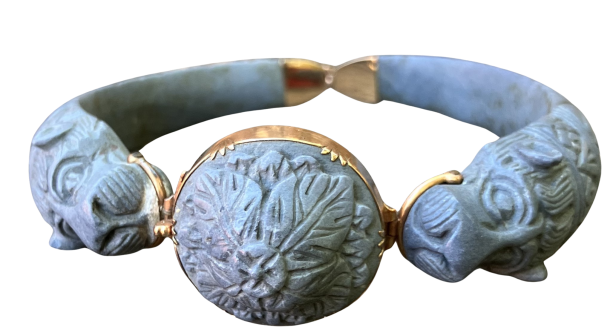
The lava jewellery souvenirs vary quite a bit in quality and obviously cost. Some was set in gold, some in silver gilt and rolled gold, others in metal. Also, some of the carving was very fine, but some was not so distinct or detailed, particularly those from the later part of the 19th century. Let’s look at a few pieces. The grey lava bangle above is an early piece of lava jewellery. It has two carved lion’s heads with a central carved flower on the clasp. A very unusual piece.
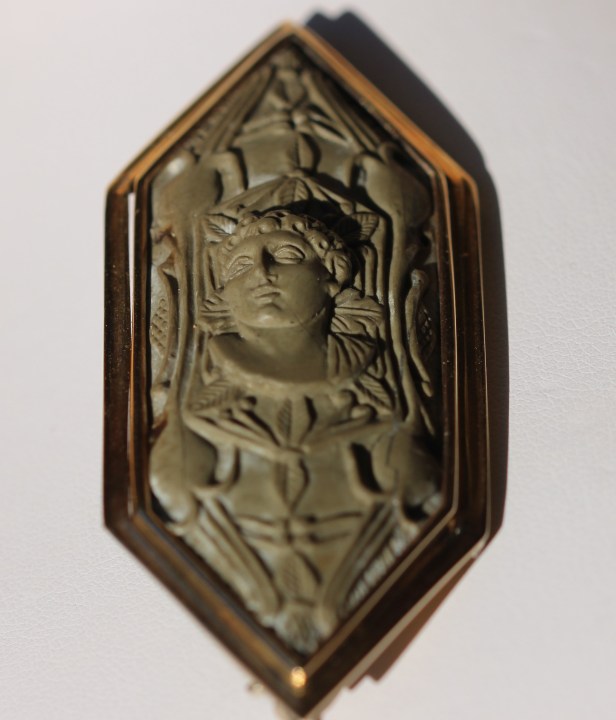
The brooch above is also unusual. Most lava carvings were usually of classical heads or great Italian artists or writers. This one, though, has a medieval feel and the carving is beautifully executed. It is set in a stretched hexagon gold border and is quite large.
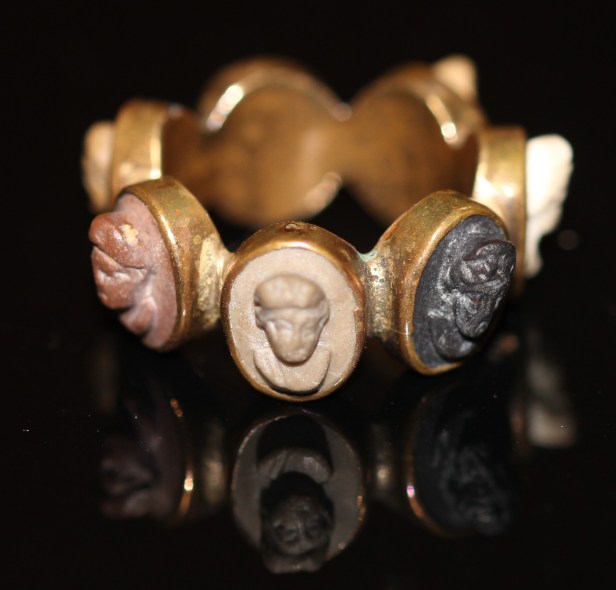
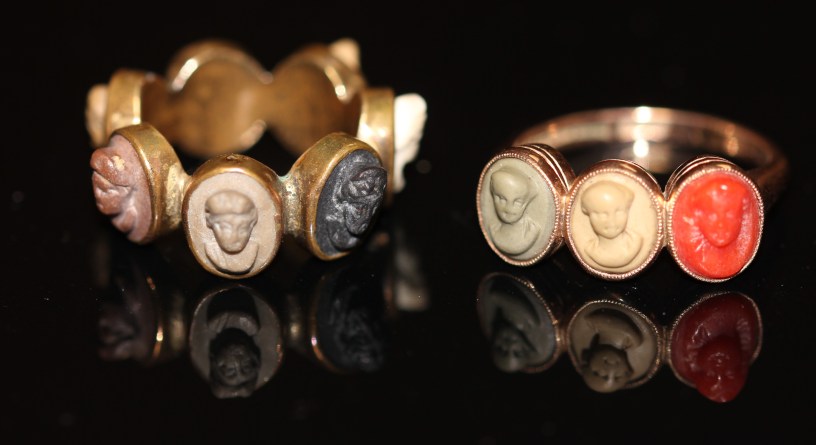
There are two rings at the top of the post. One, with three carved faces, one in coral, is set in gold. The other, with seven carved faces, is set in gilt metal. It is in the photo above. The faces, one of which is carved in coral, represent gods and goddesses, for each day of the week. It is also quite an earlier 19th century piece.
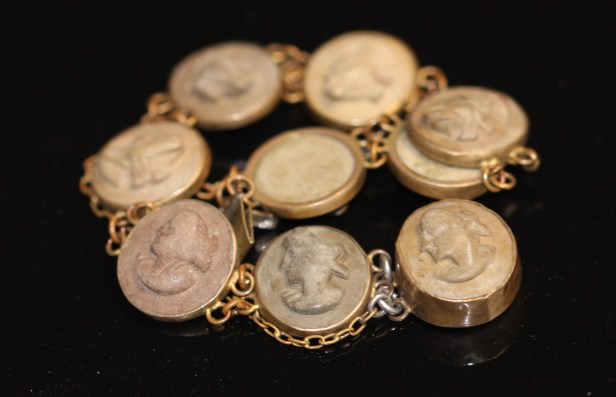
The bracelet below is a later 19th century piece and is set in metal. Again, it has carved gods and goddesses, in lava with only slight colour differences.
 navette jewellery
I love the fact that the ‘lava’ wasn’t actually lava.
Artisans of Naples – providing tourists with what they want, from time immemorial. 🙂
LikeLike
Limestone just lacks the image that lava from Mt Vesuvius conjures up, doesn’t it’
LikeLike
I have wondered why stone was called as lava. Thanks you for this information.
LikeLike