

If I see an antique split ring for sale at an auction, I try to buy it as they are very useful for creating collections of small seals, charms and lockets. In the 19th century, men wore chains to attach to their pocket watches. The watches were stored in little pockets, called fob pockets, at the top of their breeches. At the other end of the chain were little objects like watch keys, seals, charms membership badges, and novelty pieces like a compass. The chains became known as fob chains and the little objects attached to one end of the chain became known as fobs.
All these little objects are still around and they look attractive collected together in little bunches, hanging from a split ring attached to a chain. I like to experiment with different collections. The collection at the top of the post has a Georgian agate seal, a Georgian mourning hair pendant and an Australian Edwardian gold medallion.
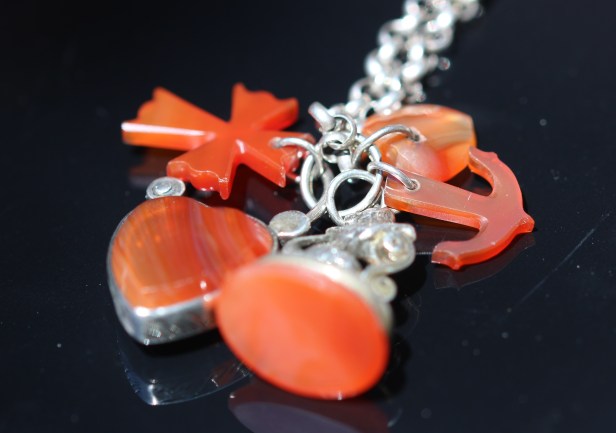
The collection above brings together silver pieces all set with carnelian. There is a Scottish padlock, a Victorian seal with a lion at the top and a a trio comprising and anchor, heart and cross.
The collection below comprises two antique matching pieces (a seal and watch key), a T bar, and a 19th century gold polygonal and intricate circle shape screw system crystal locket.

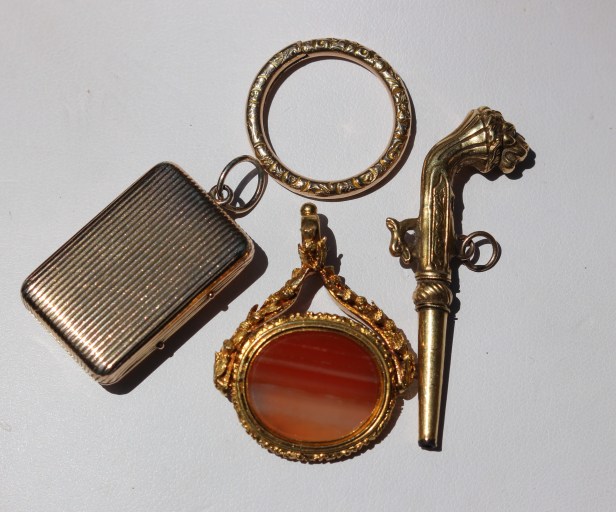
The collection below is one I am playing with at the moment. It comprises an 18ct gold watch key, modelled as a pistol with lion head grip, an 18ct banded agate swivelling fob, and an antique French gold over silver locket. I like the contrast of shapes but maybe the gold colours aren’t quite right. I’ll keep trying.
 navette jewellery
One of the things I adore about SmeltyMelty my Aquaflame, is that I am able to solder really delicate pieces, even close to things like pearls. But a sturdy split ring is a rare joy
LikeLike
I am a little envious of you and your aquaflame.
LikeLiked by 1 person
Does the word fob refer to the seal, the connecting chain/rings or any charm on the split ring? I have found sources that give different definitions.
LikeLike
The meaning has shifted. Originally it referred to the little pocket in which a pocket watch was kept, then it referred to the chain holding the pocket watch, then seals, then anything hanging from the chain.
LikeLiked by 1 person