

December has three birthstones – turquoise, zircon and tanzanite. I am focusing on turquoise in today’s post. Turquoise is a lovely gemstone. It is an opaque gem, usually in cabochon form, and comes in blue tones ranging from sky blue to a greenish blue. It is found mainly in the Middle East, the US, South America and China and so, historically, was used in jewellery in a wide range of early civilisations like the Egyptians, Romans and Aztecs. It reached Europe through Turkey, resulting in its name being derived from the French expression ‘pierre tourques’ (Turkish stone).

Although popular with the Egyptians and the Romans, turquoise was not common in the west during the Dark and Middle Ages. It was in the 14th century that it began to be used more frequently, usually for religious jewellery and ornaments. Turquoise began to be used in non-religious jewellery in the 16th, 17th and 18th centuries. It was used in particular in sentimental flower jewellery as the blue colour was similar to the blue forget-me-not flower. In the 19th century, turquoise was also used a lot in Egyptian revival pieces.
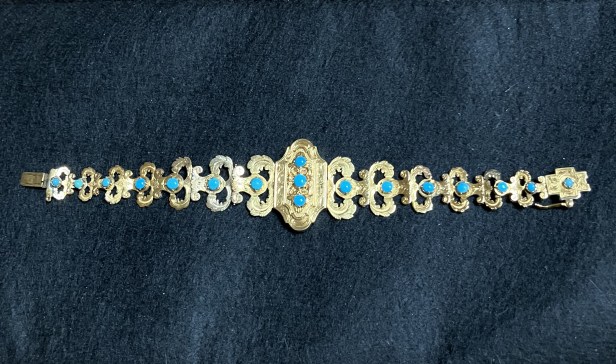
A lot of Victorian era jewellery contains turquoise. It is usually set in gold and some may be pave set. Most of the turquoise is a sky blue colour, sometimes with a very slight green tinge. It has few matrix. Some individual turquoise might have turned green as a result of exposure to oils, perspiration or grease.
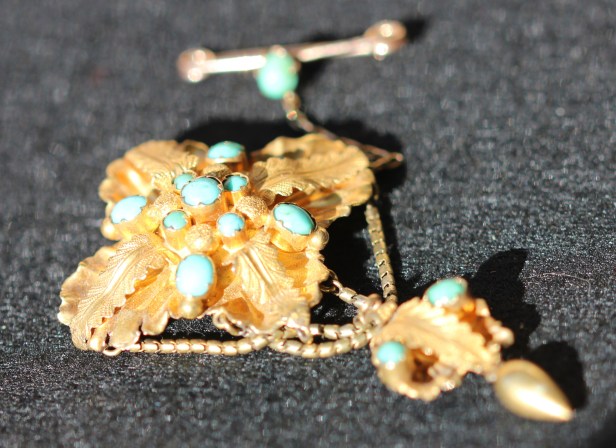
It is such a pretty stone!
 navette jewellery