
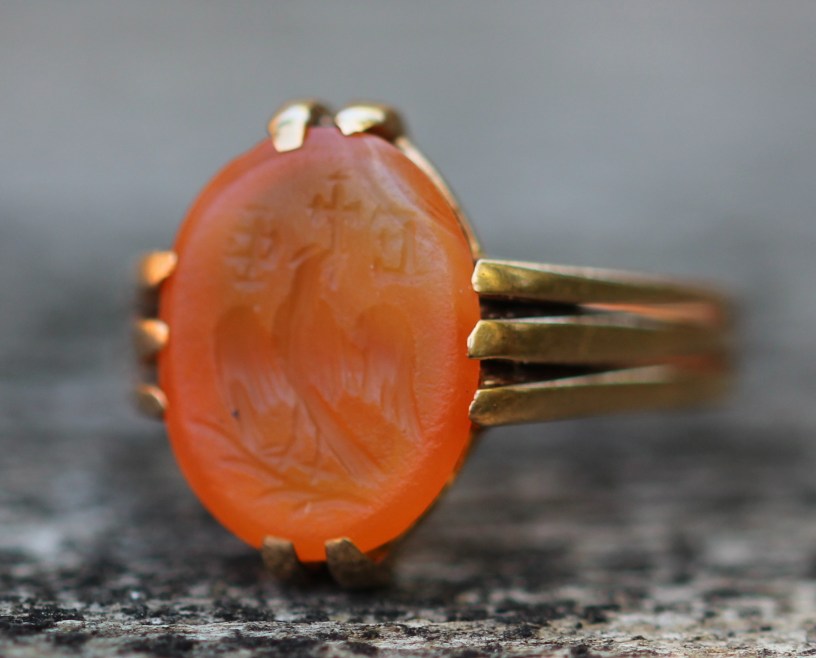
Carved pieces of jewellery have been created for thousands of years. The earliest forms of carved stones were probably designs carved into soft stones like sandstone and soapstone, fired clay or into man-made ceramic faience (comprised of quartz, alkaline salts, lime, and mineral-based colouring agents). The Egyptians used these engraved stones as seals, with the top being in the shape of a scarab and the bottom engraved with hieroglyphic characters. Rings holding gemstones with the engraving on the top came in in the Hellenistic period (from 323BC to around 40BC) and these finger rings were adopted to hold personal seals (Gray, 195). The Romans also wore rings that were not necessarily personal seals, with gems engraved with images of gods and goddesses, political leaders and sports stars. Metal rings (gold, silver, bronze) began to be used for seals around this time
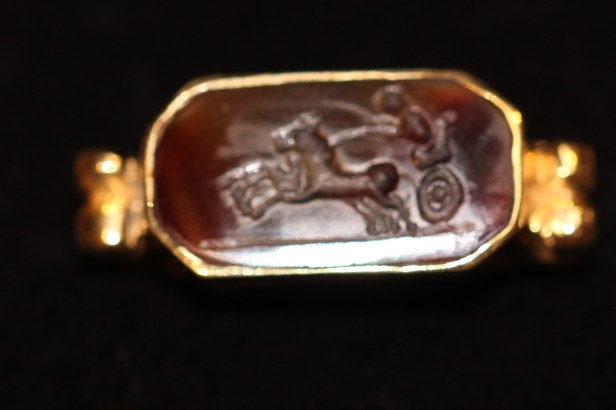
There is often an assumption that intaglio rings contain personal seals but this is not always the case. The image in the intaglio may just be a popular figure in society or a god or goddess and have nothing to do with a personal signature. It is not easy to tell, however. If we look at the image in the Roman intaglio above, it is showing a charioteer driving a biga (or bigae) which was a two horse chariot used in games in Ancient Roman. The races were an important sporting event and this is an image that appears in a number of Roman rings (https://art.thewalters.org/detail/24395/intaglio-with-a-chariot-set-in-a-ring/) and pottery (https://archaeologicalmuseum.jhu.edu/class-projects/the-roman-house-at-hopkins/the-art-of-light/charioteer-on-a-biga/), and in some 18th/19th century intaglios (Guy Lariere collection). There were also ancient Roman and Greek coins that have charioteers on one side. It makes me feel that this intaglio was not a personal seal.
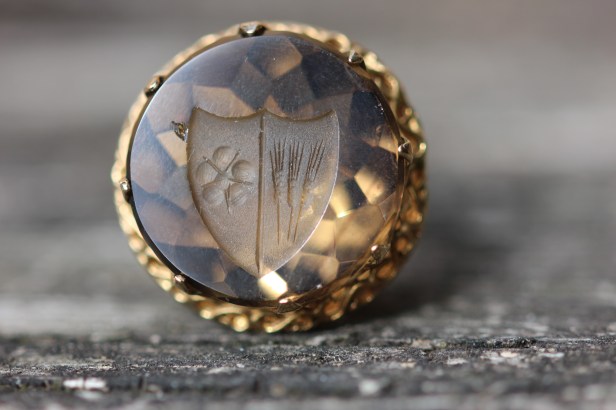
Intaglios from the 18th and 19th centuries appear to be personal seals, with coats of arms, mottos, etc. The ring above has a shield with three wheat stalks on one side and a flower on the other. The wheat ears means faithful while the flower is a cinquefoil (a five petal or lobed flower) which means hope and joy. The carnelian intaglio in the photo at the top of the post features a bird on a branch with three symbols above its head.
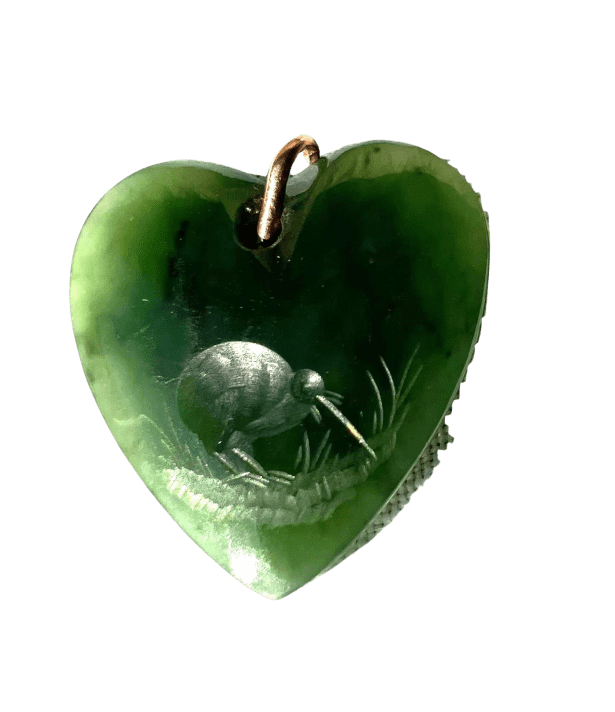
Of course, intaglios are not only set in rings or seals. The little colonial New Zealand greenstone heart above with its intaglio of a kiwi is a favourite of mine.
References:
F Gray, ‘Engraved gems: a historical perspective’, Gems & Gemology, Winter 1983, pp 191-201, https://www.gia.edu/doc/Engraved-Gems-A-Historical-Perspective.pdf
 navette jewellery