
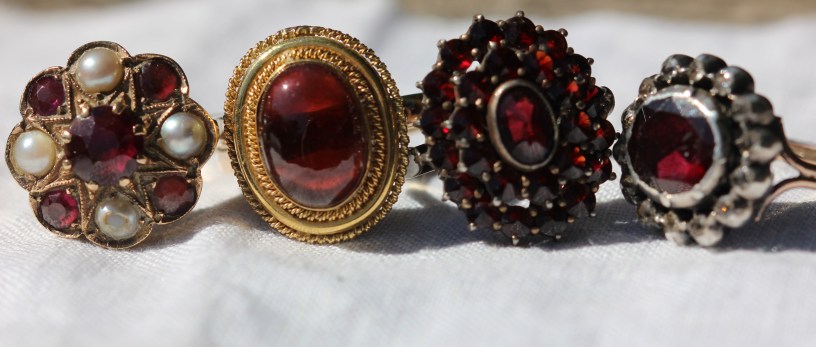
Happy New Year and welcome back to the blog for 2026! It hasn’t been a great start to the year in terms of international politics and stability but there’s not much we can do about that. We can, however, focus on some positive things, like beautiful jewellery and gemstones. To start, let’s celebrate the lovely garnet family, the birthstone for January.
Garnets are a beautiful but complex family of gemstone, with some of the species having a different chemical composition but still able to be classed as a garnet. The word garnet comes from the 14th‑century Middle English word gernet, meaning ‘dark red’ which in turn is derived from the Latin word granatus, from granum (‘grain, seed’), believed to be associated with the pomegranate which has red seeds. The most common colour for garnets is red.
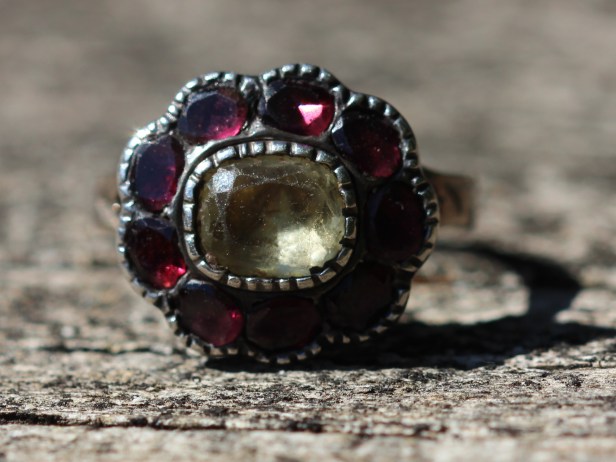
Generally, the colour of a garnet is determined by its chemical composition and there is quite a range from pink, red, purple, orange, black, yellow, and green. Those with iron or manganese in their composition are likely to be red, while those with calcium are inclined to be green.
Garnets in the pink to red colour range are the most common. Almandine garnets are generally a very dark red while pyropes are a fiery red. Mixtures of garnets are common, resulting in almandine-pyropes, such as the rhodolite which is a pinkish mauve colour, and pyrope-spessartines (an orange-red). Then there are demantoids, a green garnet, hessonites, a yellow orange, and tsavorites, a rich green.
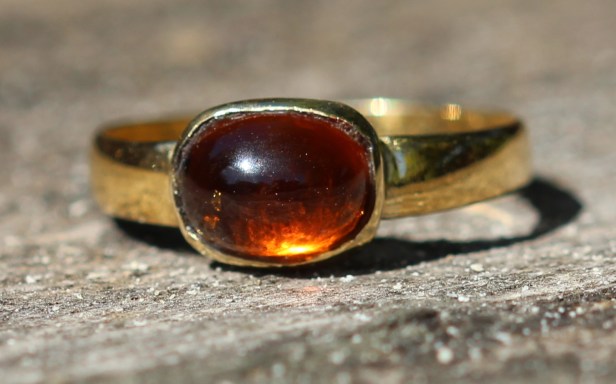
Usually presented as a cabochon in antique jewellery, almandine garnets were also likely to be foiled and have closed backs. The foil, which was a small sliver of tinted copper (in the Georgian period), made from a leaf of tin (19th century) or aluminium foil (from 1910 onwards) was set behind the stone or lining the setting. Foiling enhanced the colour and brilliance of the stone. Even when open settings became common for gemstones in the 19th century, foiling of garnet cabochons continued throughout the century.
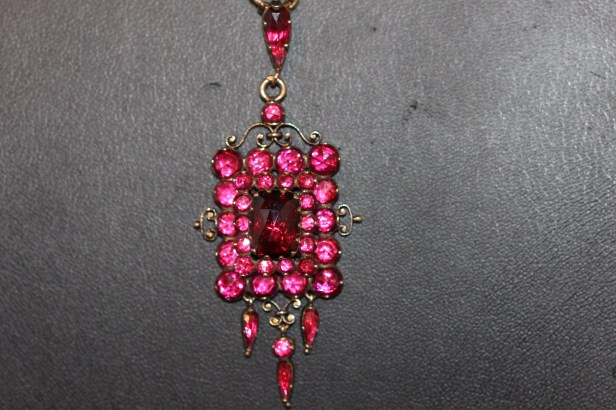
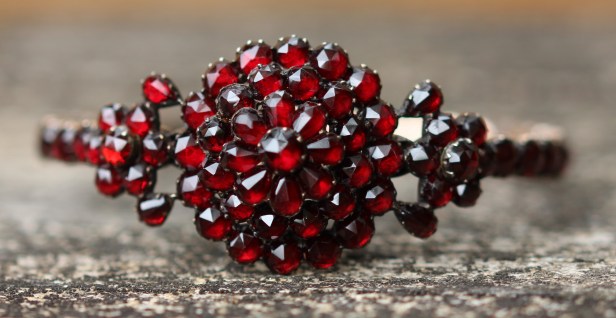
Pyrope garnets were used (and still are) in Bohemian garnet jewellery in particular. Craftsmen in 19th century Bohemia (later part of Czechoslovokia) began to produce jewellery using pavé-set clusters of multi-faceted stones. This jewellery was mounted either in gold, often low grade, but also in silver gilt or metal. Typical designs used rose cut garnets clustered around a garnet cabochon in star shaped patterns or flowerheads, with the settings were usually closed at the back.
 navette jewellery