
Bracelets, bangles, cuffs, armlets – all different styles of jewellery designed to be worn around the wrist and normally grouped under the heading of bracelet. The word bracelet originates from the Latin for arm, ‘brachium’. It became ‘bracel’ in Old French, with the diminutive form becoming ‘bracelet’.We have come to use the word ‘bracelet’ to mean a linked or flexible item which is done up around the wrist with a clasp or hinge while ‘bangle’, from the 18th century Hindu word ‘blangli’ meaning glass bracelet, is used to cover jewellery which is rigid, either able to be slipped over the hand without a closure or joined with a clasp. Of course, some bangles are not joined into a complete circle, like a cuff. We do use the terms interchangeably though.
I am concentrating in this post on bangles (and bracelets) that are expandable or stretchable, often but not always without a clasp. I have small wrists so I am always looking for bracelets that will fit.
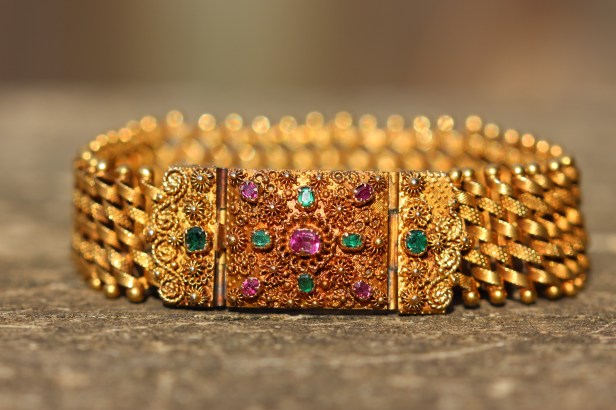
I am starting with the Georgian period. The Georgian bracelet above has a cannetille decorated clasp, set with a central garnet and coloured paste stones, attached to a woven gold chain band which expands, typical of bracelets from the 1820s to 1830s . The construction of the band allows it to stretch about 2cms. There were different versions of flexible woven bands made from gold and alloys like pinchbeck. During this period. Woven hair was also used in some mourning jewellery.
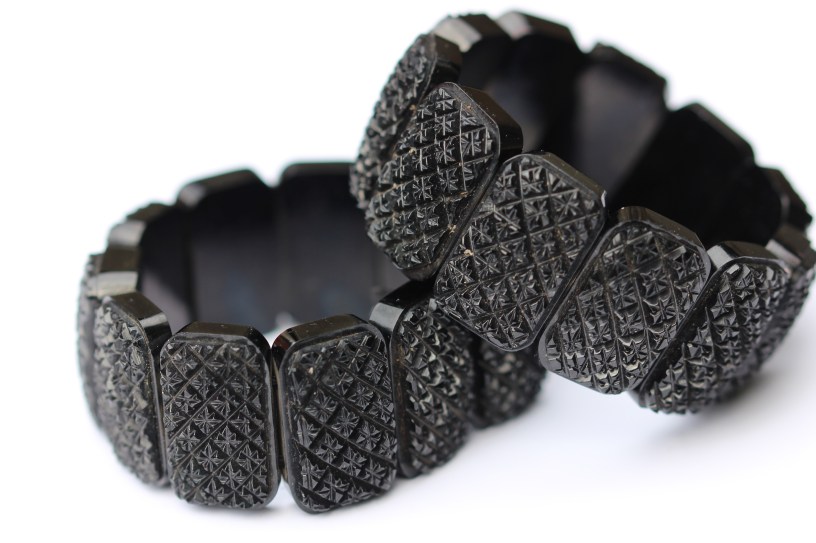
The next bracelets, at the top of the post, are Victorian, made of jet and held together with elastic. A patent for the use of elastic as fasteners for shoes and gloves was granted in 1820 and for rubber bands made from vulcanized rubber in 1845. Elastic was used in jet bracelets from the 1860s onwards, as seen in these here and in the flexible wrap jet snake bracelets that were so popular.
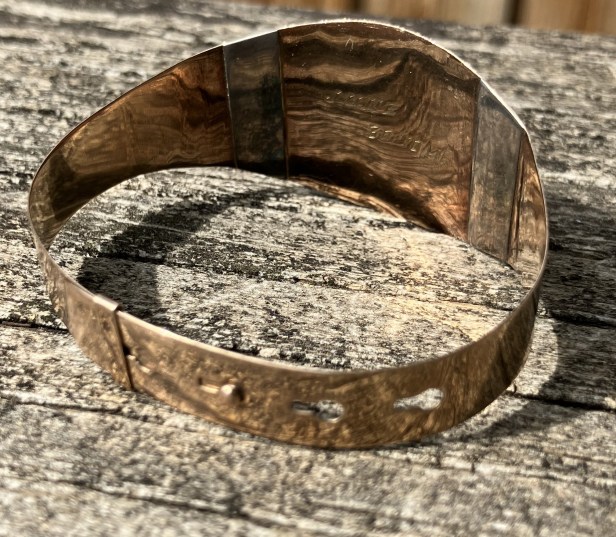
The next, above, is an adjustable one from the 1875 onwards. It is a thin gold band with an engraved front. The back of the band on one side has holes while the other has an upright peg which fits into one of the holes depending on the size of your wrist. There is a keeper band to hold the bangle in place.
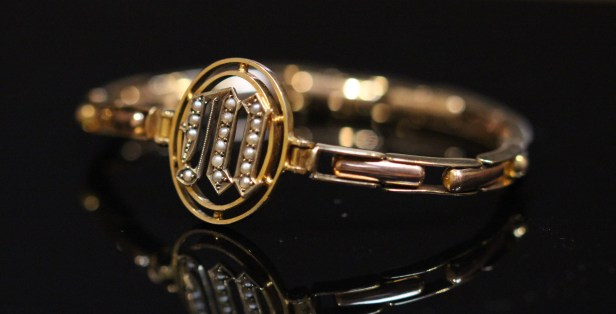
There are a number of different versions of adjustable bracelets at the end of the 19th century which can be traced through many patents. In 1890, D.F. Briggs Co of Attleboro, Massachusetts developed the Carmen Adjustable Bracelet, which had a hinged link system rather than elastic. They were in gold-fill. In 1913, a patent for an expansion bracelet was granted to the Hadley Jewellery Company in Providence, Rhode Island. The band is similar to that used for wrist watches as seen in the early 20th century gold bracelet above.
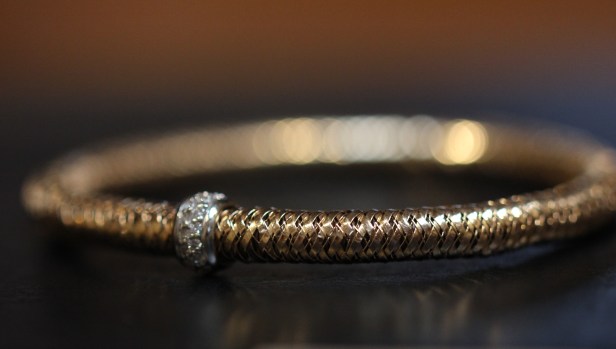
The final bracelet is a more modern one by Italian Roberto Coin, called the Primavera diamond accent bracelet. It has no opening and slips over the wrist. It is made of a flexible, gold mesh-like construction .
 navette jewellery
I suppose that you are referring to the Late 18th century Hindi word “baṅglī.” Actually there are different (much older 2800 + year old) words in Sanskrit and other Indian languages that refer to different types of bangles, cuffs, armlets and bracelets and the words are not used interchangeably even today. However, there is a kada, a sutarla/ Sutadla/sutlada which is a bendy openable bracelet with a screw. It is adaptable if not slightly expandable.
LikeLike
Thanks, that is very helpful, Margaret
LikeLike