
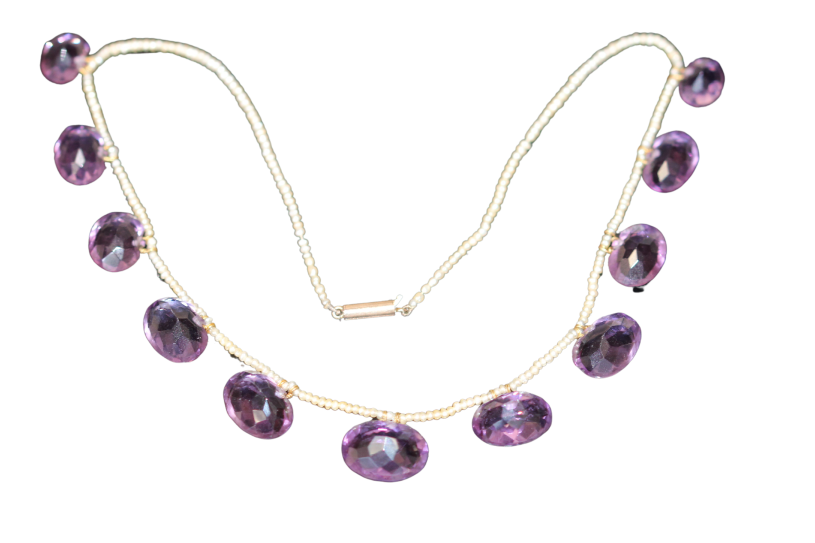
In my previous two posts, I focused on box clasps and whether or not they can be used to date a piece of jewellery, specifically antique jewellery, but there are other necklace and bracelet clasps that were used on antique pieces. Two key clasps introduced in the 19th century are the spring ring (or bolt ring) clasp and the tube clasp.
We know that the bolt ring clasp was invented in the 1840s . This was a round detachable clasp, designed to wear with silver and gold collars or chains. A piece of the ring is hinged and can be pushed in so that rings on each end of the collar can be pushed inside the ring. The hinge then snaps back and the collar is joined. It then developed into the spring ring clasp, a round ring which contains a tiny spring operated by a small lever or knob. You draw back the lever, opening the ring, insert the end of the collar and often a locket, then release the small lever. The spring mechanism keeps the clasp closed. It was still a detachable ring at this stage.

Over the next few decades, the small lever or knob turned into a larger thumb knob, easier to push open and shut. It began, too to be joined to one end of the collar, rather than being detachable. The spring ring with an added bale on top came in about the 1900s. This version of the spring ring clasp is widely used today.

We also know that the tube clasp came into use around the mid 19th century. The tube and tongue clasp is a slimmed down version of the barrel and tongue clasp and was used a lot for thin chains and necklets and bracelets, continuing well into the Edwardian period of the 20th century. It consisted of a small hollow tube into which a thin folded tongue was inserted. It is not seen much in vintage and modern necklaces and bracelets as its place was taken by the spring ring, lobster and parrot clasps, as well as some magnetic clasps and fishhook clasps.
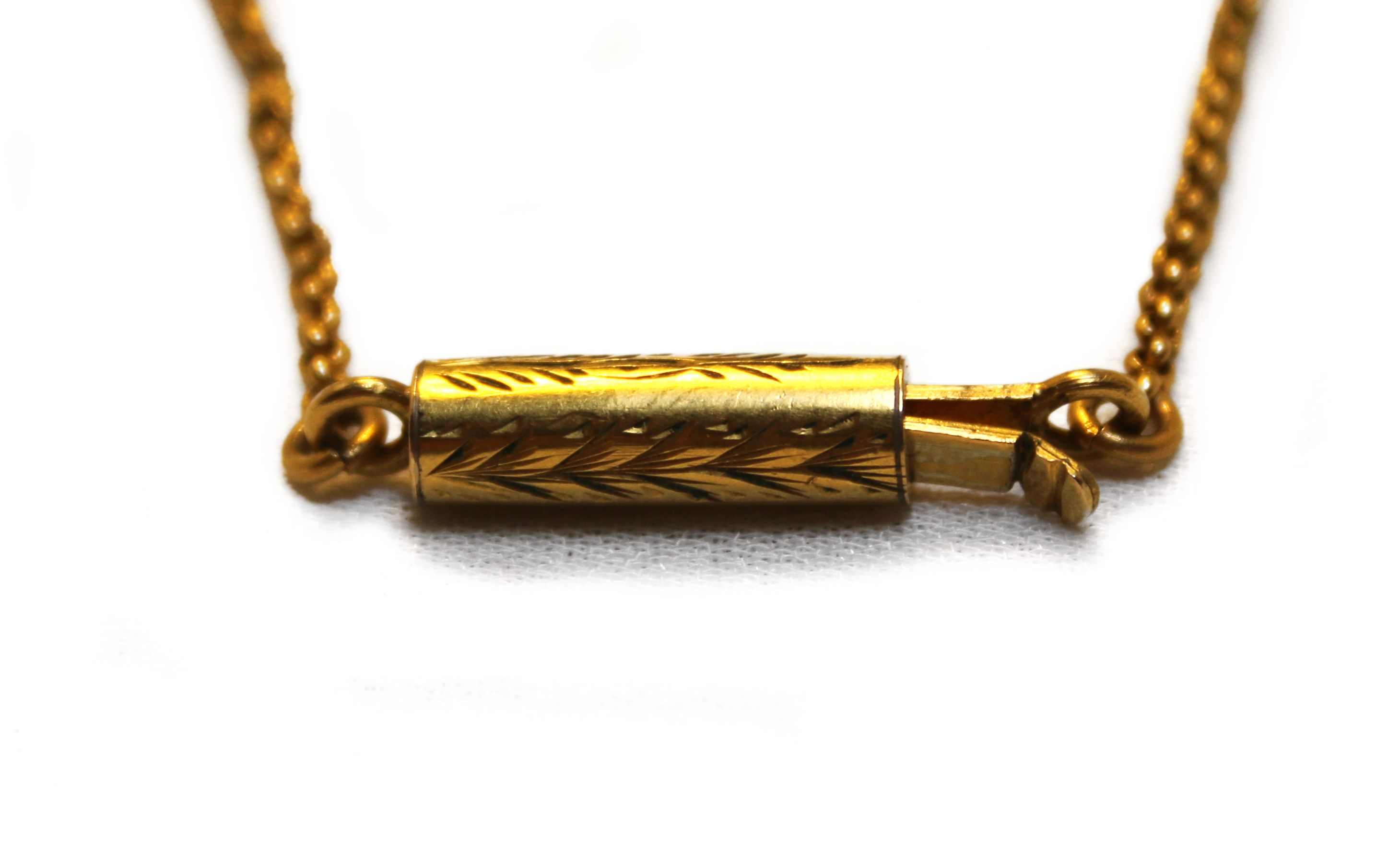
The tubes were usually plain but some were engraved or etched, like the one above.
The 20th century saw a lot of new clasps being patented, like the magnetic clasp, lobster clasp, cage clasp, snap clasp, fold over clasp (like a watch clasp, and W-shaped clasp, and, of course, the spring ring clasp continued to be further developed and refined, pushing the tube clasp out of favour. A necklace or chain with a tube clasp without hallmarks is likely to be antique, as is a necklace with the earlier versions of the spring clasp discussed above. It should be noted, though, that some antique pieces might have replacement modern clasps, often because the piece needed to be extended or to replace a broken original clasp.
 navette jewellery
This is such an interesting and useful series. Thank you
LikeLike
So pleased to hear this, Margaret
LikeLiked by 1 person
I have a sterling silver thin chain necklace with the tube clasp with D & C makers marks, I believe it is Daggett & Clap Co dating from 1896, c.1915. So I am guessing it is antique.
LikeLike
Hi Carol, that sounds right, Margaret
LikeLike
Good Morning Margaret! I was wondering if you have anything written about Camphor Glass? I have a piece that is set in sterling silver and signed H between two triangles. I don’t think it is a Helgen Mfg. Co because their logo is a H but the triangle s are one above the H and one below and the one I have the triangles are located on the sides. I wanted to date the piece.
LikeLike
Hi Carol,
Can you send me a photo of the maker’s mark? Margaret
LikeLike
I should be sleeping but I just found your site and can’t stop reading. Thanks for all your sharing!
LikeLike
Hi Holly, I’m so pleased you are finding the site useful, Margaret
LikeLike
i have a tube clasp necklace with an engraving. I cannot seem to find anything at all on it.More than ok with sending you a photo of the marking as I’m desperately trying to see if it has significance to when it was made and where
LikeLike
Hi Christina, happy to see if I can help. Send me some photos at margaret.a.jackson@bigpond.com, Margaret
LikeLike