
Imitation gold metal, an alloy of copper and zinc, was invented in around 1720 by Christopher Pinchbeck, described as a ‘clock, watchmaker and toyman’. In Georgian England, a ‘toyman’ was a person who sold luxury trinkets, like snuffboxes, watches, chatelaines and etuis, buckles, hair combs, cane heads, coat buttons, clasps and so on. Pinchbeck was durable, long lasting and didn’t tarnish. Pinchbeck meant that people with social aspirations who couldn’t afford gold jewellery could buy pieces that looked like the real thing. Pinchbeck jewellery continued to be produced into the 19th century until the 1840s when electroplating of gold became available commercially. Then in 1854, legislation was enacted to allow for low carat gold such as 9ct to be used in jewellery and pinchbeck lost its appeal.

Wars during the Georgian period led to shortages of precious metals and gemstones so jewellers and goldsmiths were unable to make the ornate and heavy jewellery of the early Georgian period. These shortages lead them to create the light but intricate Georgian gold chains and necklaces so typical of the period. Another type of jewellery technique that developed as a result of metal shortages was cannetille work. Cannetille work involves the use of thin wires of metal, usually gold, which is coiled into various shapes like rosettes, beehives, pyramids, and scrolls, sometimes welded onto thin plates. The work was time consuming and mostly all hand made.

Later in the Georgian period, as a result of the Napoleonic Wars, jewellers produced wafer thin pieces of jewellery, often decorated with enamel rather than gemstones. The bottom sections of the earrings below are only about 1.5 mm thick with only slight indentations to allow for the enamel decorations.

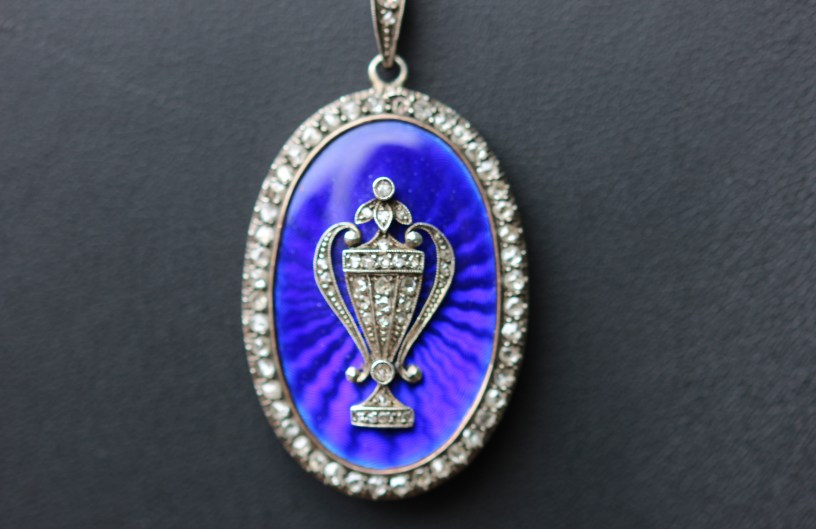
Enamel could be used to good effect as is the case with the lovely Georgian pendant in the photo at the top of the post. It has a rich blue enamel layered over a guilloche silver base. Guilloche work was a form of engine turning where a special lathe was used to produce a swirled pattern on metal with a translucent enamel placed on top. A diamond set lidded urn was attached to the front of the pendant with a border set with diamonds around the whole piece. This is an elegant piece, typical of the beginning of the 19th century.
 navette jewellery
That mesh bracelet is fantastic
LikeLike
Isn’t it! So much work.
LikeLike