

Johannes Vermeer was a Dutch painter who lived from 1632 to 1675. His paintings were of interior house settings, mostly featuring one of two of the rooms in his house in Delft, and focused on middle class people, mainly women. One of his most well-known paintings is titled ‘Girl with a Pearl Earring’ (apparently it was originally titled ‘Girl with the Turban’ up until the 1990s). The young girl in the painting is wearing a very large tear drop shaped pearl earring. A number of other paintings by Vermeer feature women wearing large pearl earrings, including Mistress and Maid, Young Woman with a Lute, and A Lady Writing.
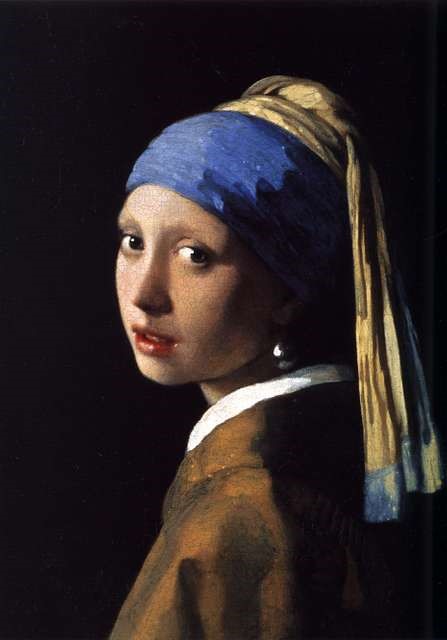
The painting, along with other Vermeer works, is housed at the Rijksmuseum in Amsterdam, and an exhibition on Vermeer was held at the museum in 2023. Pieter Roelofs, Head of Painting and Sculpture at Rijksmuseum and co-curator of the Vermeer Exhibition, wrote in the catalogue (see link below) that the pearl worn by the girl in the turban was likely to be a fake pearl as it was extremely large and would have been a very expensive item, out of the scope of the class of people Vermeer was depicting in his paintings.
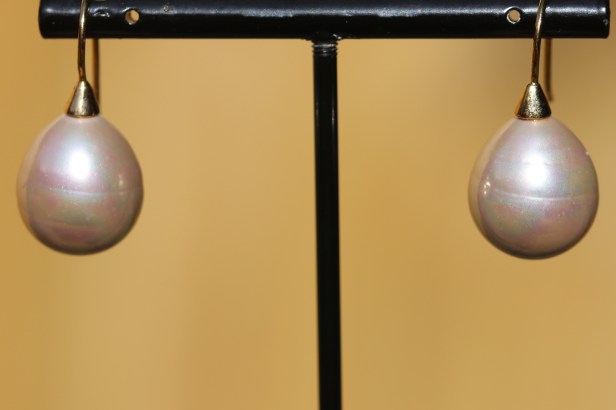
He argued that the pearl was likely to be a fake pearl made in Venice by glass blowers. Recipes for fake pearls have been around for a long time. The Egyptian Stockholm Papyrus, dated around 400AD, has a couple of recipes for imitating pearls. The Romans attempted to create imitation pearls by coating glass beads with silver and then re-coating them with glass or by coating small clay balls with ground mica and baking them (Anna Weller, Big Bead Little Bead, 1). As early as the 13th century, Venetian glassmakers combined egg whites, powered glass and snail slime and then let the beads harden to form pearls while, in Rome, the workshops coated alabaster balls with wax and then an essence created from fish scales (Weller).
Vermeer was interested in the effects on light and the reflection from the ‘pearl’, whether an imitation or just an imaged image, is beautiful and it captures the eye.
References:
Vermeer Catalogue, https://artsandculture.google.com/story/vermeer-a-painter-of-pearls-mauritshuis/LAXh0Fkfg9m6Lg?hl=en
Enking, Molly, ‘Did Vermeer’s “Girl” really have a pearl earring?’, 15 Feb 2023, https://www.smithsonianmag.com/smart-news/did-vermeers-girl-really-have-a-pearl-earring-180981638/#:~:text=Something%20isn’t%20right%20about,rather%20than%20a%20real%20pearl.
Weller, Anne, ‘History of Man Made Faux Pearls’, BIG BEAD LITTLE BEAD, https://www.bigbeadlittlebead.com/guides_and_information/history_of_faux_pearls.php#:~:text=Two%20forms%20of%20faux%20pearls,snail%20slime%20and%20egg%20white.
 navette jewellery
I loved the movie so much. ‘Girl with an imitation pearl earing’ doesn’t have the same ring to it.
Jonathan
LikeLike
I know, it loses some of the magic, doesn’t it?
LikeLike