
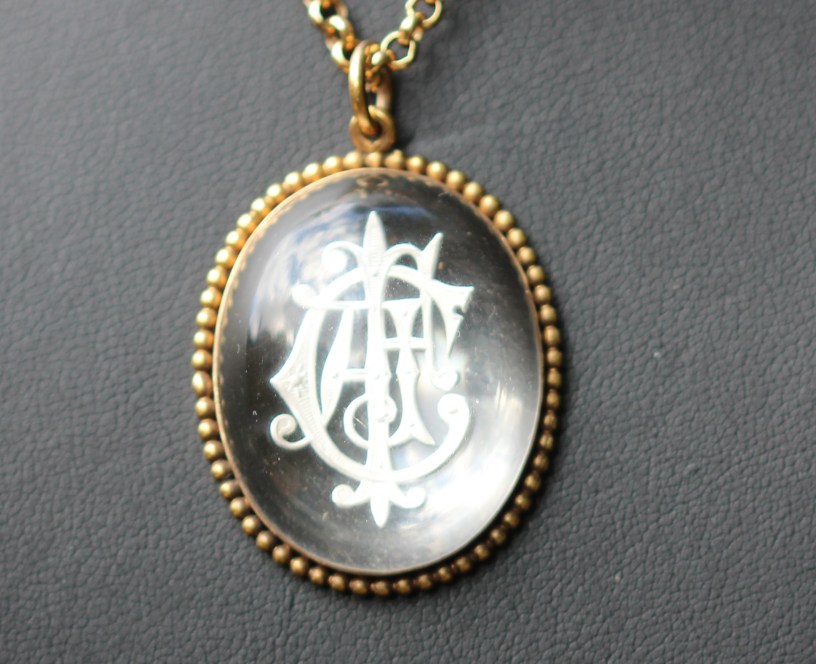
Rock crystal is a member of the quartz family of gemstones, along with amethysts, rose quartz and citrines. It is transparent, colourless and very hard. It has been used as a gemstone for centuries as well as being used to make bowls, vases and other items. In his Natural History books, Pliny the Elder believed that it was ‘hardened by excessively intense freezing’ and ‘that it is a kind of ice is certain’. The name ‘crystal’ comes from the Greek for ‘ice’, ‘krystallos’.
Rock crystal has been used for different types of jewellery, including being facetted to replicate diamonds but I like it when it is left as a clear cabochon. It is particularly known for its use in reverse intaglio crystals where a design is carved into the flat back of the cabochon. The design is then painted to create a three-dimensional effect. This technique was developed around 1860 by a Belgium and was then developed further in England. The pendant in the photo at the top of the post has a white monogram intaglio which appears to float within the crystal.

Another popular way to use rock crystal was to place the flat sides of cabochons together to form a locket. Anything placed inside the locket, like a tiny flower, is magnified. The Georgian locket above comprises two slightly domed rock crystal cabochons placed flat sides together, set within a garnet set gold frame. A tiny hinge is located on one side of the locket at the back.
The late 19th century locket below also comprises two slightly domed cabochons place back to back. They are set within a 15ct gold frame decorated with enamel painted leaves and split pearls. The locket is hinged at the side.

The final piece, below, is a ‘pool of light’ locket, named because of the way the light reflects through the gems. Sometimes the light passing through results in the crystals glowing almost white. The lockets comprise domed cabochons which, when placed flat sides together, form a ball. They were most popular in the Edwardian period, from 1900 to 1914.

 navette jewellery
I used to love seeing such a pendant as a child in my grandmother’s house. However, I thought it was glass then(which was fascinating by itself). Thanks for the information. Its a pity that I do not know where it is now.
LikeLiked by 1 person
I know, many pieces were not kept.
LikeLiked by 1 person