

Gold is a heavy metal, very malleable, able to be turned into thin threads, and resistant to most corrosive elements. It doesn’t tarnish like silver and it doesn’t cause skin irritation. However, it is a soft metal and needs to mixed with other metals like silver or copper so it can be worked for jewellery or coins, although such alloys can appear naturally. These alloys result in different shades of gold, the most common being yellow gold, green gold, rose gold and white gold.
Yellow gold is the colour of gold most commonly used for jewellery but is still an alloy of gold, silver, copper, and zinc. The proportions differ depending on the carat weight of the gold.

When gold is mined, it is rarely found in a pure state, that is, it is often found with other metals like silver. Gold with silver is called electrum. Pliny the Elder wrote about electrum in his Natural History of Metals, Book 23:
In all gold ore there is some silver, in varying proportions; a tenth part in some instances, an eighth in others. In one mine, and that only, the one known as the mine of Albucrara, in Gallæcia, the proportion of silver is but one thirty-sixth: hence it is that the ore of this mine is so much more valuable than that of others. Whenever the proportion of silver is one-fifth, the ore is known also by the name of “electrum”… An artificial electrum, too, is made, by mixing silver with gold. (https://www.perseus.tufts.edu/hopper/text?doc=Perseus%3Atext%3A1999.02.0137%3Abook%3D33%3Achapter%3D23)
The colour of electrum ranges from a pale to bright yellow, depending on the proportions of gold and silver. It is usually found with trace amounts of copper and other metals which can affect the colour. Electrum was used for coins dating from the 7th century BC and was used for decorative purposes by the ancient Eygptians. It has been described as green gold although it was more of a soft yellow colour.
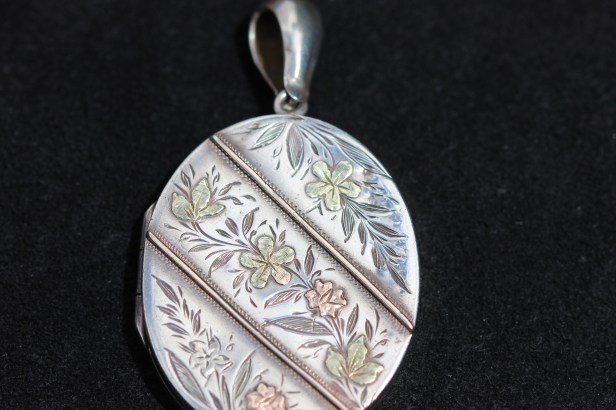
Green gold became popular again during the Victorian era, particularly in the latter part of the century, as it provided a lovely contrast to yellow and rose gold and to silver. The silver locket above, from the Aesthetic period which was in turn influenced by Japonesque arts, is a good example of green gold (and rose gold) being used to decorate a piece.
At that time, it was created by adding silver and cadmium. As cadmium produces toxic fumes when being melted, production of green gold began to cease https://www.kalmarantiques.com.au/articles/an-article-on-green-gold/. Nickel was also added at one time (and may still be) but that also has health issues. Today, green gold appears to be produced just with adding silver or with silver, zinc and copper, for example, look at https://www.carreracasting.com/services/casting-service/green-golds.
Next post, I will discuss rose gold and white gold.


Thanks for the interesting information.
LikeLiked by 1 person
Thanks for reading.
LikeLiked by 1 person