
Living in Australia, the majority of the antique jewellery that can be found here is still predominantly English-made, with a tiny proportion being Australian made. But it is possible to obtain some antique jewellery from Europe, particularly France, and in this post, I am concentrating on French pieces.
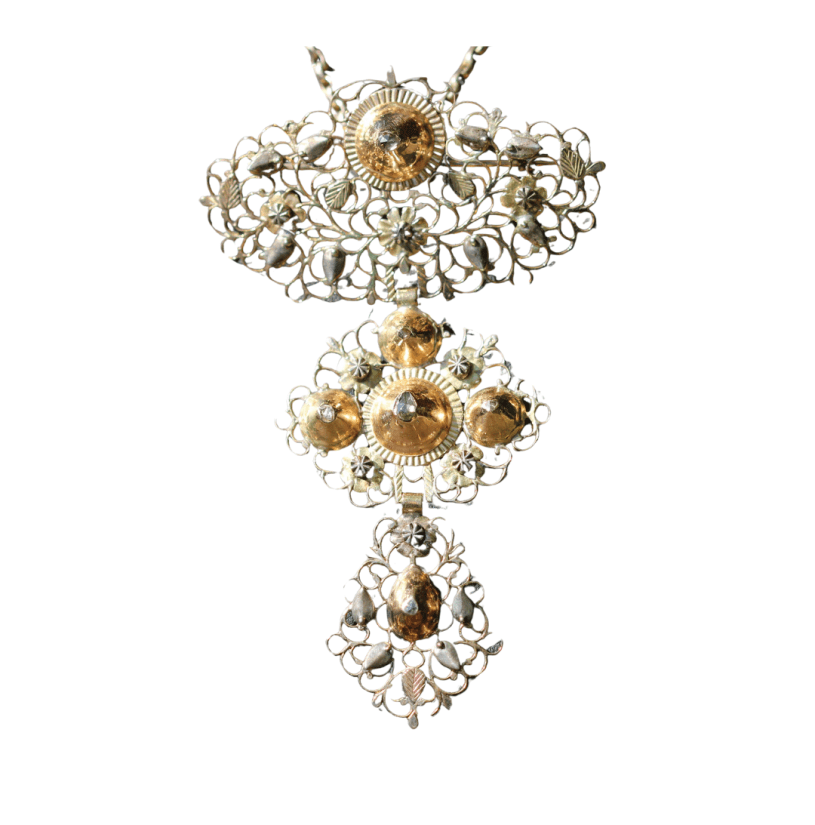
Religion played a big part in traditional jewellery made in the Iberian Peninsula, Italy, France and many other parts of Europe. Crosses were an essential part of daily wear. Different regions had different crosses, some very simple, others very ornate and intricate. The cross at the top of this post is a very ornate one. Intended to be worn through a threaded velvet choker, it is a Papillon or Flemish cross, comprised of three articulated segments in delicate gold and silver, set with small diamonds. It comes from the north of France. It is comprised of three parts, all articulated, two sections forming the cross plus a top section which is the slide. It is made of silver, gold and small diamonds.
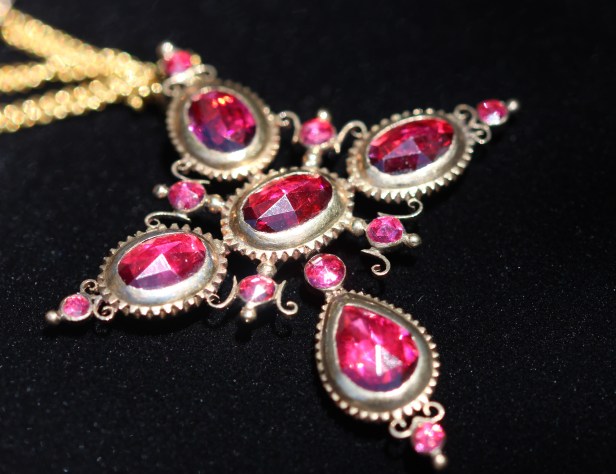
Another beautiful French cross, above, is the ‘croix badine’, a traditional cross from the Languedoc-Roussillon region of France. It is made in rose gold, with foiled bezel-set rose-cut Perpignan garnets, and the bottom section of the cross is hinged.
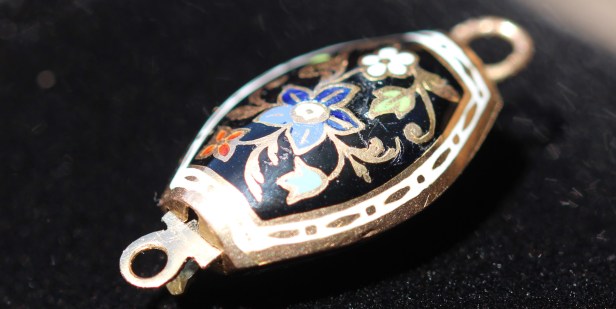
Traditional French jewellery also featured beautiful enamelled clasps, plaques and medaillons. Often quite large (the clasp in the photo below is 3cms long), the clasps could be rectangular, barrel shaped or a cylinder with hexagonal sides. The medallions and plaques were usually rectangular or square. The enamel work mainly depicted flowers, often with sentimental messages, like the pansy (‘penseé’ meaning thought or think of me), or it might depict a dog (for loyalty) or a dove.
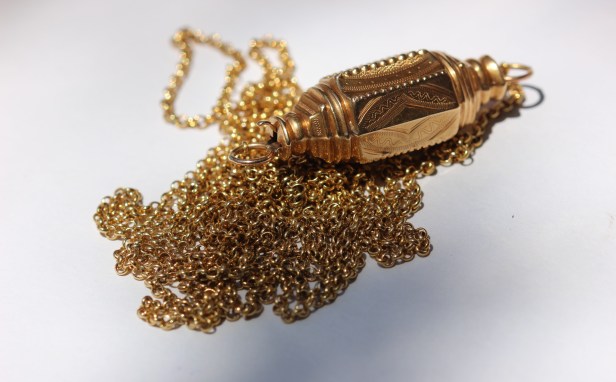
Not all traditional clasps were enamelled. The clasp below is a large early Victorian French 18ct gold hexagonal or cylindrical clasp, with delicate geometric engraving all over. It is almost six cms long and comes from the north of France. They were attached to long chains, called ‘sorcière’ chains, according to Michael Feiggen (see reference book below) which could be between 120cm and 150cms in length.
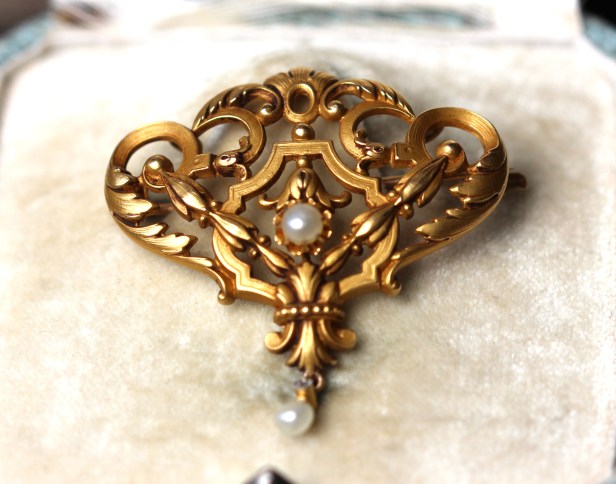
Of course, not all antique French jewellery is traditional, as France has had a long history of jewellery design and dominance in the industry, particularly from the 18th century onwards. I will finish today’s post with a lovely gold brooch/pendant from the Belle Epoque period set with natural pearls and a small rose cut diamond.
Reference:
Michael Fieggen, ‘Traditional French Jewellery’, 2021
 navette jewellery
Exceptionally gorgeous examples
LikeLike
Thank you
LikeLiked by 1 person