
Women and men have been wearing long chains for a long time. Long chains have been excavated from Ancient Egyptian tombs and from numerous hoards. Romans commonly wore chains around their necks or across their bodies, with or with pendants, and long ornate chains were worn by the wealthy during the medieval and Renaissance eras. Some chains were hung with pendants and miniatures. Men tended to wear heavier long chains than women during the 17th and 18th centuries.
Long light chains became popular in the 18th century. They were either a chain with a clasp or a continuous loop, lacking a clasp. Long thin chains with clasps were frequently traditional regional chains, with the chain wrapped several times around the throat with an ornate clasp meant to be worn at the front of the neck. These chains were adopted by those from cities as a result of tourism and international exhibitions.
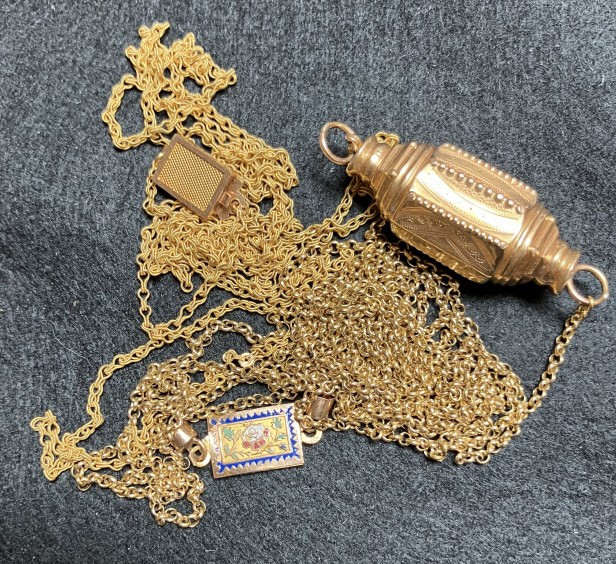
The second type of chain, the continuous chain, would usually have a dog clip or split ring to enable a watch, fob or lorgnette to be attached. Initially chains worn by women were draped over the shoulders and caught at the waist with a watch hook or tucked under a belt or in a watch pocket. They were used to carry watches as well as lorgnettes or vinaigrettes, and were described as ‘guard chains’.
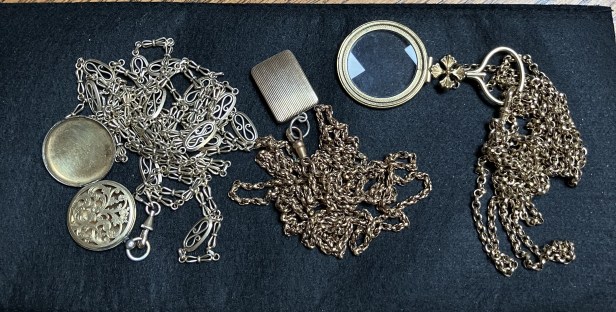
Women continued to wear long chains well into the Victorian period but the chains had become thinner and they were worn around the neck. Depending on their use, such chains were still called ‘watch chains’, but also ‘lorgnette chains’, ‘longuard chains or ‘muff chains’. Some had a swivel attachment and some had a slide to allow the drape of the chain to be adjusted.
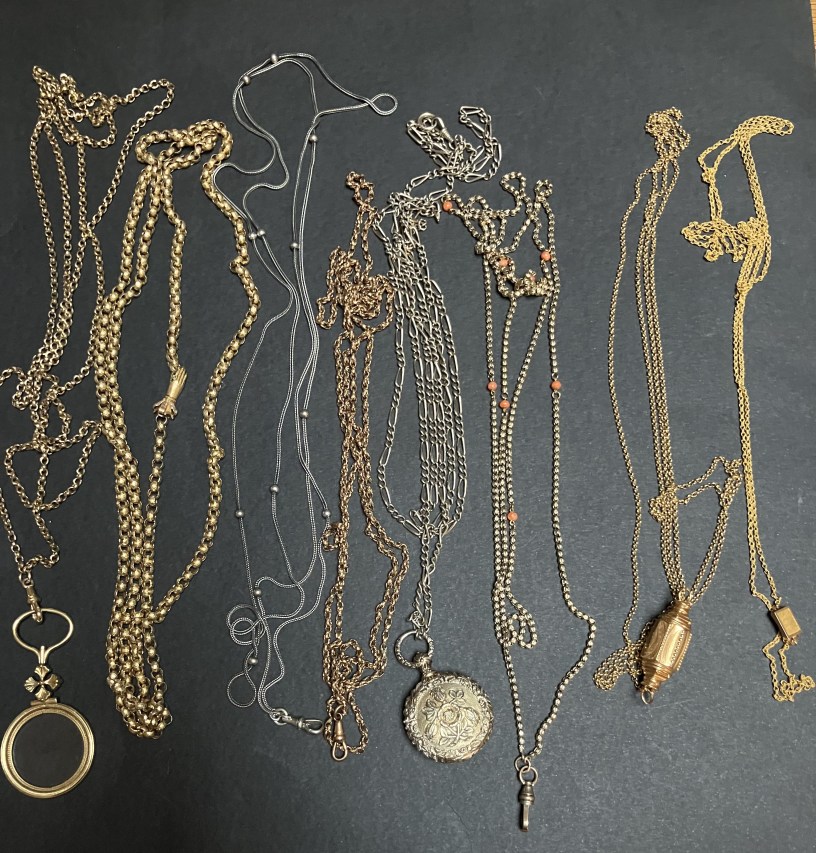
As you can see from the photo at the top of the post, long chains came in different forms. Apart from their length, generally around 150cms, there was no expectation for them to be comprised of a particular link. They also came in different metals. They could be silver, gold over silver, pinchbeck, and gold of different carats.
References:
S Bury, ‘ Jewellery: Volume 1: 1789-1861’, 1991, Antique Collectors Club
G Cummins, ‘How the Watch was Worn’, 2010, Antique Collectors Club
M Fieggen, ‘Traditional French Jewellery’, 2021
 navette jewellery
I’m seeing guard chains make a comeback, Margaret. People are wearing them with their phone attached, to guard against thieves on scooters who snatch their phones out of their hands.
None as pretty as these though.
LikeLike
I think its going back to when the chains were used to hold your fur muff safe and ready for use, as the muffs were pretty heavy. It is good to see new ways re-inventing old ways, Margaret
LikeLike