

A blog reader asked me recently when did counterfeiting jewelry first start? I thought that was an interesting question and worthwhile exploring in more detail. First, what is a counterfeit? A counterfeit is something ‘made in imitation of something else with intent to deceive’ https://www.merriam-webster.com/dictionary/counterfeit. The Chambers Dictionary describes a counterfeit as something false or copied or that pretends to be true and original. So a counterfeit is a deliberate attempt to deceive someone and not just producing a piece of jewellery which may be similar to an existing antique piece. An example of this is some jewellery I noticed recently on the internet. The pieces, which are made in India, look like exact replicas of mid-Victorian turquoise-set gold snake necklaces. However, the sellers are not claiming that the pieces are Victorian jewellery. They are also silver plated, which the originals are not, and the prices are a lot less than the antique originals. So these pieces are not counterfeits per se.
What would happen, though, if someone purchased one of these Indian necklaces and then tried to sell it as an original antique? That is misrepresentation or fraud and might become counterfeiting, depending on the circumstances. Another word that is used as a synonym of a counterfeit is ‘fake’. A fake can be something that is not a genuine item and can be a counterfeit if there is an intent to deceive a person.
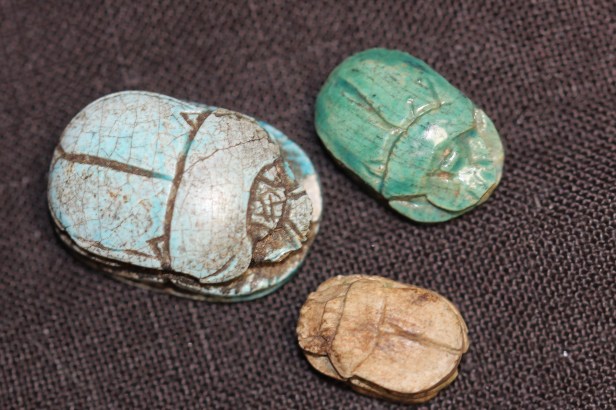
Counterfeiting, fakes and misrepresentation are not new problems and have been around for centuries. There are instances in ancient history where fake or imitation gems have been found in items of jewellery contained in burial sites but it is not clear why they were imitations. One example often used is that of faience, a ceramic blue material with a glaze of a material which was used by the Egyptians to duplicate prized turquoise. The central scarab in the photo above is an example of faience, though quite worn.
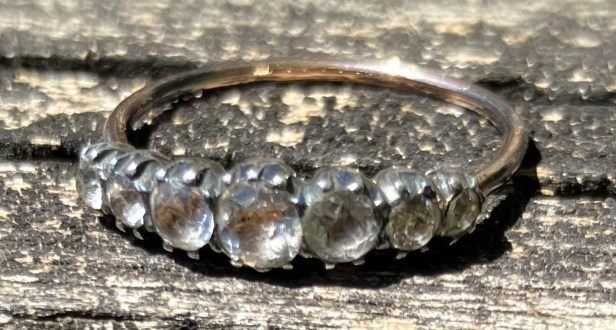
There was certainly plenty of information around to help produce gemstone fakes in antiquity. An Egyptian manuscript from 400AD, the Egyptian Stockholm Papyrus, contained recipes and methods for treating gemstones to improve the colour of stones and dyeing stones, usually rock crystal and quartz, to resemble more expensive gems. Pliny the Elder in 77AD discussed the issue of fake gemstones, warning that rock crystal could be dyed to imitate emeralds and other coloured gemstones, and that glass imitations were becoming common. What is not necessarily known about these fake gemstones is whether they were created and produced with the intention of misleading and deceiving a purchaser or not. Were they instead early versions of costume jewellery in which relatively inexpensive glass gems was used to reduce the cost of pieces for those who couldn’t afford the genuine stone? The use of paste to imitate diamonds is a good example here as seen in the Georgian paste half hoop ring below.
I will discuss a few ways in which gems have been legally protected by jewellers in my next post. And if you are wondering about the relevance of the photo of the Victorian earrings at the top of the post, they are a type of fake. They appear to be onyx earrings with the white layer of the stone carved away from the black layer to create the cameo. However, the cameo is separate and glued on, which I only discovered when one of the cameos fell off the earring and had to be re-glued. They still look good but they are not quite what they purport to be.
 navette jewellery
Thanks, Margaret.
I thought that you might be interested in the work of Robert Baines. He was a jeweller at RMIT who was very skilled in his own right. He was also very skilled at spotting fake antique jewellery (generally because the techniques weren’t right). He told me at one point that there were galleries and museums where he wasn’t welcome because he had caused trouble by calling out some of their treasures.
He played with this in his exhibition: Fake News and True Love.
He wrote his PhD on this topic.
Baines, R. (2005). Reconstruction of historical jewellery and its relevance as contemporary artefact (Doctoral dissertation, RMIT University).
Abstract: The dating of ancient jewellery is given by the archaeological context. Technology applied by the ancient goldsmith is traceable through archaeometallurgy. The aim of this research is to analyse historical jewellery and to construct copies based on the known technology of the era. Resultant laboratory constructions with their historical correctness and the new knowledge of jewellery structures will then be available for reworking to convey a contemporary visual relevance and a statement of history. The results of these analyses and reconstructions will form the basis of metalwork objects in which contemporary aesthetics are informed by historical practice.
His thesis hasn’t been digitised. It is available at RMIT Special Collections: THR 739.27 B162.
LikeLike
Thanks Jonathan, I’ll track it down. It’s such an interesting area, Margaret
LikeLike