

There have been a number of occasions when jewellery from an earlier era is revived and re-invented. Most of these times occurred in the late 18th century and throughout the 19th century as it was during this time that collections of earlier jewellery began to be gathered by museums and by private collectors, and public displays of such collections took place. In England, the Great Exhibition of the Works of Industry of all Nations in 1851, the London International Exhibition of 1862 and the Paris Universal Exhibition 1867 all led to public exposure of jewellery from different cultures
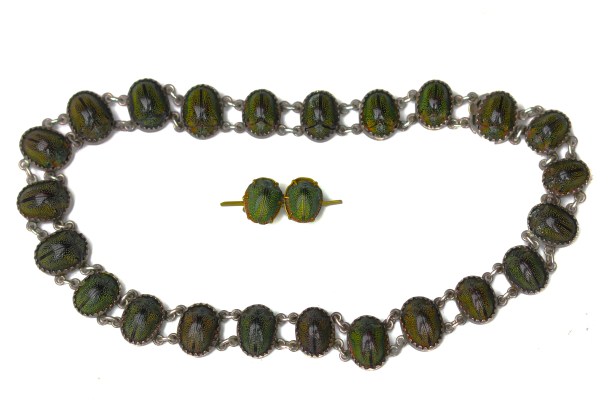
The excavations in Egypt by Europeans which first began with Napoleon’s invasion of Egypt in 1798 in was to lead to discoveries of jewellery, amongst other treasures. One particular Egyptian motif which caught the attention of Victorian was the scarab beetle, and many versions of jewellery containing actual beetles were produced. Dried iridescent green beetles were imported from South America from around 1869 onwards and were incorporated into imitations of ancient Egyptian amulets and pendants containing scarabs. Using real beetles also satisfied the Victorians’ interest in natural history.
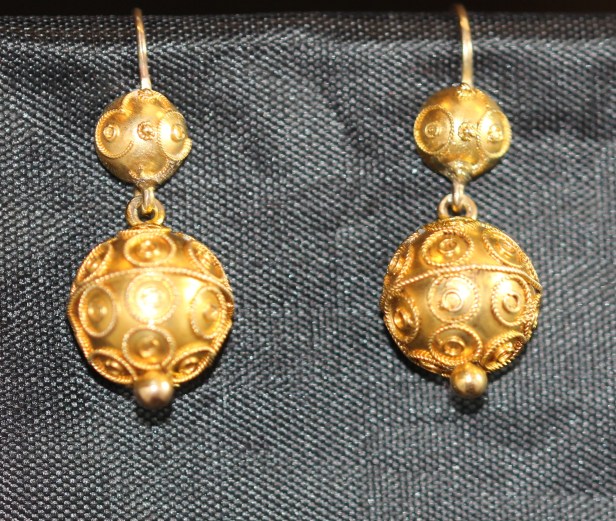
Then there were the excavations of Etruscan graves in the 19th century. The Etruscans lived on the western coast of Italy, now Tuscany, from approximately 700 – 300 BC. Their culture was based largely on the Greek culture but they in turn influenced the Romans who eventually defeated them in the 4th and 3rd centuries BC. During the Early Etruscan Period (7th century BC to the 5th century BC), they developed their own unique metal working techniques, which included granulation, tiny gold beads, and thin twisted wires densely applied to the surface. Wealthy Etruscans were buried in massive tombs, some entirely underground, accompanied by their jewellery and other possessions. While some grave excavations occurred during the Renaissance and in the eighteenth century, it was in the mid nineteenth century that major archaeological sites were established in Tarquinia, Cerveteri, and Vulci.
The gold jewellery found in Etruscan tombs used metalworking techniques that were not currently used by goldsmiths. Fortunato Pio Castellani, a Roman jeweller, and his sons, began to study the jewellery and to re-create the techniques. The family remained the leaders in high quality Archaeological-style jewels from the 1860s until the 1930s when the last member died. Due to its popularity, other Italian jewellers began to produce Etruscan-style jewelry as did jewellers in the UK like Phillips, Streeter and Brogden.
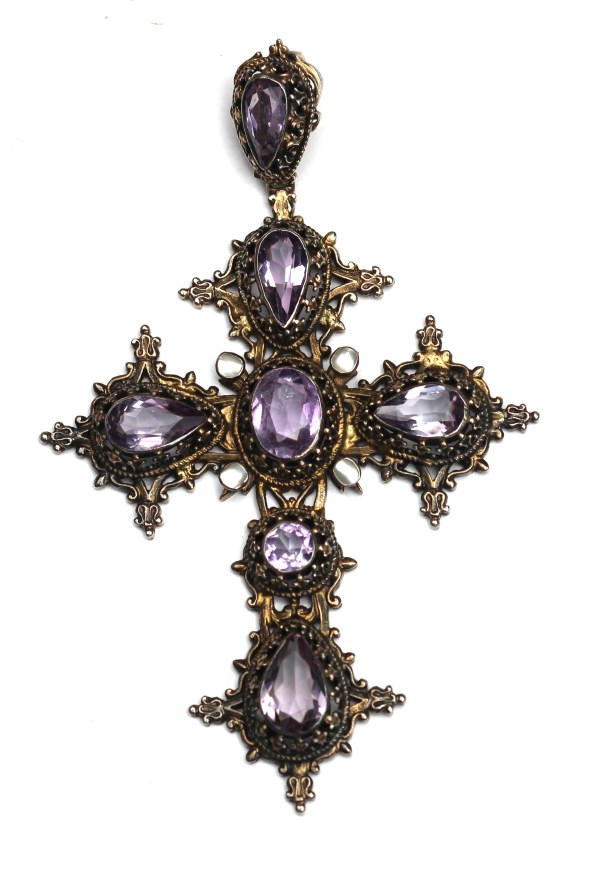
Another 19th century jewellery revival was the Gothic revival, in which jewellers were inspired by Gothic architecture, with its pointed arches, ribbed vaults, and flying buttresses, as well as excessive ornamentation. Crosses and religious motifs were also featured. This large amethyst cross is a good example.
The mid 18th century saw the introduction of the Renaissance revival style, with its emphasis on large pendants covered with enamel, often white enamel decorated with black dots, coloured gemstones and /or paste, and pearls set in gold, silver or silver gilt. Some of these pieces are hallmarked, many are not. The quality can vary a lot. This style of jewellery was popular across Europe but was especially associated with Austro-Hungary and Germany. The pendant at the top of the post, showing a horseman, is an simple example of an Austro-Hungarian enamel piece.
 navette jewellery