
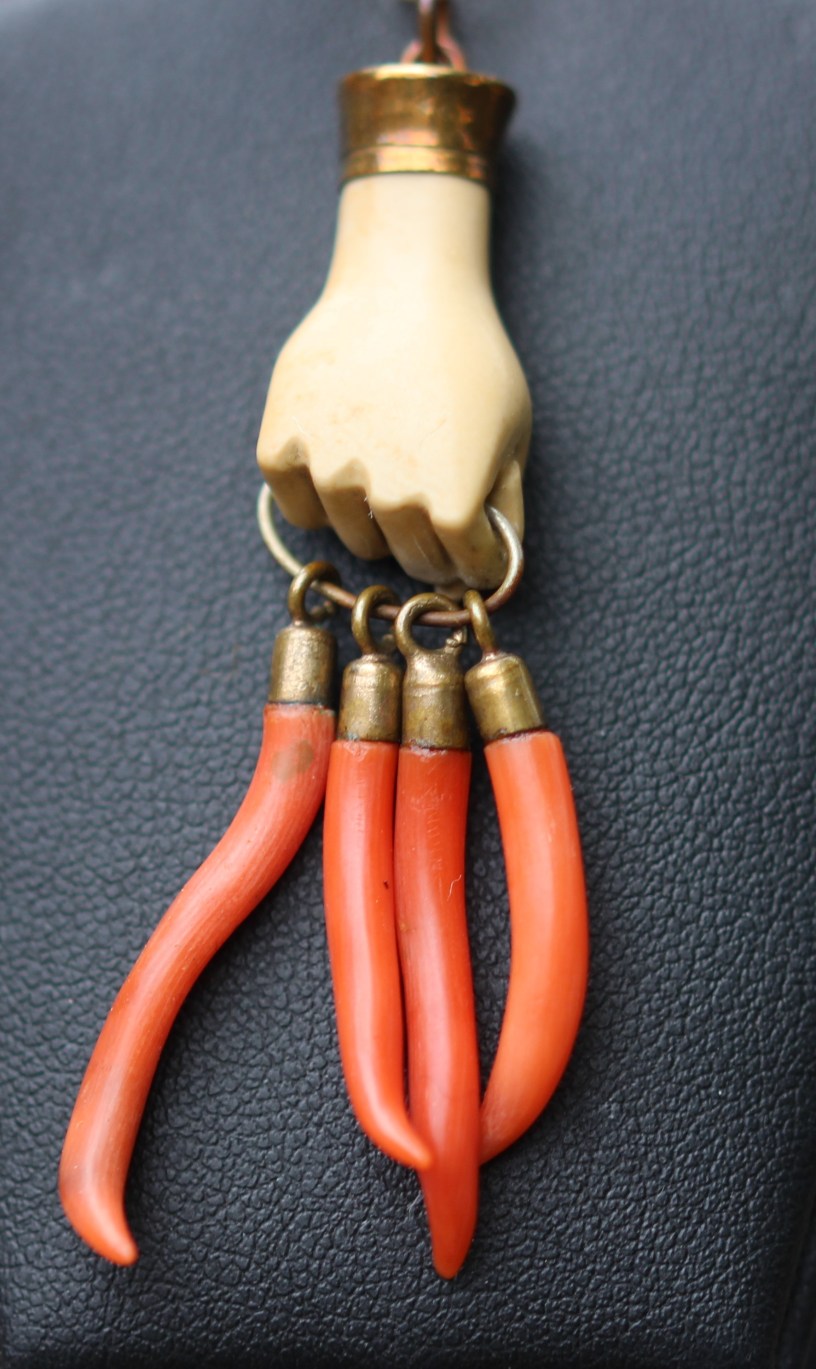
Clasped hands and single hands are a motif seen in antique jewellery over a very long time. The motif of hands has been used in jewellery for a long time. Jewellery with hands has been found from the Phoenic1an, Egyptian, Roman and the early Celtic periods and they were found again in the late Middle Ages and Renaissance and into the Georgian and Victorian eras.
The most common example of clasped hands in jewellery is that of a ring and they are usually associated with romance and friendship. They are called ‘Fede’ rings, for faith, trust, etc, based on the Italian mani in fede (hands in trust). They have two clasped hands and were associated with ‘handfasting’ or engagements leading to marriage, as well as commercial agreements. Between the 17th and 19th centuries in France, a traditional engagement ring was the faith ring (or fede ring). The faith ring has a design of either two holding hands (sometimes holding or hiding a heart), or of two joined hearts, generally set below a crown (Fieggen, http://www.bijouxregionaux.fr/en/). They were usually silver.
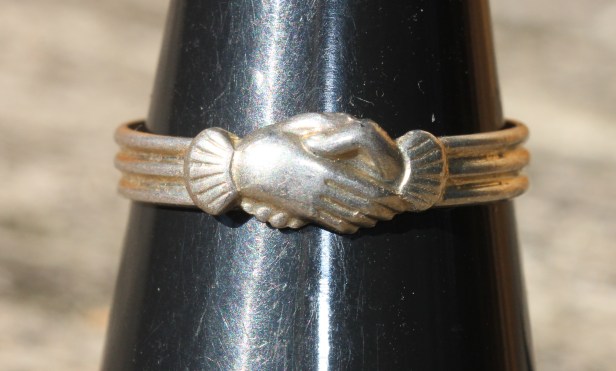
The fede ring evolved in the late Middle Ages and Renaissance into the gimmel ring, with the hands on separate but linked rings which locked together. Gimmel derives from the Latin Gemellus and means ‘twin’. The rings have two and sometimes three separate hoops which join together to form one ring usually with clasped hands, but sometimes including a heart which the hands clasped. As a betrothal ring, the couple could each wear one hoop until they were joined together into one ring at the wedding.. The Claddagh ring, comprising a heart (love) held by two hands (friendship) and topped with a crown (loyalty) was an Irish version of these rings, originating in the 17th century. Their use continued into the 19th century.
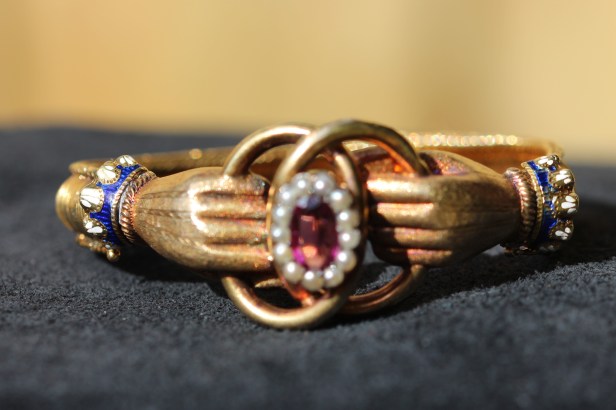
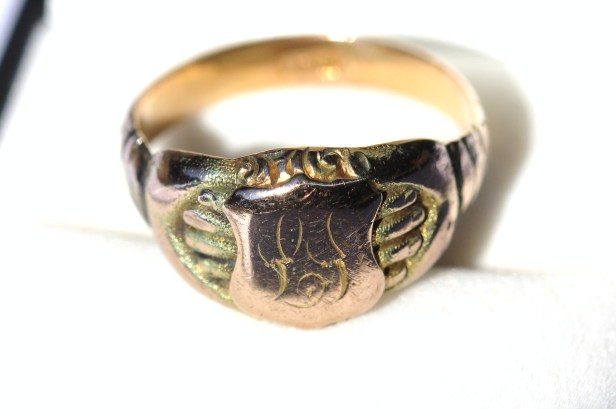
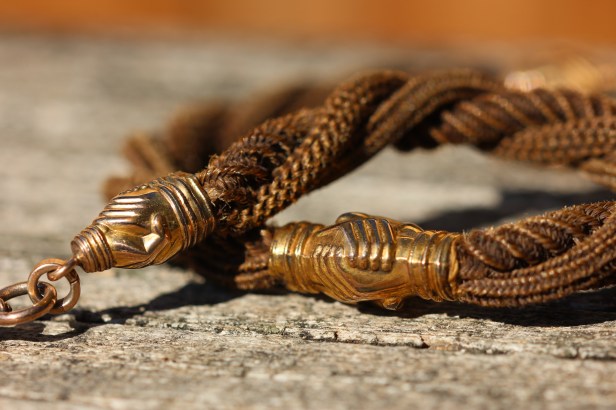
Sometimes, the hands in jewellery could be holding something other than a heart, as seen in the bracelet above and the signet ring below.
Traditionally, single hands were also used as amulets. The hamsa, which is an open hand, palm forward, dates from early Mesopotania, and is a protection against evil. Another version of a hand amulet is the figa, with the thumb of the hand protruding through a clenched fist. It has been held to promote fertility, due to it representing female genitalia, as a gesture of contempt, and as a protection against evil.
Hands as jewellery became very fashionable again in the late Georgian era, used as necklace clasps in the form of hands. There was generally just a single hand, usually gloved and with cuffs, some made of lace, set with gemstones, or with a cuff bangle. The hand might be wearing a ring.
Hand brooches were popular in the Victorian period, some made of Whitby jet and holding a wreath symbolising mourning, others carved in ivory with cuffs, holding flowers, which were probably given as a romantic gift.


Thanks, Margaret. Lovely and informative, as always.
LikeLike
Thanks Jonathan. Hope you are well, Margaret
LikeLike