
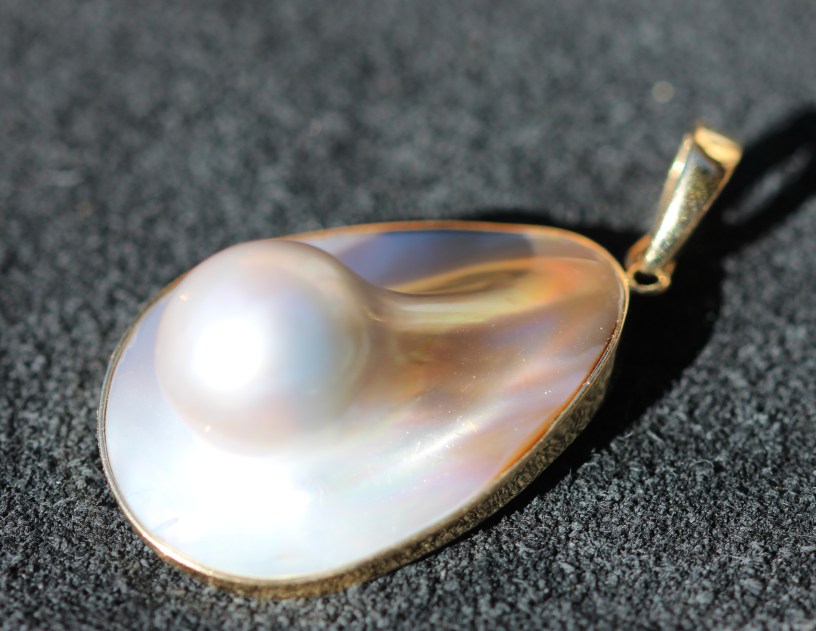
Pearls are one of the three birthstones for June (the other two being moonstones and alexandrites). I am only going to talk about pearls in this post but I am not talking about beautiful smooth rounded pearls but rather misshapen pearls and related nacre growths that still have great beauty.
Pearls are created under water, whether it is salt water or fresh water, and they are created by and within a living creature, although now that creation has a lot of help from humans. Pearls come from the tissue or mantle of saltwater oysters or freshwater mussels which secretes an iridescent material called nacre. This nacre is also called mother of pearl. If an irritant of some sort, such as a parasite, is caught between the mollusc’s shell and its mantle, then the mantle wraps the object in layers of nacre, often resulting in bulges rising out of the nacre, some of which form hemispherical pearls. Nacre that is not a round pearl is still used in jewellery.
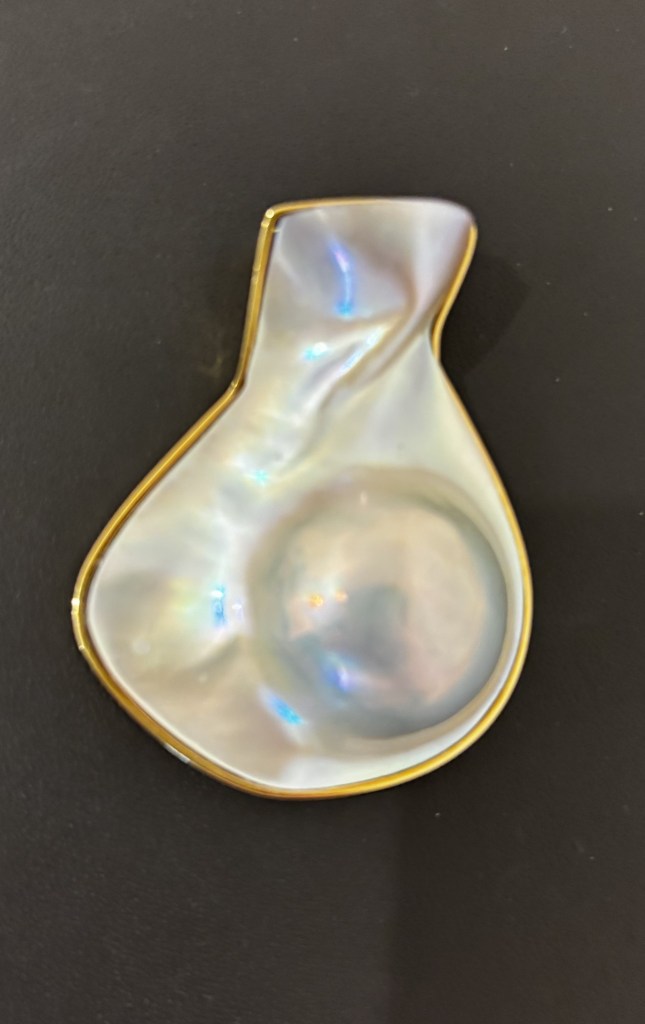
Some pearls form naturally but can fall between the shell and the mantle. The mollusc begins to secrete nacre over the pearl and it becomes attached to the shell (GIA). This becomes a natural blister pearl. Blister pearls are naturally occurring irregular shapes appearing in the shell of the mollusc, often looking like a round pearl trying to grow out of the shell. The pendant in the photo at the top of the post is a blister pearl as is the one above.
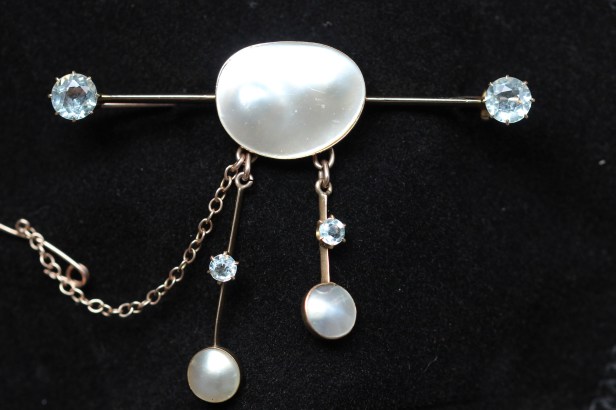
There is another nacre growth which is called a natural shell blister (GIA). Like natural blister pearls, they are comprised of nacre but they are more inclined to show smaller bumps and shallower growths than natural blister pearls. The photo above contains a natural shell blister.
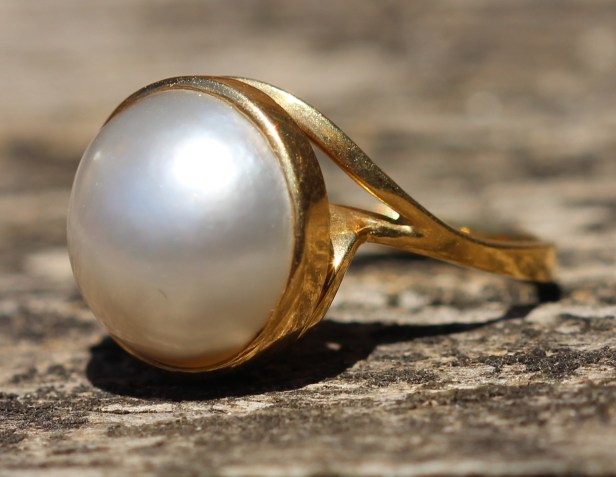
Mabe pearls are cultured blister pearls, usually seen as a half dome of nacre, with a flat back. They became very popular from the 1950s onwards.
Reference:
GIA, ‘Natural Shell Blisters and Blister Pearls: What’s the Difference?’, https://www.gia.edu/gia-news-research/natural-shell-blisters-and-blister-pearls


Wonky pearls are my fave pearls
LikeLike
They are so appealing. I have fallen in love with the blister pearls.
LikeLiked by 1 person