
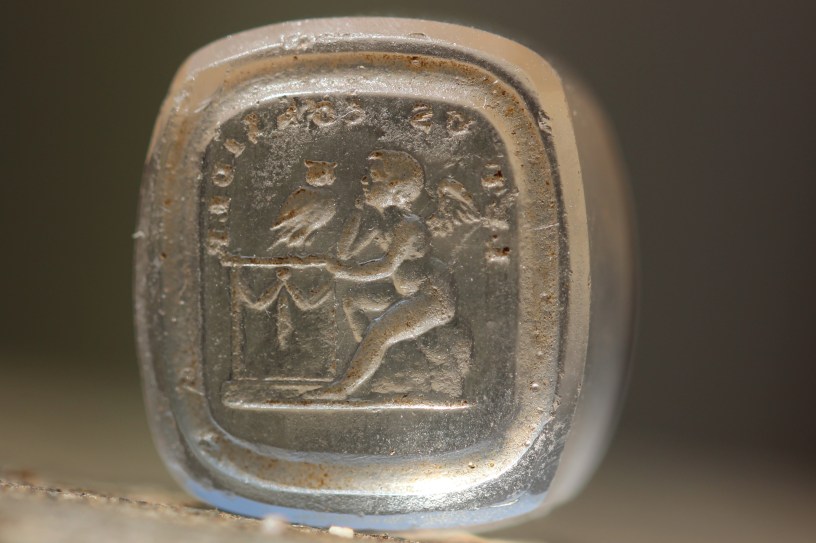
A common image in antique jewellery is that of a chubby naked boy, usually depicted with wings and often seen with a bow and arrows. Some of these figures represent Cupid, while others are cherubs or putti. Let’s start with Cupid. In Greek mythology, he is called Eros, the God of desire, erotic love, and affection, and is the son of Aphrodite (the goddess of love) and Ares (the god of war). In Roman mythology, he is known as Cupid, the son of Venus (goddess of love) and Mars (god of war). For the Greeks, he was originally depicted as a winged naked young man carrying a bow and arrow but from the 4th century BC, he became younger and younger, ending up as a chubby child with wings and bow and arrows. The Romans adopted the image of the child, sweet and a little mischievous, who could cause people to fall in love if hit by his arrows.
The next little boy that can be seen depicted is a putto. Putti are naked little boys who began to be included in classical, renaissance and baroque religious and mythological paintings. They may or may not have wings but don’t have a bow or arrow. They can be seen at the bottom of Raphael’s painting of the Sistine Madonna from 1513–1514. They appear to represent innocence and often have a role as observers.
The last group are cherubs. Cherubim are heavenly creatures that appear in the Old Testament and in other religious texts. They are not described as being plump little boys with wings. Instead, they have four wings and four faces: a human, a lion, an ox, and an eagle. It appears that cherubs evolved as a form of religious putti during the Renaissance, acting as angelic spirits.
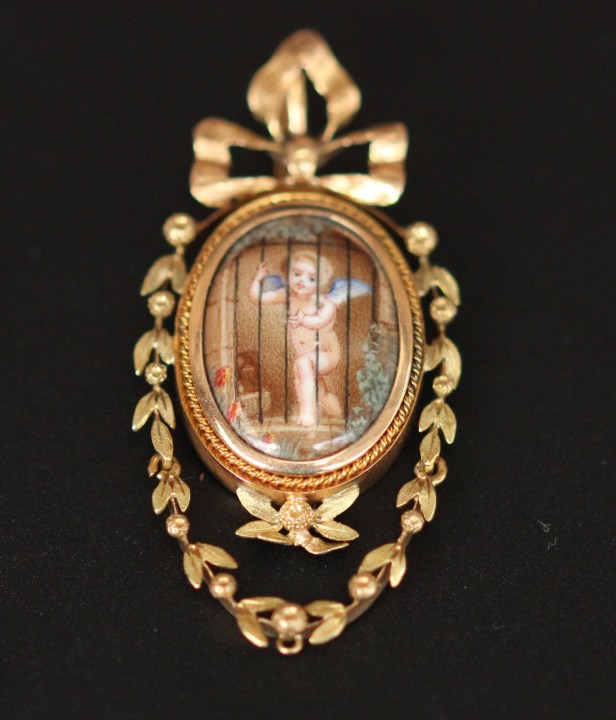
So let’s look at some jewellery and see if it is possible to determine if the little boy depicted on it is Cupid, a putto or a cherub.
The lovely 18ct gold French pendant above shows Cupid imprisoned behind bars and symbolizes love being captured and the imprisonment of the heart. Antique French allegorical jewellery like this, which may be described as ‘Cupid in a Cage’, are most commonly found in the mid-to-late 19th century.
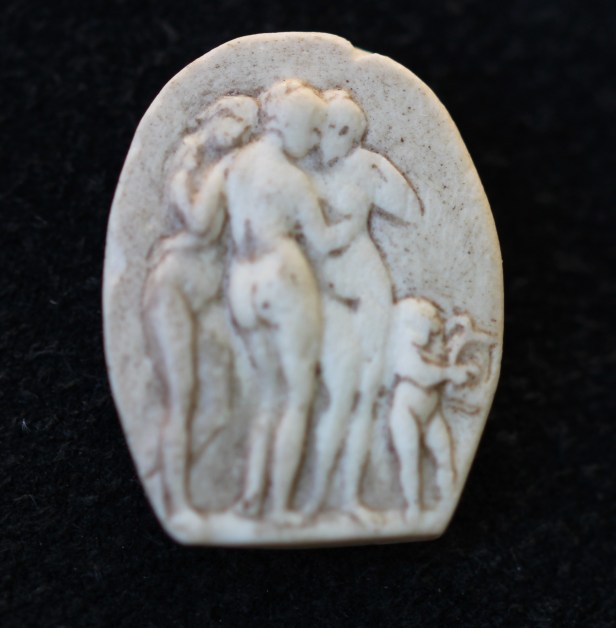
The small carved plaque showing three naked women and a little boy playing a lyre depicts a classical scene showing the three Graces and Cupid. It symbolises beauty, love and modesty. The Graces are the daughters of Jupiter, but they act as servants to the goddess of love, Venus, and Cupid is Venus’ son.
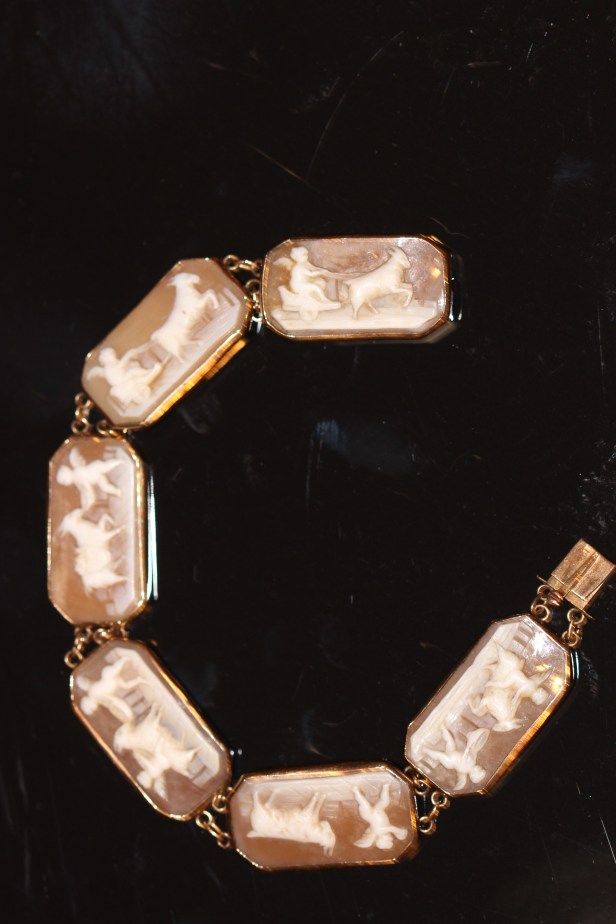
The cameo bracelet above shows a number of scenes of a little boy and a goat, with the goat hitched to a chariot, being fed or groomed. The little boys have wings. I think they are putti. Similar scenes occur in Renaissance paintings and in cameos, and are light-hearted in tone, rather than religious or spiritual.
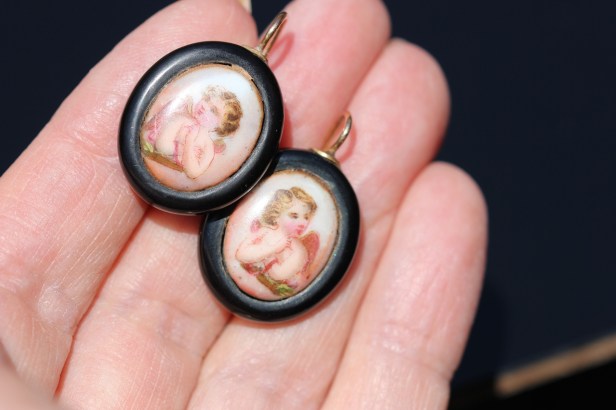
The Whitby jet earrings with the painted enamel plaques depict little boys similar to the putti contained in the Sistine Madonna painting.
The antique glass intaglio in the photo at the top of the post shows a winged boy and an owl. I can’t quite decipher the text around the top but the piece has a classical feel and I think the boy is Cupid. It may be that the owl represents Minerva, the Goddess of wisdom.
There is no doubt there is a clear overlap with the three categories of cupid, cherub and putti, and they do appear often in antique and modern jewellery.

