
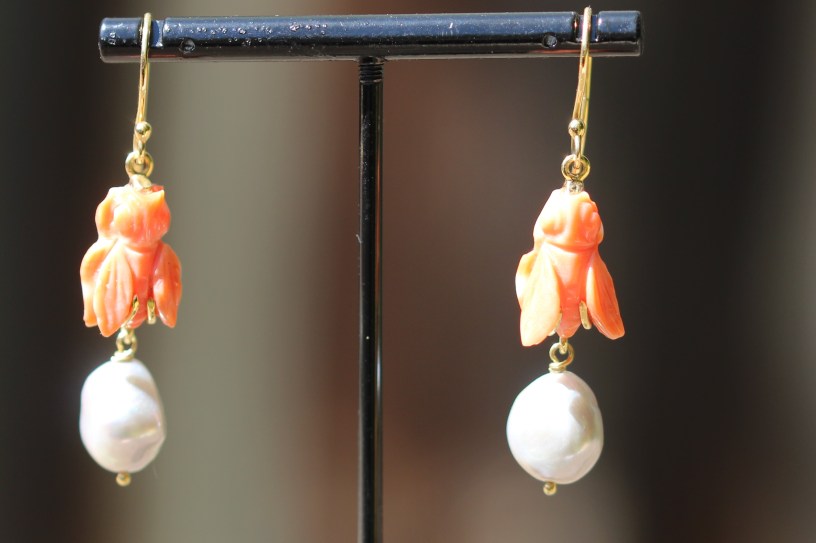
The Gemmological Institute of America (the GIA) has developed seven pearl value factors, one of which deals with shape. There are three main categories of shape – spherical, symmetrical, and asymmetrical. I am going to talk about the latter category first.
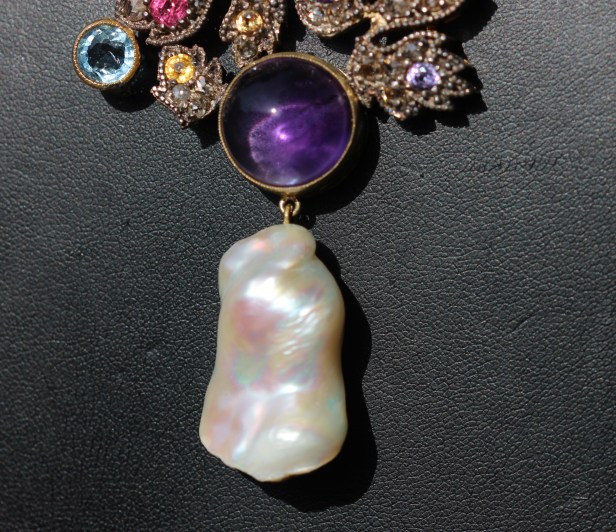
Baroque pearls fall into the category of asymmetrical. They are irregular shaped ones, like the ones in the photo of earrings at the top of the post and in the one below. Sometimes they appear to be shaped as something recognizable, such as an animal or, in the case of the Canning Jewel in the Victoria and Albert Museum in London, as being the torso of a merman (see it at https://collections.vam.ac.uk/item/O33882/the-canning-jewel-jewel-unknown/). Baroque pearls can have a high lustre and a silky surface. They can be natural and cultured.
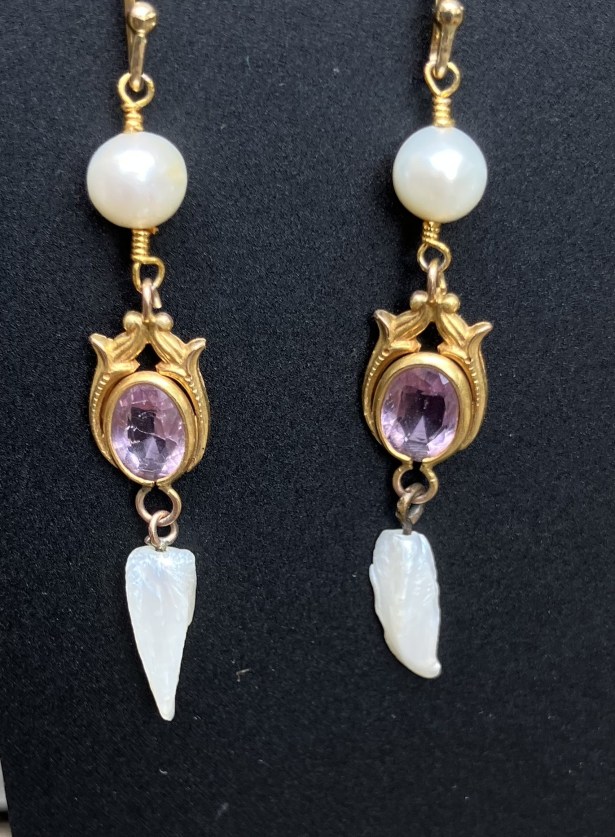
Natural freshwater pearls can be quite irregular shapes. One particular group of baroque pearls are found in the Mississippi River. They are elongated, with a tooth-like appear, often described as a dogtooth pearl. The earrings below have such pearls as well as spherical ones.
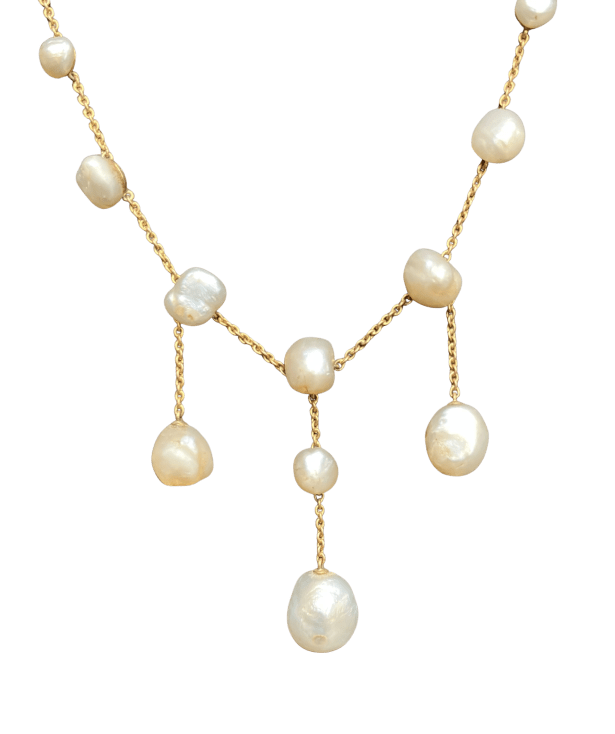
The pearls in the antique Australian necklace below are a mixture of asymmetrical baroque pearls and symmetrical pearls. With symmetrical pearls, if cut in half, each side would be a mirror image of the other.
It is easy to understand why pearls of all shapes and sizes are so appealing to us.

