
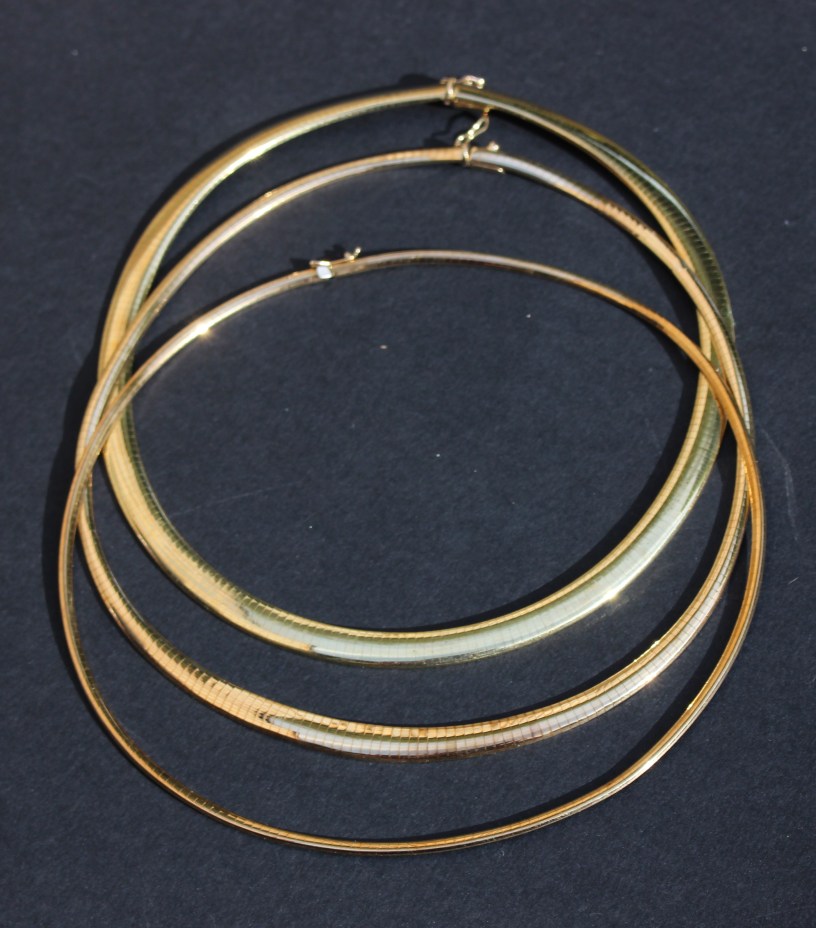
There are a number of different types of necklace chains, usually created by joining individual links together. There are a few that are constructed in different ways, such as the Omega chain. The omega chain is comprised of individual metal plates which are wrapped around a roll of mesh wire or a hollow wire. The metal plates are either hooked around the underlying mesh or pushed together tightly together along the mesh wire, resulting in a smooth surfaced semi rigid necklace. They have shiny surfaces (and are hard to photograph). The necklace holds its shape as a curved collar and doesn’t bend. The chains can’t be bent as they can kink and need to be stored flat.
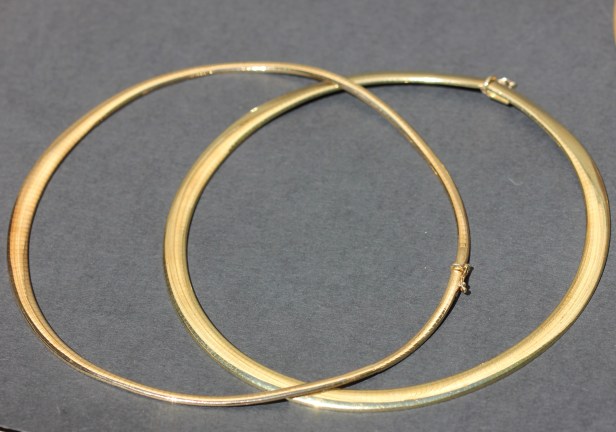
Omega chains can be concave or convex. The concave version is sunken on the back side and are often a little lighter than the convex chain which is rounded on both sides. Some convex chains can be constructed with yellow gold on one side and silver on the other side.
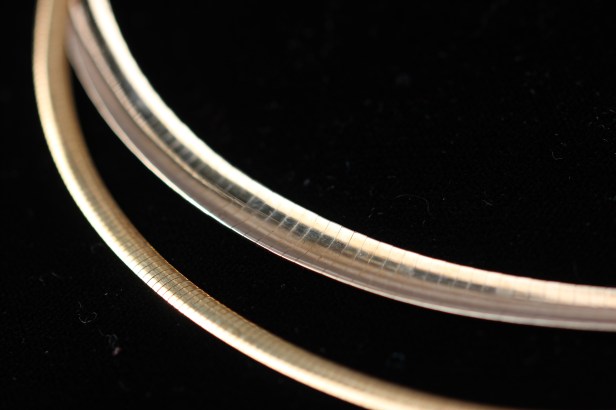
Omega chains appeared in the 1980s, often as quite wide stand alone necklaces. I haven’t been able to locate the back history of them. Although I have searched, I haven’t been able to locate any jewellery patents for them until the 2000s. These jewellery patents outline ways to make the manufacturing process less demanding as it is an time consuming and thus expensive activity. Omegas are similar in some ways with snake chains and tubogas chains but there are differences in their construction. The latter two chains don’t have an inner mesh structure and they are much more flexible.
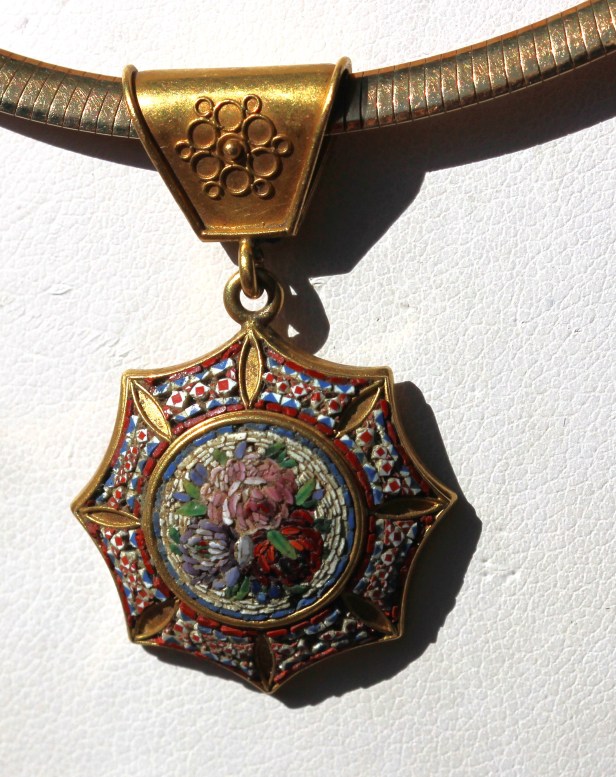
The thinner omega chains look very good with a pendant but the bail needs to be a large flat shape, as seen above, rather than a small ring. Thicker omega necklace really look good on their own, with no need for a pendant.

