
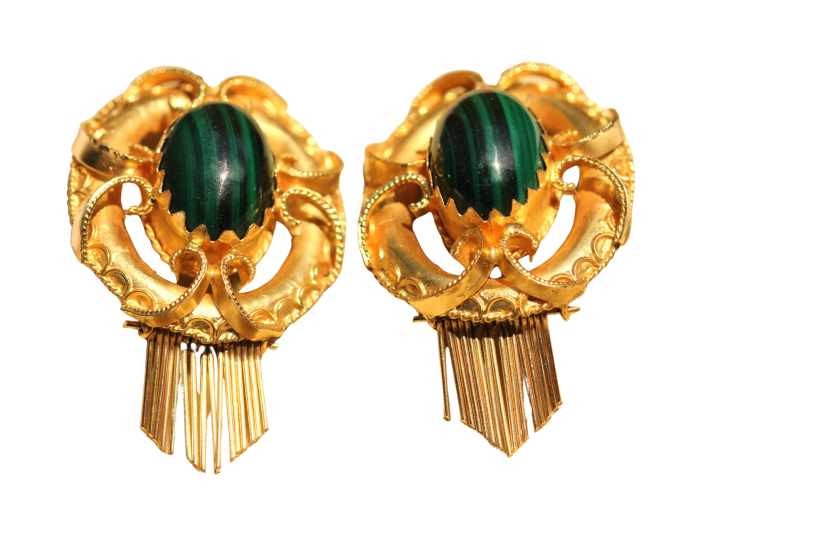
I like colour in my jewellery and gemstones and there are so many to choose from. One favourite colour is green. There are some lovely green gemstones around. Some are transparent like emeralds and peridots, some are translucent like jade and some are opaque, like malachite. In this post, I am examining malachite.
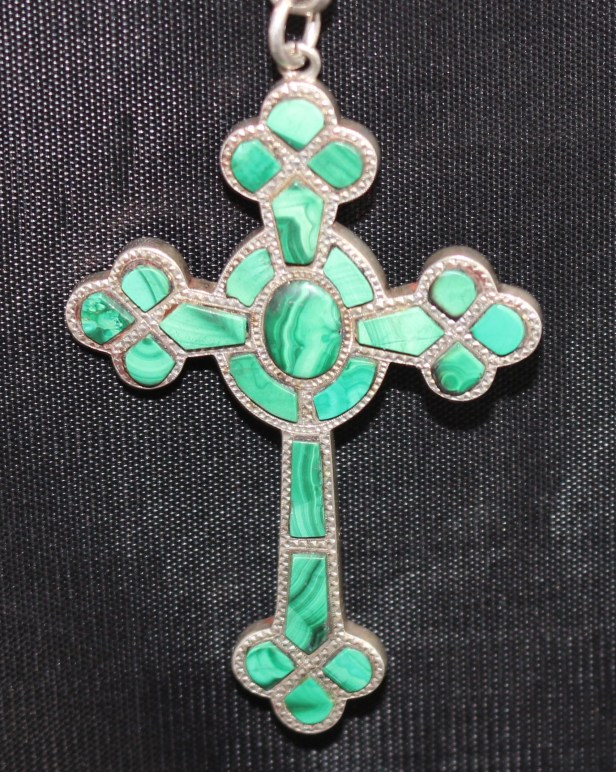
Despite the fact that it is quite a soft stone, malachite has been used as a gemstone for centuries. Pliny described it as ‘an opaque stone of a rather deep green shade and owes its name to its colour, which is that of the mallow. It is warmly recommended because it makes an accurate impression as a signet, protects children, and has a natural property that is a prophylactic against danger’ (Pliny’s Natural History XXXVI Book 37, section 114). It was also finely ground and used as a paint pigment and as an eye shadow.
The 18th and 19th centuries also saw malachite used as a veneer for small objects like boxes as well as for wall panels.
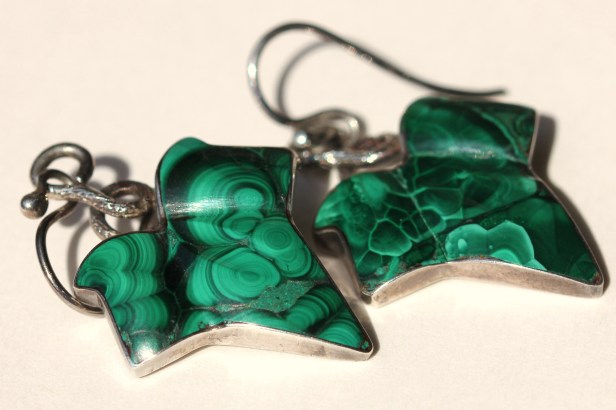
Apart from the striking colour, the way that malachite forms adds to its appeal. It forms in circular bands of darker and lighter shades of green, as well as in grape-like clusters. Jewellery cutters slice into the stone, creating concentric rings with bull’s eyes or bands of different greens.
The Urals in Russia were once a major source of malachite but mining there has ceased. The main producer now is the Democratic Republic of the Congo but it is also found in a number of other countries including Australia, Chile, Namibia, Zimbabwe, France and Arizona in the US.

