
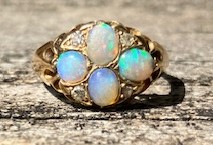
The birthstone for October is the opal. The word ‘opal’ is derived from the Sanskrit word for precious stone, while the Greeks called it ‘opallios’, meaning to see a change of colour, reflecting the beautiful play of colour they display. Opals don’t have a crystalline structure but are like a form of hardened jelly which, when it cools, forms as fine films which reflect light in different colours, a ‘play of colour’ (Mason & Packer). The play of colour is a display of iridescent colours – blue, green, yellow and/or red – which change depending on the direction you hold the gemstone.
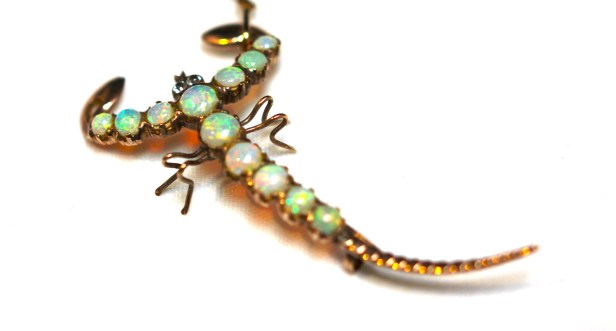
There are different types of precious opal and the type of opal it is depends on the background colour within the stone. Black opal has a black, brown or dark grey background, white opal has a white or cream background and crystal opal is translucent. The most valuable opal is the black opal, the national gemstone of Australia, and Australia remains the main source of black opal.
Black opal was not mined commercially in Australia until 1903 so that opals found in 19th century and earlier jewellery, as well as much of the Edwardian period, will be either white opal (with a white and translucent to opaque body) or crystal opal (with a colourless, transparent body). Most of the opals were mined at Czernewitza in Hungary (in what is now Slovakia).
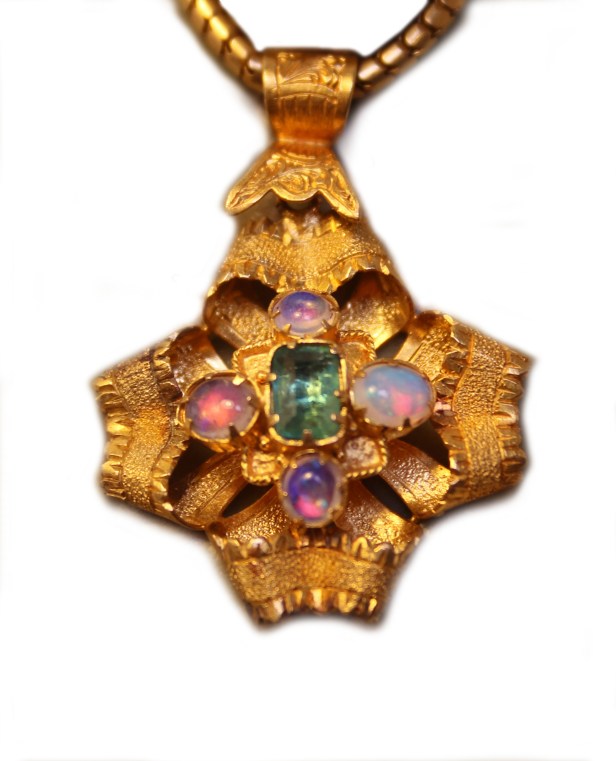
There were a few rare black opals found, however, as they appear in some pieces of antique jewellery. For instance, Napoleon Bonaparte gave a black opal known as the Burning of Troy to Josephine. Where it were mined, though, is not known although Honduras has been suggested as a source.
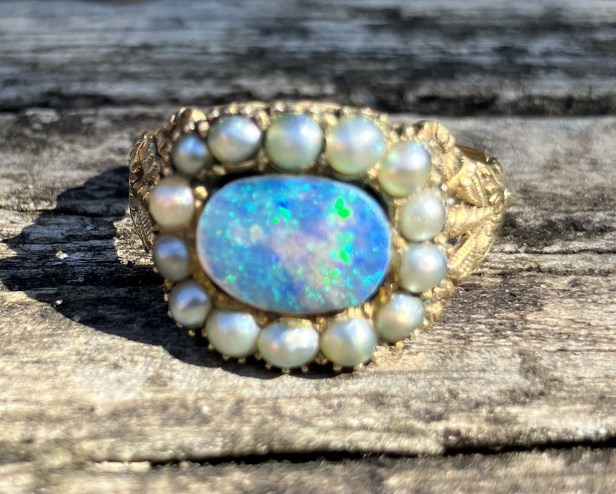
Black opals do display a striking play of colours and it is easy to understand why they are so desired. The black opal in the Georgian mourning ring above is a modern replacement for what would have been a glazed compartment containing hair.
Reference:
Mason & Packer, ‘An Illustrated Dictionary of Jewellery’, 1973, Osprey Publishing

