
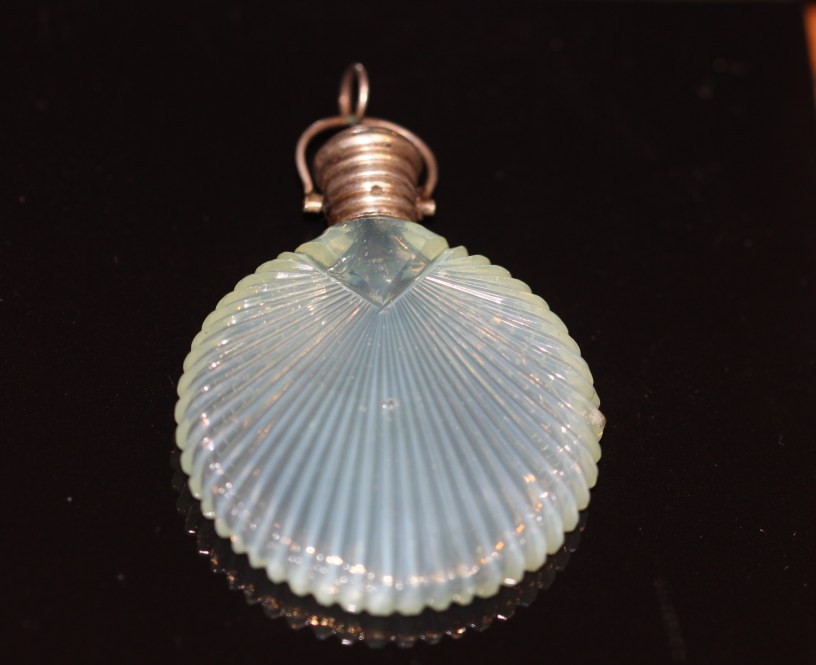
I like jewellery that is decorative but which also has a functional use, like watches, lace pins and so on. In this post, I am talking about decorative containers of perfume or scented objects which can also look good worn as jewellery – that is, pomanders, vinaigrettes and perfume bottles. Pomanders, from the old French Pomme d’embre, meaning apple or ball of amber, originated from the habit of the wealthy from the 13th century onwards, to carry an orange studded with cloves or an ambergris ball mixed with spices in an attempt to avoid bad smells. By the 16th century, men began to have small silver boxes containing perfume fitted to the top of their ebony sticks or staff, and women began to wear silver pomanders as a part of their belt chatelaine, rather than attaching scent bags. Some were even worn as rings or bracelets.

Pomanders might have several sections that unscrewed and which might contain different herbs and spices and scented powders and a section for a sponge soaked in vinegar. They were often shaped like a pear or an apple. The silver pomander above, shaped like a pear, unscrews into three sections, two for powdered spices and one for a sponge, with a cover set with holes. It would have been worn originally on a belt but can be worn as a pendant. It’s quite large, measuring 8cms in length, and is beautifully engraved.
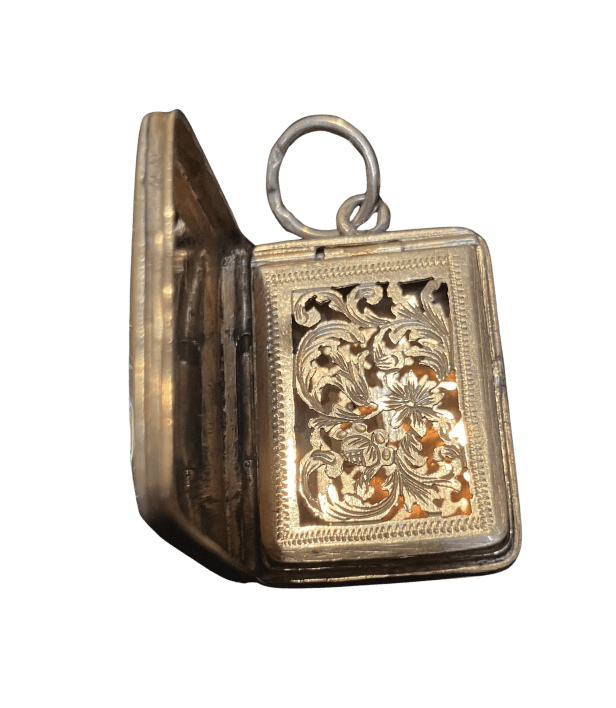
In the late 18th century, pomanders became replaced with smaller boxes intended to be worn. Birmingham silversmiths were leaders in producing these small decorative boxes with a finely pieced hinged inner lid through which sponges soaked with an aromatic vinegar could be smelt. Often, more work went into the decorative grille than into the outside of the box, as was the case with the Georgian vinaigrette pendant above.
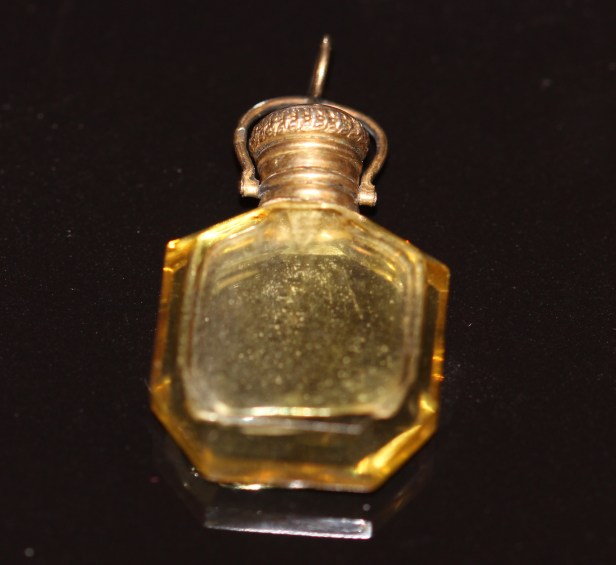
Small glass bottles containing perfume began to replace vinaigrettes in the middle of the 19th century. Liquid perfume was more up to date than smelling soaked sponges and pretty little bottles designed to be pendants were produced as well as larger bottles, often with two sections meant to sit on dressing tables or in a purse. The cut glass opalescent perfume bottle pendant at the top of the post is a good example, as is the yellow glass one above. Both are French.


I love functional pieces too
LikeLike
It just makes sense, doesn’t it, to make things we use look attractive.
LikeLiked by 1 person