
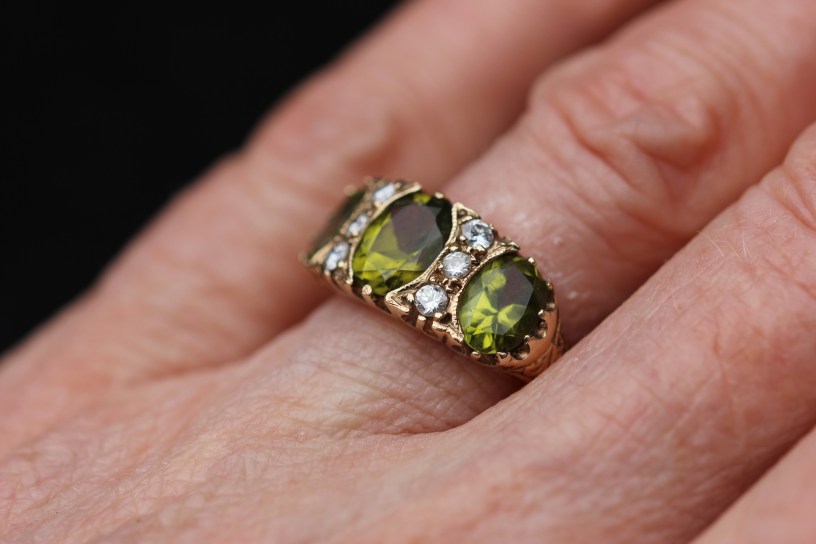
August has three birthstones – peridot, spinel and sardonyx. I’m only looking at peridot and sardonyx in this post. Peridot makes me think of Spring. It only comes in the colour green and while there are a range of green shades, the most common is a vibrant green. Always a lovely pop of colour as seen in the three rings below.

It was not identified gemmologically until around 1790 when it was placed in the olivine family of minerals. It became known as peridot. Apart from its distinctive colour, it is doubly refractive and so has a great depth of colour.

Sardonyx is quite a different gemstone. It is not a commonly used gemstone today but was used a lot in signet rings, cameos, seals, and lockets. Sardonyx is a part of the family of chalcedony quartz which are translucent, have a dull or waxy lustre, and usually display some type of banding, though it can be quite indistinct. The stone is called ‘sardonyx’, which is derived from two words, ‘sard’ and ‘onyx’. We know onyx today as black but onyx is actually a parallel banded chalcedony agate with, usually, bands of black or dark brown and white. When the parallel bands are reddish brown and white, the stone is called ‘sardonyx’. There is a bit of confusion about sard and carnelian, another chalcedony quartz. Carnelian is a beautiful orange colour but as the colour becomes darker and more brown, it is then described as sard. The only difference between sard and carnelian is the colour.
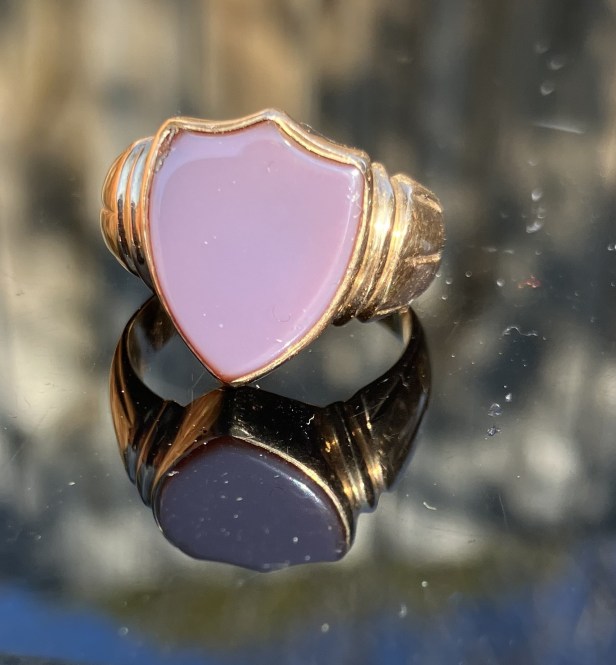
The sardonyx signet ring above is a dark brown with a very thin white top layer. The two layers of agate would be more clearly revealed if incised. The ring below has a bird intaglio which clearly shows the banding.


